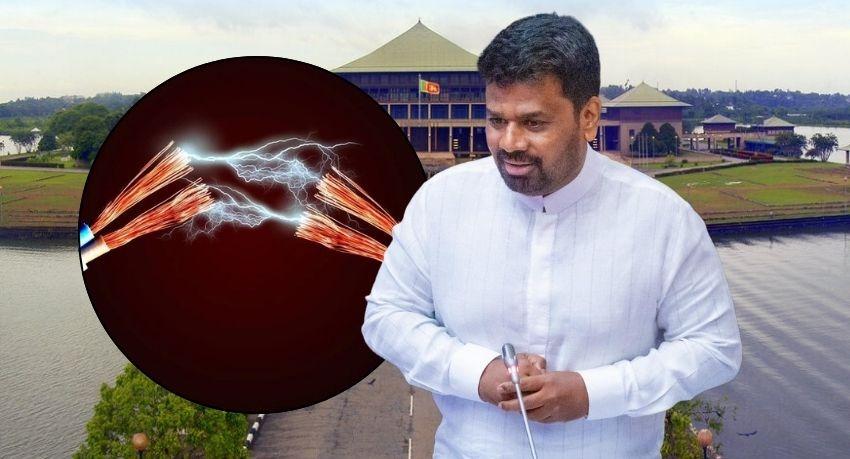
President Anura Kumara Dissanayake announced on Tuesday (7) that households consuming less than 90 units of electricity per month will receive a state subsidy when the next tariff revision is implemented, with the Treasury committing Rs. 15 billion over three months to absorb the cost.
Speaking in Parliament during his concessional relief package address, Dissanayake said the government will spend roughly Rs. 5 billion a month from April to keep low-consumption bills protected as global fuel prices and dry-weather thermal generation push sector costs higher.
The President framed the support as a “shared approach,” with the Rs. 32 billion in projected three-month sector losses split between the State, the public and the National System Operator. “The burden will be distributed among the State, the public, and the National System Operator,” he told MPs, with the Treasury bearing the Rs. 15 billion subsidy share so that the Ceylon Electricity Board does not absorb the full hit.
The new measure sits alongside the 25 percent electricity tariff increase that took effect on April 1 and the broader concessional relief package drawn up by Minister Upali Pannilage’s committee. Government officials have repeatedly cited the Middle East energy shock — including the Israeli strike on the South Pars petrochemical hub and the closure of the Strait of Hormuz — as the trigger for emergency thermal generation that has driven costs higher.
Specific implementation timelines, the unit-block calculation and how the subsidy will appear on bills are expected when the Public Utilities Commission of Sri Lanka publishes the next tariff revision. Roughly two-thirds of domestic accounts fall into the under-90-unit consumption bracket, according to past CEB cohort data.