HSBC Chief Executive Georges Elhedery said Sri Lanka may have paid up to $286 per barrel for oil during the Middle East conflict — the highest buyer price he had heard from any market. Speaking at an investment forum in Hong Kong on Tuesday, Elhedery said benchmark prices quoted in Western media do not reflect the actual costs Asian buyers are facing.
“What worries me is not the headlines. Oil headline is above $100, $110,” Elhedery said, according to a transcript obtained by Bloomberg. “Realistically, if you are now trying to get oil from the Middle East, you may be paying $140, $150.” He said the highest figure he had heard was $286 in Sri Lanka. The remarks were first reported by Middle East Eye and carried in Sri Lanka by Newswire on Thursday.
The disparity reflects premiums stacked on top of benchmark crude prices after the US-Israeli war on Iran disrupted global energy flows. Iran has blocked the Strait of Hormuz while the United States has enforced a counter-blockade against Iranian oil, slowing tanker traffic to a trickle.
Saudi Arabia has emerged as the region’s dominant exporter, dispatching roughly five million barrels a day from its Red Sea port of Yanbu. Even the Omani benchmark at around $100 a barrel does not capture the full burden on Asian buyers: shipping costs from the Red Sea have added $30–$40 a barrel, and marine insurance premiums have jumped from 0.25 percent to 5 percent.
Elhedery said the crisis has left smaller economies such as Sri Lanka facing extreme price shocks, underscoring their vulnerability to geopolitical disruption. Iran has further warned it could close the Red Sea unless the United States lifts its blockade.
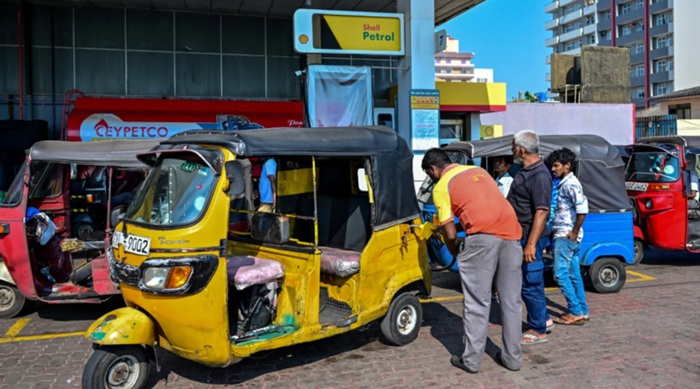
The $286 figure is the first concrete dollar estimate from a major global bank quantifying what Sri Lanka has been paying for fuel during the crisis, and lands as Colombo continues to ration petrol under the QR code system.