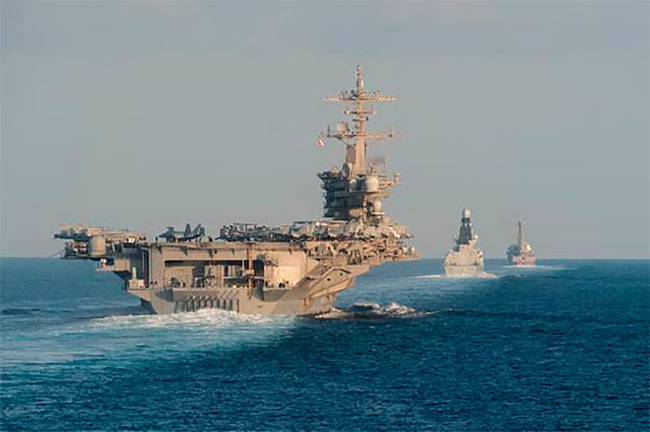
Two US Navy guided-missile destroyers transited the Strait of Hormuz on Saturday — the first American warships to pass through since the Iran conflict began — as the first phase of in-person ceasefire negotiations in Islamabad concluded with both sides continuing to exchange texts.
US President Donald Trump announced the Hormuz transit on Truth Social, stating: “We’re now starting the process of clearing out the Strait of Hormuz.” The Wall Street Journal and Axios both confirmed the operation, each citing three US officials. The transit was not coordinated with Tehran.
Iranian sea mines remain an acknowledged hazard in the strait, and full navigational clearance could take weeks. However, the transit signals active US enforcement of the critical shipping lane beyond the passive ceasefire framework agreed on April 8.
Islamabad talks enter new phase
Separately, the first phase of in-person negotiations between Iranian and US expert teams in Islamabad has concluded, according to Iran’s state-run Fars News Agency. Both sides are now exchanging draft texts, though no formal agreement has been announced.
The talks are operating within the two-week ceasefire window brokered by Pakistan. Iran’s demand for war compensation remains unresolved, and the ceasefire’s durability remains uncertain following violations in Lebanon and renewed strikes on Saudi energy infrastructure.
Sri Lanka implications
The dual developments carry significant implications for Sri Lanka’s fuel supply chain. The Ceylon Petroleum Corporation has secured nine shipments for April, but elevated insurance premiums and rerouting costs linked to the Hormuz closure have kept fuel prices high.
If the US successfully clears the strait’s navigational hazards and the ceasefire holds through the talks, shipping costs could decline meaningfully — potentially easing pressure on Sri Lanka’s already strained fuel rationing regime and supporting the case for the fuel price reductions demanded by opposition parties.