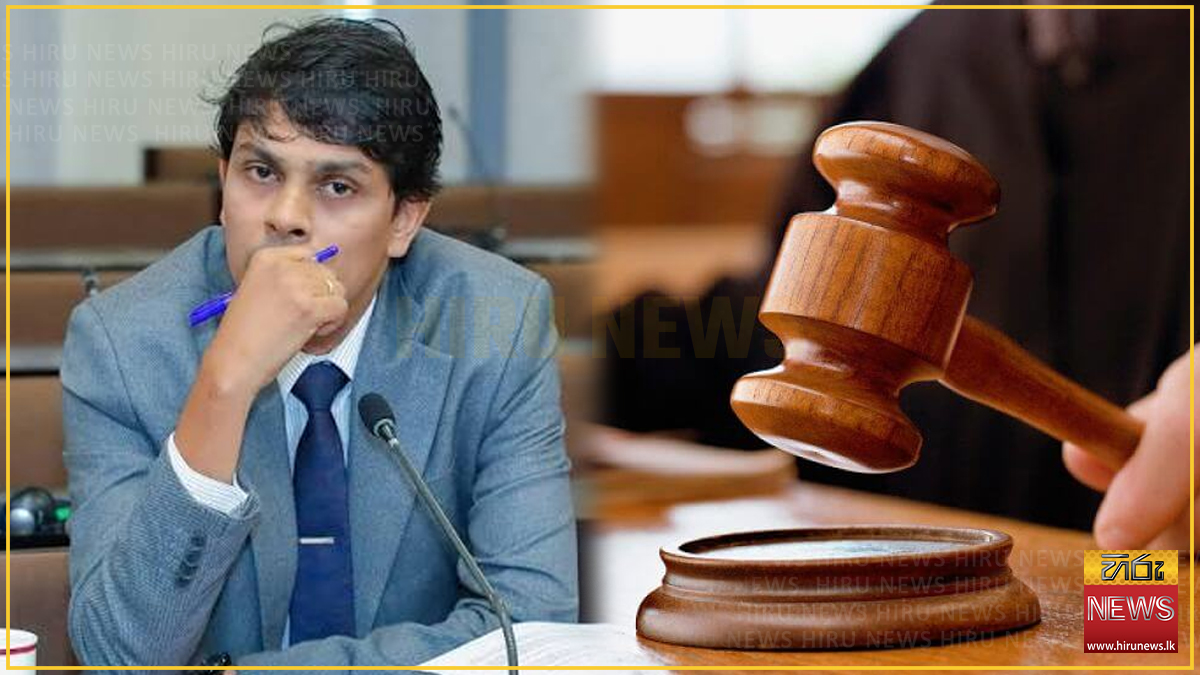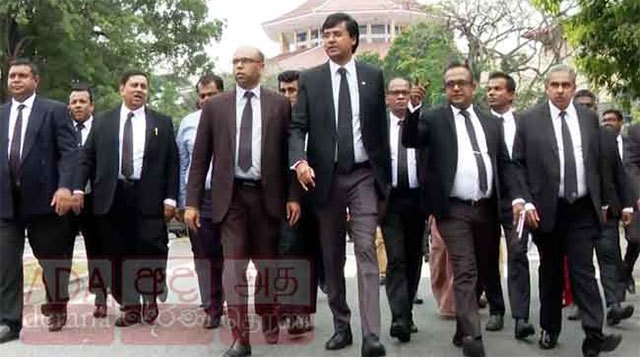
The Bar Association of Sri Lanka (BASL) unanimously adopted seven resolutions on Wednesday opposing the government’s proposed constitutional amendment to raise the retirement age of judges, and the Justice Minister has undertaken to place the association’s objections before the President before the government finalises its position.
In a statement issued after a special general meeting at its Colombo premises, the BASL called on the government to refrain from proceeding with the amendment — which covers judges of the Supreme Court and the Court of Appeal — except in circumstances fully consistent with established constitutional traditions and Sri Lanka’s international obligations.
BASL President Rajeev Amarasuriya said the resolutions were carried unanimously by the general membership at the meeting, which drew a large turnout of lawyers.
Separately, a BASL delegation led by Amarasuriya held a meeting of nearly an hour with Justice Minister Harshana Nanayakkara. Speaking to reporters afterwards, Amarasuriya said the association had reiterated its position that the proposed amendment should not be pursued at this time, and had stressed the need for its concerns to reach the President directly.
The Ministry of Justice subsequently informed the BASL that Nanayakkara would brief President Anura Kumara Dissanayake on the proposal, and convey the association’s concerns and requests, before the government communicates its decision on the matter.
The dispute follows Cabinet’s approval on July 27 of a two-year extension to judicial retirement ages. The plan would lift the retirement age of Supreme Court judges from 65 to 67 and that of Court of Appeal judges from 63 to 65, with comparable extensions under consideration for High Court judges and magistrates. Because those limits are fixed in the Constitution, the change cannot take effect without a constitutional amendment carried by a two-thirds majority in Parliament.
Objections have accumulated across the legal establishment since June. The Judicial Service Association of Sri Lanka, which represents all District Court judges and magistrates, passed a resolution by secret ballot opposing any extension and wrote to the President. Its president, Magistrate Pasan Amarasena, resigned earlier this month over the manner in which that meeting was called. Opposition party leaders have separately met to coordinate a response.
Amarasuriya has framed the dispute as one of institutional principle rather than personality, saying it concerns the independence of the judiciary, the fundamental principles of the Constitution and public confidence in the justice system, and that fundamental constitutional changes should be introduced only through a transparent process of broad consultation.
Update (July 30): Opposition MP Dayasiri Jayasekera has raised a further objection, warning that the amendment would eventually require judges to rule on a measure that benefits them personally.
“The government should not put the judges into a difficult situation by making them give a determination which will benefit them,” Jayasekera told journalists, in remarks reported by the Daily Mirror. He noted that a time will come when judges in Sri Lanka will have to deliver a judgement on themselves, being called on to determine a proposal to extend their own retirement age by two years.
The point goes to a procedural feature of the process. Because the retirement ages are fixed in the Constitution, the change requires an amendment bill, and the Supreme Court holds sole jurisdiction to determine whether such a bill is consistent with the Constitution — putting the judges whose tenure would be extended in the position of ruling on the measure.
Jayasekera also called for the question to be put to voters. “A referendum should be called for to seek the view of the people because the retirement age of judges is a constitutional amendment. President Anura Kumara Dissanayake should therefore call a referendum as it was done by late President J. R. Jayewardene,” he said.
Asked about government members’ claims that the opposition’s stance is driven by concern over cases being filed against politicians including the Rajapaksas, Jayasekera said the government could file cases against anyone but should not interfere with the judiciary.
Update (July 31): The government has pushed back against the criticism, with Health Minister Dr. Nalinda Jayatissa calling the judicial-independence objection a “false argument.”
Jayatissa said the government has a mandate to give people relief by reducing the backlog of cases, noting that large numbers of cases are pending in every tier of the court system from Magistrate’s Courts to the Supreme Court. The measures planned to address it include increasing the number of courts, filling judicial vacancies and extending the retirement age of judges by two years, he told reporters in remarks reported by the Daily Mirror.
“No one should panic about it. I wonder how the independence of the judiciary is affected when extending the retirement age of judges, increasing number of courts and filling vacancies in courts,” he said. “I hope judges and lawyers also want to see the reduction of pending cases to ensure trust in the judicial system.”
He argued that a judge who had worked independently until the age of 60 would not become a threat to judicial independence after 60, and acknowledged that different groups can hold different views when constitutional amendments are brought forward. The Minister appealed for support for the effort to clear the backlog.
The government’s framing places case delay at the centre of its argument, while the BASL’s objection has rested on process and constitutional principle rather than on whether the backlog exists.
Update (July 31, evening): The dispute escalated on two fronts on Friday, with a bribery complaint filed against the Cabinet decision and a senior figure inside the governing party saying he had been asked to stop speaking about it.
Dayasiri Jayasekera, who had earlier objected on procedural grounds, lodged a complaint with the Commission to Investigate Allegations of Bribery or Corruption against the Cabinet decision to extend judicial retirement ages, alleging the move violates several provisions of the Bribery Act, Hiru News reported.
Hiru also reported that the French National Bar Council expressed full support for the BASL’s opposition at its annual general meeting in Paris, citing a letter sent to the President warning that the public would view raising judicial retirement ages as undue interference with the courts.
Separately, senior lawyer Lal Wijenayake — a member of the ruling National People’s Power’s Leadership Council, Executive Committee and National Operation Committee — told the Daily Mirror that Agriculture Minister K.D. Lalkantha had asked him to stay silent on the issue.
“One member gave me a call one day — a member of the Leadership Council, the Political Bureau and other bodies. He simply said, ‘Why don’t you keep silent on this matter?’” Wijenayake said, identifying the caller as Lalkantha. He said he later wrote to Lalkantha setting out his position, copying President Anura Kumara Dissanayake and NPP Secretary Dr. Nihal Abeysinghe.
Wijenayake, who has been associated with the Lanka Sama Samaja Party for about 50 years, said he could not stay quiet after more than five decades of campaigning for judicial independence, and that his objection was one of principle rather than a personal disagreement with NPP leaders.
“This is a matter of principle. To live in a civilised society, there must be the rule of law. The rule of law will prevail only if there is independence of the judiciary,” he said. He argued that decisions affecting judges’ service conditions could weaken judicial independence by giving future governments a means of manipulating the judiciary.
He also criticised the party’s internal process. “However, in the NPP, I do not see that kind of process. Decisions seem to be taken somewhere, but it is not clear where those decisions are actually being made. That is the problem,” he said.
The remarks place the opposition to the amendment inside the governing party’s own senior structures, alongside the objections already registered by the BASL, the Judicial Service Association and opposition MPs.
Update (August 1): Wijenayake set out further detail on how the proposal moved through the NPP’s internal bodies, telling the Daily Mirror that the matter was discussed at a meeting of the National Operations Committee, where President Anura Kumara Dissanayake explained the rationale behind it.
He said he remained unaware whether the Leadership Council or the Executive Committee had formally endorsed the amendment before it was announced. Contrasting that with his own political background, he said: “I have been in the Lanka Sama Samaja Party for about 50 years. I am therefore used to a system where decisions are taken after wide-ranging discussions with everyone’s views taken into account.”
Wijenayake said his remarks were intended to encourage broader internal discussion and collective decision-making within the coalition, rather than to criticise the government.
Update (August 1, evening): The BASL has written directly to President Anura Kumara Dissanayake asking him to halt all further steps on the amendment until the association can put its case to him in person.
The letter, signed by BASL President Rajeev Amarasuriya and Secretary Nalin De Silva, restates concerns the association first raised in a letter dated May 25, 2026, Hiru News reported. It argues there is no compelling institutional necessity for altering the constitutional provisions on judicial retirement, noting that recent increases to the approved cadre of both Superior Courts already address the capacity and workload problems the government has cited.
An amendment aimed solely at extending the tenure of sitting judges, the association wrote, inevitably raises questions about its purpose and motivation, and risks eroding public confidence in a judiciary whose standing depends on being seen as free from influence, favour or accommodation.
The letter also sets out a broader objection to the process. Constitutional amendments affecting the Superior Judiciary should never be made in an ad hoc manner or in response to temporary circumstances, it says; reform of that magnitude requires transparent public justification, broad stakeholder consultation and careful reflection, because public trust rests as much on how a change is made as on its substance.
The association expressed regret that no official response followed its May communication, while the Cabinet went on to approve the proposal without giving the legal profession an opportunity to present its concerns. It noted that a written request for a formal discussion had been sent to the President’s Private Secretary on April 9, 2026, but that no meeting had followed in the months since.
Initial submissions were subsequently presented to Justice Minister Harshana Nanayakkara, who assured the delegation their position would be conveyed to the President along with the request for a personal meeting. The BASL said it remains hopeful of putting its views to the President directly.