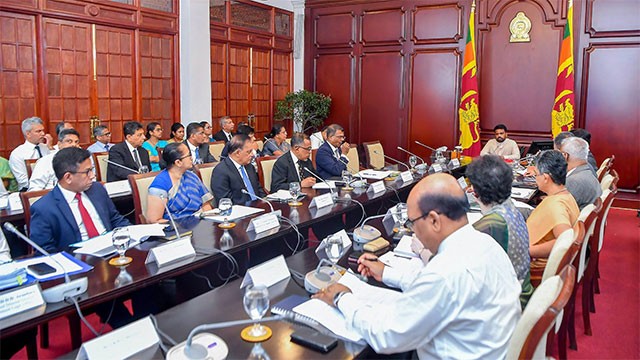
President Anura Kumara Dissanayake has told public and private sector institutions that their contribution is critical to completing Sri Lanka’s third Mutual Evaluation on Anti-Money Laundering and Countering the Financing of Terrorism, saying success is vital to the country’s standing in the international financial system.
The President made the remarks at a special discussion held at the Presidential Secretariat on Tuesday to review preparations for the evaluation, according to a statement from the President’s Media Division. He said the relevant recommendations needed to be implemented systematically in the coming months.
The evaluation is conducted by the Asia/Pacific Group on Money Laundering and will assess Sri Lanka’s compliance with the 40 Recommendations issued by the Financial Action Task Force, together with the effectiveness of their implementation measured against 11 Immediate Outcomes. The evaluation team’s on-site visit is scheduled for this year.
Central Bank officials said preparations have been under way since 2023 and have intensified over the past two years under strict timelines. Around 25 government institutions are involved, with coordination handled by the Central Bank’s Financial Intelligence Unit. A Presidential Task Force is monitoring progress against institutional action plans.
Dissanayake also asked about steps to curb online gambling, the progress of related legislation, and the establishment of the Authority for the Management of Proceeds of Crime. Officials said the Authority has been set up and staff recruitment is under way.
Those present included Deputy Minister of Digital Economy Eranga Weeraratne, Central Bank Governor Dr. Nandalal Weerasinghe, Attorney General Parinda Ranasinghe, Inspector General of Police Priyantha Weerasooriya and Chief of National Intelligence Major General Nalinda Niyangoda.
Three amendment Acts certified the same day
Hours earlier, Speaker Dr. Jagath Wickramaratne certified three amendment bills strengthening the legal framework against money laundering and terrorist financing, NewsFirst reported. They had passed Parliament on July 9.
The Prevention of Money Laundering (Amendment) Bill was passed with the special majority required under a Supreme Court determination on Clause 14. The Financial Transactions Reporting (Amendment) Bill was approved with amendments, and the Convention on the Suppression of Terrorist Financing (Amendment) Bill without any.
The money laundering amendments widen the scope of the offence, allow action even where there is no conviction for a predicate offence, and strengthen procedures for freezing and managing suspicious assets, alongside expanded investigative powers and tougher penalties.
The financial transactions reporting amendments bring virtual asset service providers within the scope of regulated financial businesses, formalise risk-based customer due diligence, extend transaction suspension orders from seven days to fourteen working days, and provide for a National Committee on anti-money laundering and counter-terrorist financing.
The three bills are now the Prevention of Money Laundering (Amendment) Act No. 16 of 2026, the Financial Transactions Reporting (Amendment) Act No. 17 of 2026 and the Convention on the Suppression of Terrorist Financing (Amendment) Act No. 18 of 2026. NewsFirst reported the amendments are expected to support the country’s preparations for the coming mutual evaluation.
Background
The legislative push follows Cabinet approval in July for a national AML/CFT policy covering 2026 to 2030, and Cabinet’s move in late July to establish a regulatory framework for virtual assets.
Not all of the legislation passed without objection. The Centre for Policy Alternatives had called for the withdrawal of the AML/CFT bills, and the Supreme Court previously ruled on the terrorist financing amendment bill.