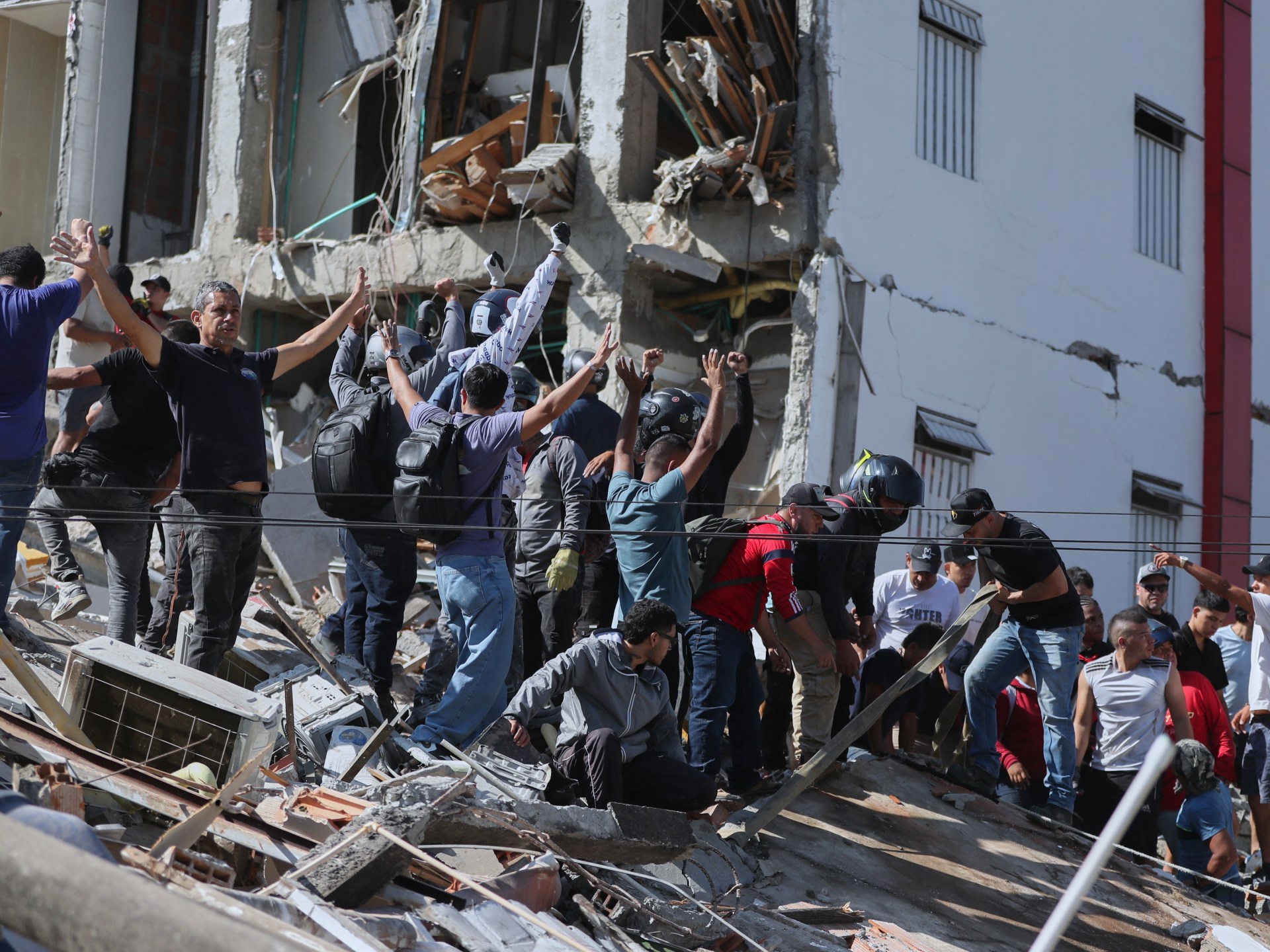
At least 250 people have been killed by a powerful earthquake in western Colombia, with rescue crews still digging through mountains of rubble and calling for quiet so they can listen for survivors. A state of emergency remains in force. The toll has risen repeatedly since the first reports on Monday — from 20 to 111, then 132 and 224 — and officials warn it is likely to climb again with people still believed to be trapped under collapsed buildings.
President Abelardo de la Espriella declared a national disaster on Monday, when the confirmed toll stood at 111.
The magnitude 7.4 quake struck at 7.34 a.m. local time (12.34 GMT) at a depth of about 103 kilometres, according to Colombia’s geological service, which described it as the strongest earthquake recorded in the country in a decade. Its epicentre was near the village of San José del Palmar in Chocó province, on the Pacific coast, roughly 400 kilometres west of Bogotá.
Most of the confirmed deaths were in Pereira, a city in Colombia’s coffee-growing region, the BBC reported, with further preliminary reports of fatalities in Manizales, Quibdó, Medellín and across the Chocó and Valle del Cauca regions.
In Cali, the country’s third-largest city, Mayor Alejandro Eder said at least 20 structures had collapsed with people trapped inside, and requested rescue teams from Bogotá and Medellín. Colombia’s civil aviation authority suspended flights at six airports — Pereira, Manizales, Quibdó, Armenia, Cartago and Buenaventura — while inspectors checked for structural damage.
The tremor was felt hundreds of kilometres away in the capital, where buildings were evacuated. Bogotá Mayor Carlos Fernando Galán said no serious structural damage had been reported there and that the city’s resources were available to affected regions. The United States tsunami warning system said there was no tsunami threat.
A vulnerable region
Al Jazeera reported that much of Chocó, one of Colombia’s poorest regions, is rural and reachable only by boat or plane, which may slow efforts to establish the full extent of the damage.
Quakes of magnitude 6.0 or above are rare in Colombia, though a 6.2 tremor in the same coffee-growing region in 1999 killed more than 1,000 people. Monday’s earthquake follows two powerful quakes that struck neighbouring Venezuela in late June, which killed more than 6,000 people.
Governments including France, El Salvador and Italy offered condolences and assistance, according to Al Jazeera.
Update — toll rises to 132, curfew in Pereira
The death toll climbed to at least 132 by Tuesday morning, with more than 480 people injured, according to a statement from Colombia’s Association of Capital Cities cited by the BBC. The Daily Mirror and Hiru News carried the revised figure in Sri Lanka.
Pereira, about 55 kilometres from the epicentre, remains the worst-affected city. Local authorities have reported at least 40 dead in its metropolitan area and 65 collapsed buildings, with people believed to be trapped in 15 of them. A curfew is in force in parts of the city until 5.00 a.m. local time on Tuesday.
Thirty-two buildings collapsed in Cali, about 160 kilometres south of Pereira. At least two people died in Manizales.
At the epicentre itself, near the village of San José del Palmar, mayor León Fabio Marín Moncada said there had been no deaths or injuries despite the roads in and out being damaged.
Hiru News reported that the tremor was also felt in neighbouring Ecuador, Panama and Venezuela.
Note: the per-city figures reported so far are preliminary and do not add up to the national total.
Update — injured count passes 570
Ada Derana reported on Tuesday that the number of people injured had risen to more than 570, citing the latest update from the Colombian government. The death toll was unchanged at 132.
The higher injury figure has not yet been reflected by the international outlets carrying the story: the BBC’s report still gave 480 injured when checked on Tuesday, and Al Jazeera’s article page had not been revised beyond its earlier count. Readers should treat 570 as the most recent figure available rather than a consolidated one, and the total is likely to move again.
Ada Derana repeated the depth of 103 kilometres given by Colombia’s geological service, and said the state of emergency remains in effect.
Update — toll jumps to 224, troops sent to Cali
The death toll rose to 224 on Tuesday, local authorities said, in the largest single revision since the quake struck. Emergency teams supported by police, soldiers and volunteers worked through the night with excavators and, at times, their bare hands.
Jose Fernando Usma, head of search and rescue for the Quindío branch of the Colombian Red Cross, said teams had detected sounds and other signs that could indicate survivors beneath the rubble, and were assessing damaged structures to reach people trapped deeper inside.
“We still have a big window of time. We have approximately 24 more hours to have hope of life,” he said.
Cali, a city of about 2.2 million, recorded at least 95 deaths. Dozens of buildings were left leaning or destroyed outright, forcing residents into the streets. Several upper floors of one of the city’s hospitals, including wards dedicated to paediatric care, collapsed, leaving some patients trapped and forcing about 600 others to be treated on a street strewn with rubble, hospital director Irne Torres Castro told Caracol television.
Authorities in Pereira, capital of the hard-hit Risaralda region, reported 72 deaths, while officials in neighbouring Valle del Cauca, which includes Cali, reported 38. Another 13 people died in Chocó, the rural province closest to the epicentre. These regional counts overlap and remain preliminary; they should not be read as adding up to the national total.
Video verified by Reuters showed Pereira’s airport swaying violently during the quake, with large sections of ceiling collapsing as people took shelter.
President Abelardo De La Espriella, who took office days before the disaster, said 1,000 members of the security forces would be deployed to Cali by dawn following reports of looting. Curfews were imposed in both Cali and Pereira on Monday night.
“Our intention is to cooperate in any way necessary. Here, there are no distinctions or ideological divisions when it comes to defending our people or showing solidarity,” he told journalists.
Reuters, whose copy Ada Derana carried, compared the disaster to the 1999 earthquake that struck the same coffee-growing region and killed more than 1,000 people, and to the quakes that killed more than 6,300 in neighbouring Venezuela in June.
Update — toll passes 250, Sri Lanka expresses solidarity
The death toll passed 250 by Tuesday, Reuters reported, with separate reports from the affected cities putting it at 254 — 101 killed in Pereira, in the heart of coffee country, and 95 in Cali. As with the earlier regional counts, these city figures are preliminary and are not a consolidated national total.
More than 100 aftershocks had been recorded as of Tuesday afternoon. Many Indigenous communities in the forested, Pacific-facing Chocó region closest to the epicentre remain without power or basic services, complicating rescue work.
Rescuers worked through Monday night and Tuesday with cranes, excavators and their bare hands, forming human chains to pass buckets of debris. Rosa Gonzalez, who ran a guest house in Pereira, described escaping with her husband and 10-month-old baby: “The structure started creaking and just as we ran outside the building collapsed.” Eight people made it out alive, but she feared an elderly man trapped on a terrace was among the dead.
Social media user Jose Gallego, who had just arrived at Pereira airport, was recording a live video when the quake struck and captured the ceiling coming down. “There were people injured, bleeding, screaming and trying to reach their families,” he told Reuters. “I crossed the city on foot; it took two hours and the scenes were devastating.”
Thousands have been left homeless, with families waiting outside cracked buildings for safety assessments. The National Coffee Federation said it was working with families on the ground to assess damage to farms and rural infrastructure.
President De La Espriella, who took office days before the disaster, travelled to the affected regions and promised economic support to those who lost homes. His government, which announced immediate austerity measures on taking power, is preparing to revise a budget of more than US$ 180 billion drawn up by its predecessors.
Sri Lanka has conveyed its condolences to Colombia. Foreign Minister Vijitha Herath said Sri Lanka was “deeply saddened” by the devastation and the loss of life, adding in a post on X that “our thoughts and prayers are with the affected families” and that Sri Lanka stands in solidarity with the people and government of Colombia in the country’s hour of grief.