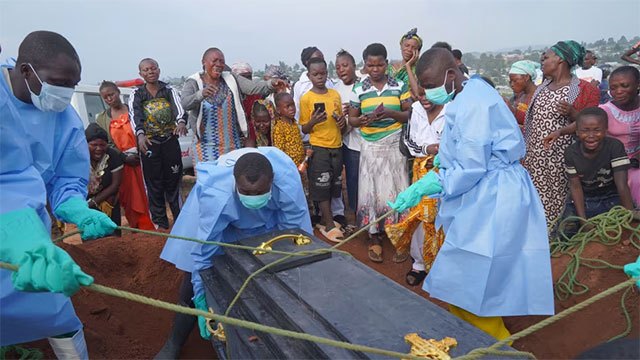
The Ebola outbreak in the Democratic Republic of the Congo is on track to become the deadliest on record, the World Health Organization warned on Wednesday, as the death toll passed 2,000 in what is already the fastest-moving outbreak of the disease ever documented.
WHO Director-General Tedros Adhanom Ghebreyesus said that at its current pace the outbreak would eclipse the 2014-16 West Africa epidemic, which killed more than 11,000 people and spurred the development of the first Ebola vaccine.
Congolese government data published overnight into Tuesday recorded 4,381 confirmed cases and 2,011 deaths. The outbreak took about nine weeks to reach its first 1,000 deaths; the figure then doubled in roughly three weeks.
It is already the second-largest outbreak in history, behind the West Africa epidemic’s more than 28,000 cases. Its case fatality rate stands at 45.9%, above the 39.6% recorded in 2014-16.
Declared in May, circulating since February
The outbreak was formally declared on May 15, but genetic sequencing later showed the virus had been spreading since February — months before health authorities knew of it.
It is driven by the rare Bundibugyo strain, for which no vaccine or treatment has been approved. The epicentre is Ituri province in eastern Congo, and cases have since spread across five eastern provinces near the borders with South Sudan, Uganda and Rwanda.
Containment has been hampered by the region’s remoteness, armed conflict, weak health infrastructure, misinformation and strikes by health workers over unpaid wages. Many infections and deaths are occurring in communities response teams have struggled to reach.
Abdirahman Mahamud, WHO’s director for health emergency alert and response operations, said the agency’s moderate projection has the outbreak peaking within six months. Under a more severe scenario, he said, it could run for nine to twelve months.
Sri Lanka’s Health Ministry adopted a five-point Ebola preparedness plan after the WHO declared the outbreak a public health emergency of international concern.
Sources
- Congo says 2,000 people have died in history’s fastest-growing Ebola outbreak — Ada Derana, August 12
- DR Congo Ebola outbreak set to become deadliest on record, WHO warns — Al Jazeera, August 12
- Congo’s Ebola outbreak is on track to surpass the deadliest one in history, WHO chief says — AP News, August 12