The United States and Yemen’s Iran-aligned Houthis reported separate attacks on shipping on Tuesday, as prospects for ending the Iran war dimmed and Tehran said the Strait of Hormuz would remain closed unless Washington accepts its conditions.
The attacks struck two of the world’s most important oil chokepoints — the Gulf of Oman, which leads to the strait, and the entrance to the Red Sea. Oil prices gained and global shares retreated. Brent crude futures settled 1.4 percent higher at $88.91 a barrel on Tuesday and US crude rose 1.3 percent to $83.20.
Six killed at the Red Sea entrance
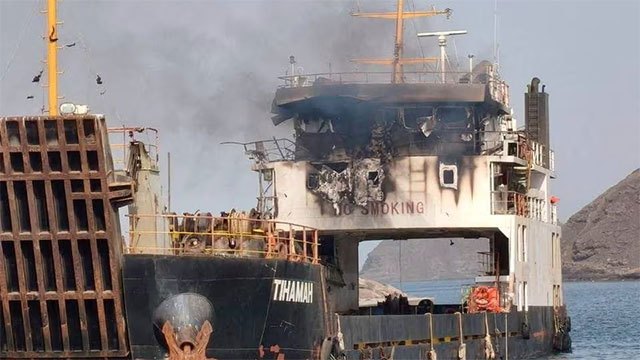
Four crew members were killed in a suspected Houthi attack on a small cargo vessel in the Bab el-Mandeb Strait, Yemen’s Transport Ministry said. Two Yemeni rescuers from an anti-Houthi military group were also killed, according to Yemen’s Coast Guard.
The deaths aboard the Egyptian-owned Tihamah, if confirmed, would be the first fatalities on commercial shipping caused by the Houthis since the Iran war began. The Houthi-run Saba news agency said the group had attacked a Saudi ship it claimed was carrying military equipment. It did not name the vessel, and there was no immediate Saudi response.
In the separate incident, US Central Command said a US Navy MH-60 helicopter fired two Hellfire missiles to disable the steering gear of a Panama-flagged cargo ship that ignored repeated warnings to stop violating a naval blockade on Iranian ports. Maritime sources told Reuters the ship was hit off Pakistan while sailing into the Gulf of Oman.
Hormuz stays shut
Iran’s top security official, Mohsen Rezaei, said the strait will not reopen unless the United States accepts Tehran’s terms — the release of Iran’s frozen assets and an end to conflicts across the region, including in Lebanon and Gaza. He also demanded an end to the US naval blockade of Iranian ports.
“As long as America does not change its behaviour and does not accept Iran’s conditions, the Strait of Hormuz will not be opened,” Rezaei said. There was no immediate comment from Washington. Al Jazeera reported that he delivered the message to China’s ambassador to Tehran, Cong Peiwu, and repeated it on social media. Pakistan’s interior minister, Mohsin Naqvi, visited Tehran the same day.
The comments were the strongest signal yet that the waterway, which handled a fifth of global oil and liquefied natural gas flows before the war, will not reopen soon. They followed a demand from US President Donald Trump on Monday that Iran pay compensation for people killed in 50 years of wars, attacks and protests.
Trump, who has alternated between threats of escalation and claims that a deal is imminent, suggested in an interview released late on Monday that the uncertainty could persist. “I’m sort of negotiating,” he said. “They’re very devious negotiators.” Speaking to reporters on Tuesday, he said “Iran is going fine” and claimed the US controls the strait.
Thousands have been killed since the US and Israel launched attacks on Iran on February 28. Iran has struck US assets and infrastructure in countries including Oman, Jordan, Kuwait, Israel, the United Arab Emirates and Saudi Arabia.
Why it matters for Sri Lanka
Sustained closure of Hormuz and disruption at the Red Sea entrance keep crude prices elevated, feeding directly into Sri Lanka’s import bill and fuel pricing formula. The disruption has also been blamed for weaker travel through Gulf transit hubs, with tourist arrivals opening August down 8 percent on the same period last year.
Sources: New attacks on shipping as Iran war talks hit fresh impasse — Ada Derana/Reuters, August 12; Iran holds firm on Hormuz conditions as Pakistan’s Naqvi visits Tehran — Al Jazeera, August 12.