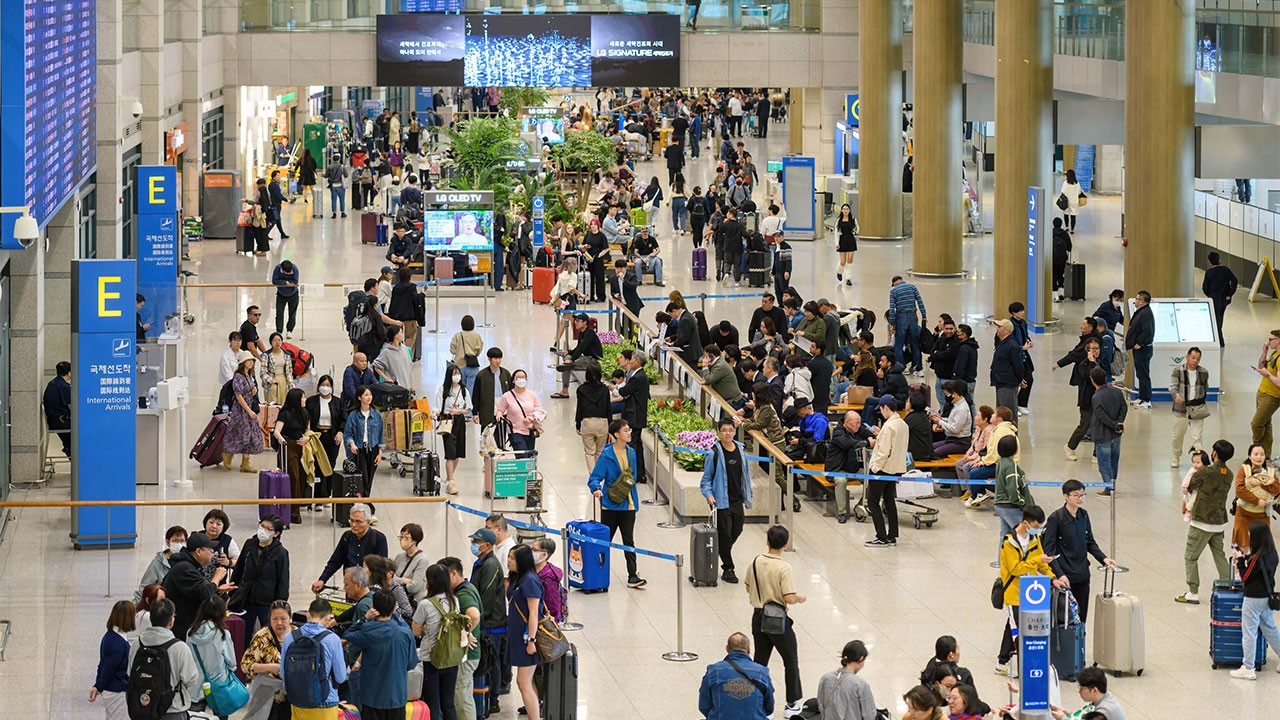
South Korea’s Incheon International Airport has become the world’s busiest airport for international passenger traffic for the first time, according to preliminary figures from Airports Council International.
Incheon handled 38.4 million international passengers in the first six months of 2026. London Heathrow came second with 37.79 million and Singapore’s Changi third with 34.53 million.
The airport operator attributed part of the rise to passengers being diverted away from Middle East aviation hubs because of the conflict between the United States and Iran. Dubai International, which ranked second on full-year statistics in both 2024 and 2025, is expected to fall outside the top five this time.
Rerouting away from the Gulf
Travellers who previously transited through Dubai en route to Europe are now flying via Incheon, the airport corporation said, driving an 18 percent rise in transfer passengers compared with the same period last year. Transfer passengers whose final destinations were in Europe rose 63.2 percent to 210,000.
The corporation said infrastructure expansion also allowed the airport to absorb the heavier load. Incheon, which opened in 2001, serves 158 international destinations — against 139 for Hong Kong International, 92 for Shanghai Pudong and 86 for Tokyo Narita.
“We’re grateful for the government’s support, the public’s encouragement and the hard work of everyone stationed at the airport in making Incheon the world’s No. 1 airport,” acting president of the airport corporation Kim Beom-ho said. He added that the corporation would focus on passenger convenience to strengthen its competitiveness.
The Sri Lanka connection
The same Gulf disruption that lifted Incheon has weighed on traffic to Colombo. Sri Lanka’s tourist arrivals opened August down 8 percent year on year, with weaker travel through Gulf transit hubs among the factors cited — the Middle East corridor carries a large share of European visitors to the island.
Ada Derana credited BBC and agencies for the report.