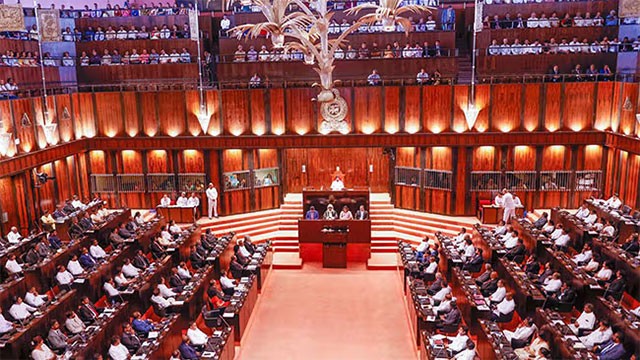
Six petitions have been filed before the Supreme Court challenging the 22nd Amendment to the Constitution, hours after the Bill was presented to Parliament on Tuesday.
The petitioners include the Bar Association of Sri Lanka (BASL), the Samagi Jana Balawegaya, Sarvajana Balaya, former Justice Minister Professor G.L. Peiris and the Free Lawyers organisation, Ada Derana reported.
Several of the petitions ask the court to rule that the amendment cannot become law on a two-thirds parliamentary majority alone and must also be approved by the people at a referendum.
What the BASL petition argues
The first petition was filed by BASL Treasurer T.M.S. Pasindu Silva and Assistant Secretary L.I. Wakishta Arachchi, naming the Attorney General as respondent.
The petitioners argue the proposed amendment directly affects the sovereignty of the people, protected under Article 3 of the Constitution. They ask the court to determine that Clauses 2 and 3, if found to contravene Article 3, would require approval at a referendum in addition to a parliamentary vote.
The petition cites concerns already raised by the Judicial Service Association of Sri Lanka, the Chief Prelates, the Commonwealth Lawyers Association, LAWASIA, the International Association of Judges, the French National Bar Council and UN Special Rapporteur on the independence of judges and lawyers Margaret Satterthwaite.
It further argues that any amendment to Article 107(5) could have implications for the International Covenant on Civil and Political Rights, UN principles on judicial independence, the Universal Charter of the Judge and the Commonwealth Charter. The BASL has asked that the case be heard by all judges of the Supreme Court sitting together.
Peiris targets the clause on sitting judges
Professor Peiris, filing under Articles 120 and 121, has challenged Clause 2 — the provision raising the retirement age of Supreme Court judges from 65 to 67 and Court of Appeal judges from 63 to 65.
His central objection is that the change would apply to judges already on the bench, including the sitting Chief Justice. Applying it to serving judges, he argues, could undermine judicial independence, the separation of powers and public confidence in the judiciary. He contends the clause is inconsistent with Articles 3, 4, 12(1), 28, 107, 108, 111C and 83, and has also asked for a full bench.
Ada Derana reported earlier in the day, when two of the petitions were filed, that the Free Lawyers organisation petition was lodged by its president, Attorney-at-Law Maithri Gunaratne.
What happens next
The government gazetted the Bill on August 7. Under parliamentary procedure, a Bill is presented for its first reading a week after gazetting, opening a further one-week window for Supreme Court challenges. The court must communicate its determination to the Speaker within three to 21 days of considering the petitions.
The companion Judicature (Amendment) Bill, also tabled Tuesday by Justice Minister Harshana Nanayakkara, would raise the retirement age of High Court, District Court and Magistrate’s Court judges to 62.