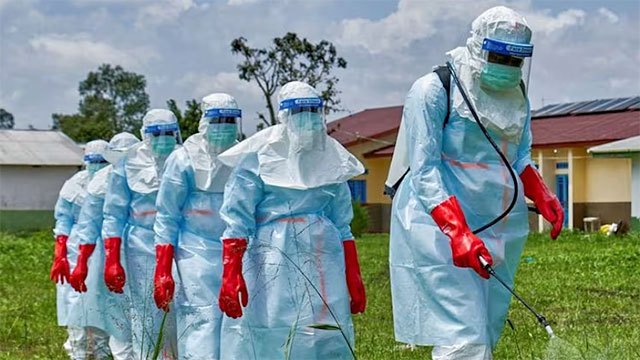
The World Health Organization’s Emergency Committee met on Tuesday on the Ebola epidemic in the Democratic Republic of the Congo, with Director-General Tedros Adhanom Ghebreyesus telling members the outbreak is “far from being under control” as infections approach 5,000.
“We must be frank: the epidemic is far from being under control,” Tedros said in opening remarks to the committee’s second meeting on the Bundibugyo virus epidemic. “It had a big head start, and we are still playing catch-up.”
Almost 5,000 people have been infected and more than 2,300 have died across six provinces and 55 health zones, the WHO said. It is the second-largest Ebola outbreak ever recorded and is moving faster than any previous one. Al Jazeera reported it has now become the deadliest in Congo’s own history, passing the 2,299 deaths recorded in the 2018–20 outbreak. Reuters, whose report Ada Derana carried, put the toll at at least 2,325 in what is Congo’s worst of 17 outbreaks.
Two assessments from the same agency
Hours before the committee convened, a senior WHO official offered a more hopeful reading. Thierno Balde, the agency’s incident manager, told reporters in Geneva from Bunia in eastern Congo that reversing the outbreak within three months remained achievable — but only with money.
“About the next plan for the three months, yes, if you have the necessary resources, I think it will be possible to do that,” Balde said. “The situation is quite difficult, but people are working here day and night trying to control this outbreak.”
Resources are lagging. The WHO has raised about 60% of the US$115 million it is seeking for the response. The agency had said earlier this month that reversing the spread was possible in three months, but the outbreak has since worsened and expanded into a sixth province.
Chains of transmission going undetected
Tedros said what concerns him most is where people are dying — “at home, in their communities, outside treatment centres, and outside known contact lists.” Every such death, he said, points to a chain of transmission not yet found.
Other officials told Reuters the outbreak is a long way from contained, noting that between 70% and 80% of new cases have no known link to a previous patient, meaning the virus is spreading unchecked in many areas. “We are far from discovering the magnitude of this outbreak,” said Dr Wessam Mankoula, the Africa CDC’s head of emergency preparedness and response.
Other obstacles include delayed detection, overwhelmed surveillance teams, armed conflict, and the absence of approved vaccines or treatments for the rare Bundibugyo species. Tedros said the epidemic is being fuelled by insecurity, displacement and population movement along roads, rivers and mining routes.
Containment is nonetheless being scaled up. An extra 400 beds have been added in the past two weeks and more epidemiologists will be deployed to trace contacts, Balde said.
Vaccine trials and cross-border spread
For the first time, two vaccines designed specifically against the Bundibugyo virus have entered human trials, Tedros said. A separate vaccine has shown cross-protection in animal studies and is being moved toward a phase three trial, while the WHO-sponsored PARTNERS treatment trial has enrolled 100 patients.
Uganda has stopped transmission after an initial spillover. But last month a traveller carried the virus to France. “Borders may slow a response; they do not stop a virus,” Tedros said.
The committee, which will decide whether to extend the public health emergency of international concern declared on May 17, was also asked to advise on temporary recommendations to states.
Sri Lanka’s Health Ministry adopted a five-point Ebola preparedness plan after that declaration. The outbreak was reported last week to be on track to become the deadliest on record.
Sources
- WHO says Congo Ebola outbreak can still be brought under control within three months — Ada Derana, August 18
- DR Congo’s Ebola outbreak ‘global emergency’ as infections pass 5,000: WHO — Al Jazeera, August 18
- WHO Director-General’s opening remarks at the second IHR Emergency Committee meeting — WHO, August 18