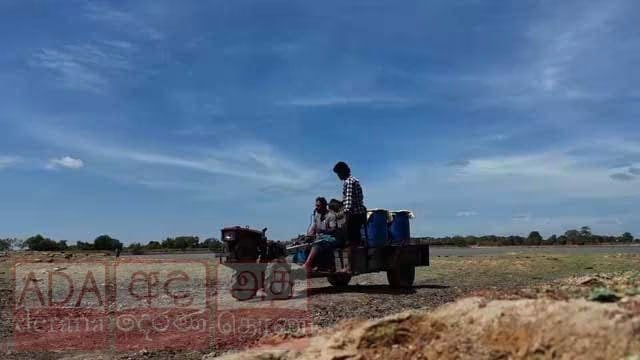
The government has moved to speed up compensation payments to farmers whose crops have been destroyed by the current dry spell, with preliminary assessments putting the damage at about 6,073 acres of paddy land belonging to roughly 4,707 farmers across five districts.
The Agricultural and Agrarian Insurance Board said the decision to expedite payments was taken on the instructions of Agriculture Minister K.D. Lalkantha. Board officials have begun inspecting the affected farmland, and compensation is to be released as soon as those assessments are complete.
Where the damage is concentrated
Water shortages have hit paddy, maize and other cultivations in Monaragala, Polonnaruwa, Hambantota, Ampara and Anuradhapura.
Anuradhapura accounts for the largest share, with 2,200 acres affecting 1,900 farmers. Monaragala follows at 1,334 acres and 960 farmers, then Polonnaruwa with 1,100 acres and 560 farmers, Ampara with 1,004 acres and 505 farmers, and Hambantota with 435 acres involving 782 farmers.
The Hambantota figures point to a concentration of very small holdings — 782 farmers sharing 435 acres works out at well under an acre each, the smallest average plot size among the five districts.
What farmers can claim
Under the state crop insurance scheme, farmers growing six designated crops, including paddy and maize, qualify for a maximum payment of Rs. 100,000 per hectare, subject to a maximum cultivated extent of five acres. Ada Derana’s report states the payment rate in hectares and the extent cap in acres; the Board’s statement as carried does not reconcile the two units.
Farmers who have lost crops to the drought have been asked to notify Agricultural and Agrarian Insurance Board field officers without delay. Losses can also be entered in the damage notification registers held at Agrarian Development Centres. The Board is operating a hotline on 1918 for further information.
A deepening dry season
The compensation drive comes as drought conditions grip large parts of the dry zone, with national reservoir storage down to 37% of effective capacity and the Meteorology Department describing the current El Niño as the strongest in 75 years heading into the Maha season.
Earlier assessments had already recorded crop damage across four provinces and more than 68,000 people affected by the dry weather. The government separately opened interest-free financing to small rice mills to buy Yala season paddy at guaranteed prices.