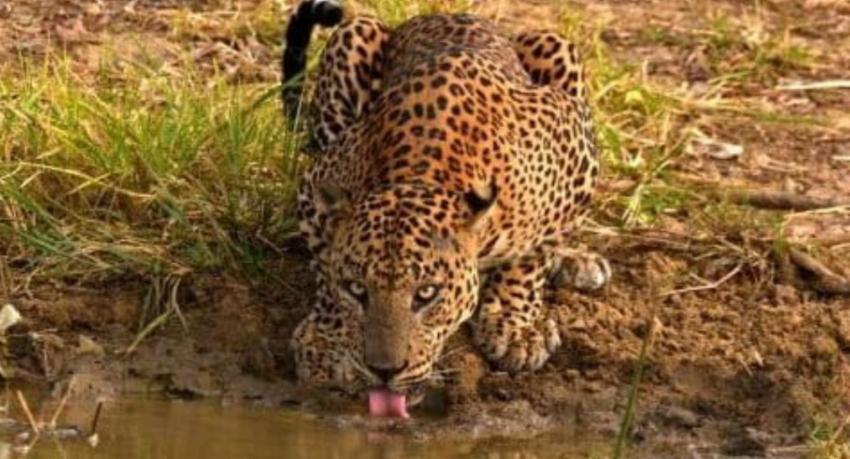
The Department of Wildlife Conservation has launched a project to build mud ponds using a new construction technique, aimed at meeting the water needs of national parks through the dry weather.
The department said the project is being carried out under the guidance of Professor Rangika Halwatura of the University of Moratuwa. Its main advantage is speed and cost: the ponds can be built rapidly and cheaply compared with conventional water storage.
Construction has already been completed at Wilpattu, Yala and Horowpathana, the department said.
Pumps and bowsers
The mud ponds sit alongside two other methods the department is using to keep water in front of animals.
Water is being delivered to parks hit by scarcity using 25 solar-powered water pumps, the department said. Bowsers are also being deployed as required to parks worst affected by the dry spell — among them Yala, Wilpattu, Bundala, Kumana, Maduru Oya and Kaudulla, together with the Horowpathana National Elephant Holding Grounds.
Trucking water is the more expensive and labour-intensive option, which is part of the appeal of ponds that can be dug quickly and refilled by solar pumps rather than refilled by road.
A dry season under strain
The measures extend an effort that has been running for weeks as the dry spell has deepened.
Wildlife officers began trucking water into Wilpattu in late July, after the main tanks in the park’s eastern zone ran dry. In mid-August the department was running three bowsers a day into Yala and had installed solar panels to feed small ponds at six sites inside that park — the same combination of pumped storage and trucked supply now being applied more widely.
The pressure is not confined to the parks. Bowsers have been sent to communities across the dry zone as tanks and small reservoirs have emptied, during what the Met Department has described as the strongest El Niño in living memory.