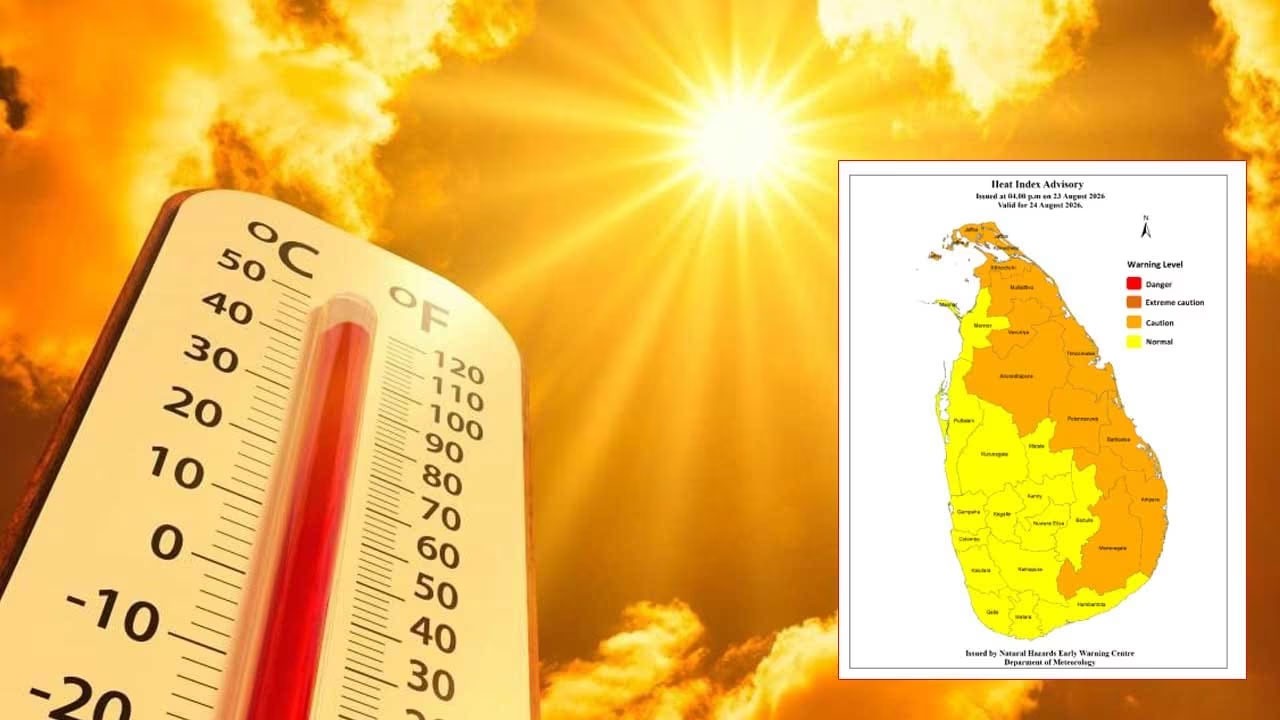
The Natural Hazards Early Warning Centre has issued an amber warm weather advisory covering the Eastern and North Central provinces and the Jaffna, Kilinochchi, Vavuniya, Mullaitivu and Monaragala districts.
The advisory was issued at 4:00 p.m. on Sunday and remains valid until 4:00 p.m. on Monday, August 24. It warns that the heat index is likely to rise to the “Caution” level at some places in those areas during the daytime on Monday.
The heat index is the temperature as it is felt on the human body. The Centre said it is calculated from relative humidity and maximum temperature, and is not a forecast of the actual maximum air temperature. The Department of Meteorology prepares the forecast for the following day using global numerical weather prediction model data.
The advisory follows the hottest readings of the run
The warning comes at the end of a day on which Polonnaruwa and Pothuvil recorded the country’s highest maximum temperature at 37.5°C, according to Daily Mirror, citing the Meteorology Department. Trincomalee reached 37.0°C, and Mullaitivu and Monaragala 36.8°C each.
Three of those four locations sit inside the area named in Monday’s advisory.
The warning area is the same as the one the Department set out for Friday, August 21 — both provinces in full, plus the same five districts. Saturday’s advisory had briefly narrowed the North Central Province to Polonnaruwa alone before it was widened again that evening.
Precautions
The Centre advised the public to stay well hydrated and take breaks in shaded areas as often as possible at workplaces, and to check on elderly and sick people indoors, who are more vulnerable to heat. It said children should never be left unattended inside vehicles.
Outdoors, the public was told to limit strenuous physical activity, seek shade and drink plenty of fluids, and to wear lightweight, white or light-coloured clothing.
The advisories continue an almost daily run of heat warnings through August. The Ministry of Health has warned that prolonged heat exposure can be fatal, and forecasters said last week that the current El Niño is the strongest in living memory and is likely to persist into the first quarter of next year. Dry conditions have already affected more than 81,000 people across seven districts.
At the time of writing, on Sunday evening, no other verified Sri Lankan newsroom had published its own report of Monday’s advisory.