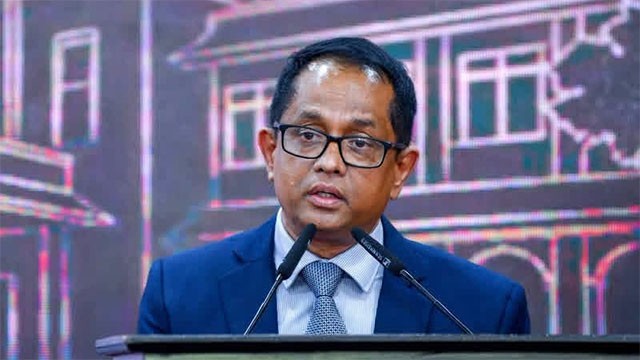
The President’s Fund, which has a 50-year history, “truly became a fund belonging to the people only from last year”, Speaker Dr. Jagath Wickramaratne said on Sunday, crediting the government’s moves to decentralise and digitalise the institution.
He was speaking at the inaugural programme of the Fund’s educational scholarship scheme for the children of low-income lottery sales assistants, held at the North Central Provincial Council Auditorium in Anuradhapura. Sixty-five children of lottery sales assistants in the North Central Province received scholarships at the event.
“The President’s Fund is no longer a distant institution confined to Colombo. It has been transformed into a truly people-friendly service that the public can easily access through the Grama Niladhari and Divisional Secretariat offices,” the Speaker said.
Decentralising the Fund to Divisional Secretariat level, together with digitalising it, had made it more accessible to the public, he said.
What the scheme covers
The scholarship scheme covers schoolchildren from Grade One to GCE Advanced Level and is being implemented across all provinces. It is framed as recognition of the contribution lottery sales assistants make to the President’s Fund through their ticket sales.
The Speaker said roughly 22,000 Development Lottery sales agents contributed Rs. 5.112 billion to the President’s Fund in the six months from January 1 to June 30, 2026.
Sunday’s ceremony delivers on a decision taken in May, when the Fund’s governing board approved monthly scholarships for the children of low-income lottery sellers at a meeting between the Fund’s secretary and officials of the National Lotteries Board and the Development Lotteries Board. Eligibility criteria and scholarship amounts had not been published at that stage; neither report on Sunday’s event stated the value of the individual awards.
Also at the event
Minister of Housing Construction and Water Supply Dr. Susil Ranasinghe said education was a key means of enabling children from rural communities to escape poverty. The government’s education reforms aimed to equip children with skills suited to the future world and to produce competent professionals and entrepreneurs, he said, adding that supporting rural children through education was essential to the government’s objective of eradicating rural poverty.
Senior government officials, members of Parliament, representatives of the President’s Fund, the Development Lotteries Board and the National Lotteries Board, and senior security officials attended.