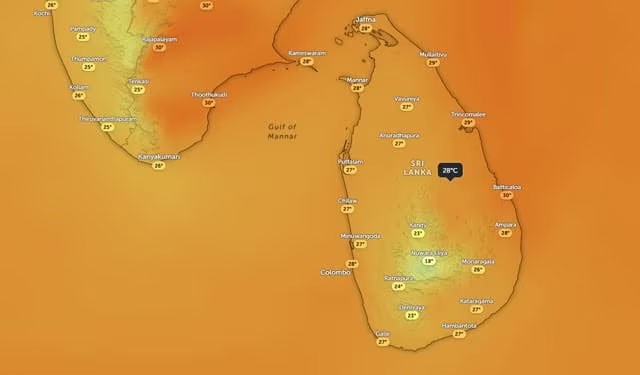
Sea temperatures around Sri Lanka have risen by 1°C, the Department of Meteorology says, as a strengthening El Niño raises concern over the weather the island faces in the months ahead.
The rise is being observed against broader warming in the Pacific Ocean, Ada Derana reported on Monday. Both daytime and nighttime temperatures have gone up, and the department warned that some affected areas may not see rain until the end of September. It described the next eight months as a critical period.
How close to a record
NewsFirst’s account puts precise numbers on the Pacific warming and shows it is still climbing.
Citing the Australian Bureau of Meteorology, it reported that temperatures in the central Pacific — the region used to monitor El Niño — had reached 2.37°C above average as of Sunday. That is within 0.4°C of the 2016 event, one of the strongest on record.
Forecasts indicate the anomaly could reach 3°C within a month, which would make this the strongest El Niño recorded since 1900, and could climb to 3.6°C by November. Ada Derana’s report gave the Pacific figure as around 3°C without distinguishing between the current reading and the forecast.
The Indian Ocean is complicating the outlook. Earlier forecasts suggested it would warm alongside the Pacific, supporting rainfall over South Asia, but observations over the past three weeks show temperatures gradually declining instead. The Indian Ocean Dipole index, which shapes regional rainfall, is easing within neutral territory at 0.17. Sri Lanka’s expectations for November and December rain were based in part on the warmer scenario.
On the ground
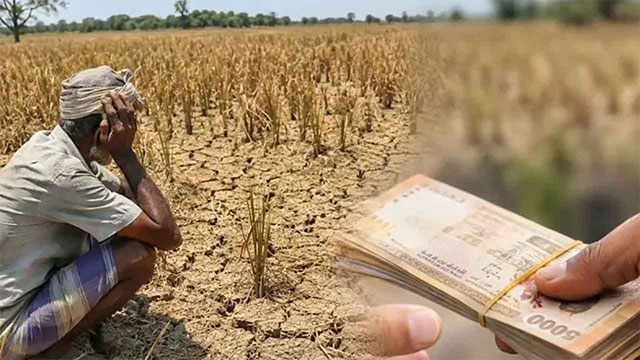
Every part of the country apart from the south-west is now dry. The two reports differ slightly on the toll: Ada Derana cited Disaster Management Centre figures of 81,605 people across 22 Divisional Secretariat areas in seven districts, while NewsFirst put it at 81,865 people from 25,628 families. An earlier DMC count on August 21 stood at 81,765. Drinking water is being trucked to 72,153 people from 23,048 families across 20 Divisional Secretariat divisions.
Reservoirs managed by the Irrigation Department are at about 35 percent — 35.8 percent according to H.M.P.S.D. Herath, Director of its Water Management Unit — and the Mahaweli system at roughly 55 percent. The Irrigation Department says drinking water supplies from reservoirs and tanks will be maintained, but releases for agriculture may have to be restricted.
Planting against the calendar
President Anura Kumara Dissanayake convened a special discussion with agriculture and irrigation officials on August 21, focused on whether water could be managed to support cultivation and whether irrigation releases could begin by October.
Additional Director General of the Department of Agriculture G.G.V. Shyamali said farmers should not wait for irrigation releases and should begin preparing with available rainfall. The department recommends cultivation be completed by October 15, so that crops are about a month old when heavier rains are forecast to arrive around November and better able to withstand them. Farmers are being urged towards short-duration paddy varieties, given concerns about water shortages in the 2027 Yala season.
Herath said many of the 29 irrigation schemes fed by the Mahaweli system have enough water to begin cultivation, but that other projects will depend on rainfall. He expects rain around mid-October and through November, allowing many schemes to start in late October or early November.
What Sri Lanka can and cannot see coming
Senior meteorologist Malith Fernando made a point about the limits of the forecasting: Sri Lanka does not independently monitor or forecast El Niño, relying instead on a small number of international institutions and comparing their output against local historical records.
He also flagged the possibility of record heat next year. Sri Lanka’s highest recorded temperature remains 40.1°C, measured at Vavuniya on April 10, 1983. Pottuvil has recently reached 39.9°C — within 0.2°C of a record that has stood for 43 years.
Ada Derana’s own video coverage continues to describe the dry spell as affecting 14 districts, a figure that has not been reconciled with the seven districts in the DMC’s published count.