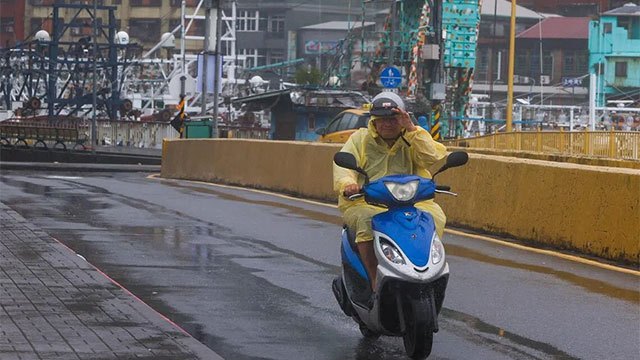
Regional governments across southern Taiwan closed offices and schools on Monday as torrential rain continued to flood the region, with a typhoon expected to reach the north of the island at the end of the week.
The cities of Kaohsiung and Tainan, home to more than four million people between them, ordered closures, as did Pingtung and Chiayi counties and the mountainous eastern counties of Taitung and Hualien.
Kaohsiung’s government said cumulative rainfall over the five-day span of the low-pressure system was expected to exceed 1.3 metres (4.3 feet) — close to half of what the city normally receives in an entire year.
Evacuations and flooding already under way
Taiwan’s Central News Agency reported that Kaohsiung had evacuated 2,203 people from mountainous areas under landslide alerts as of Sunday afternoon, while Pingtung County had moved 115 residents.
In Kaohsiung, a vehicle was almost submerged by floodwater in Niaosong District, with all three occupants rescued safely, and a fallen tree struck a Kaohsiung Light Rail train, briefly halting the service. Floodwater reached waist height around the Love River park area in Sanmin District, and landslides and fallen trees blocked roads in Renwu District.
Pingtung County had recorded flooding or fallen trees in 36 areas by 4.00 p.m. on Sunday. A section of Provincial Highway No. 24 was closed as a precaution after forecasts of around 400 millimetres of rain in 24 hours in mountainous parts of the county.
The initial Sunday-evening announcements covered Tainan, Kaohsiung and Pingtung; Chiayi, Taitung and Hualien were added as the system persisted.
A typhoon behind the rain
The Central Weather Administration attributes the downpour to a low-pressure system combined with strong southwesterly winds, and expects heavy rain across southern and eastern Taiwan to continue through Tuesday. Conditions should begin to stabilise around Wednesday, though afternoon thunderstorms remain possible.
From Thursday the outlook depends on Typhoon Saudel, currently tracking towards Japan’s southern Okinawa region. The administration expects it to pass north of Taiwan early on Friday before reaching the eastern coast of China.