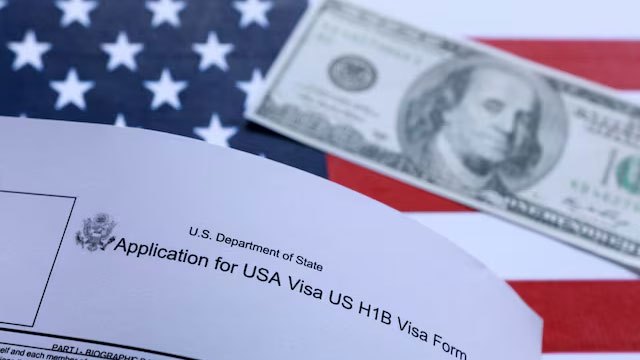
The Trump administration on Monday released a proposed regulation that would make permanent a fee of more than $100,000 on new H-1B visas for skilled foreign workers — a charge the president first imposed by proclamation last year, and which the courts have blocked.
The US Department of Homeland Security put the proposed figure at $103,265. It was posted to the Federal Register on Monday for formal publication on Tuesday, opening a 30-day public comment period. The rule could be finalised by the end of the year.
The H-1B programme lets US employers hire foreign workers trained in specialty fields, issuing 65,000 visas a year plus another 20,000 for applicants with advanced degrees, valid for three to six years. It is heavily used in the technology, education and research sectors. Before Trump’s order, obtaining one typically cost about $2,000 to $5,000 in fees.
Blocked in court, revived by rule
A federal judge ruled in June that the fee was illegal and barred the administration from collecting it. A Boston-based appeals court is reviewing that decision, while a separate court weighs whether a judge in Washington, D.C., was right to reject a challenge brought by a major business group.
Trump’s 2025 proclamation expires in September, a year after it was issued, but instructed Homeland Security to write regulations making the charge permanent — which is what Monday’s proposal does.
The fee is being challenged by the US Chamber of Commerce, Democratic-led states and a coalition of unions and employers. They argue the president’s power to restrict entry does not extend to overriding the statute that created the H-1B programme, and that Homeland Security cannot raise fees or taxes without authorisation from Congress. The administration counters that the charge is not a conventional tax and that courts have little standing to question presidential authority over entry.
About 70 employers had paid the $100,000 fee across 85 visa applications as of late February, according to court filings.
A shrinking pipeline
Trump and other critics say the programme is abused by companies replacing American workers with cheaper foreign labour. Business groups say it fills gaps where qualified American workers are scarce.
Registrations have fallen sharply amid the wider immigration crackdown. Employers registered for about 344,000 H-1B visas last year, down more than 25% from 2024 and fewer than half the 794,000 sought in 2023, US Citizenship and Immigration Services data shows. The administration has also ordered enhanced vetting of applicants and proposed a selection process favouring higher-skilled, better-paid workers. Earlier in August, a separate Homeland Security rule added fees of up to $4,500 on applications to extend H-1B workers’ stay or to transfer employees from overseas offices.
Neither Ada Derana nor Daily Mirror, both carrying Reuters copy, reported figures for Sri Lankan nationals on the programme or an assessment of the effect on Sri Lankan IT professionals. Sri Lankan skilled workers have faced tightening routes elsewhere, including the UK’s care worker visa clampdown.