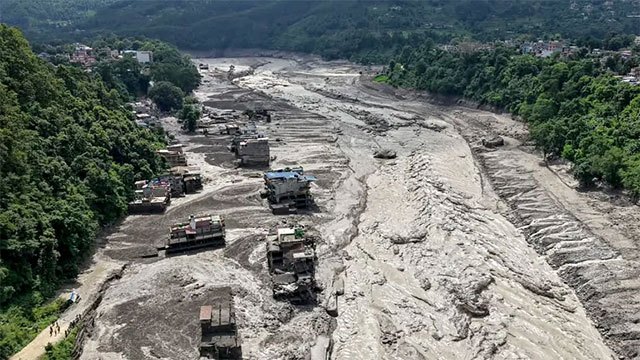
Nepal police said 270 bodies had been recovered by Thursday from the flash flood that tore through the country’s northern valleys on Wednesday, as United States government scientists withdrew their initial finding that an earthquake caused the disaster.
The US Geological Survey had first recorded the event as a magnitude 4.4 earthquake. On Thursday morning it said that “additional analysis of nearby seismic stations, long period seismic waves, and satellite imagery led to the determination that the seismic event was instead a glacial collapse and debris flow, and that no earthquake had occurred”. The agency said the collapse “caused subsequent catastrophic impacts downstream”.
The correction contradicts the explanation given by Nepal’s own foreign minister, who said earlier that the landslide had been triggered by an earthquake. Nepali authorities had separately told the BBC that a large mass of ice may have broken away from a mountain, dragging rock and sediment with it. Scientists are still reconstructing the sequence of events.
More than 1,380 missing
The missing are counted on both sides of the border. In Nepal the figure rose to 826, including 517 foreign nationals, while Chinese state broadcaster CCTV put the number in Tibet’s Gyirong county at 558, including 260 foreigners. Together that is at least 1,384 people unaccounted for. Reuters reported the combined total as “nearly 1,500 people including almost 800 foreigners”; the component figures published by each side sum to the lower number.
China has confirmed three deaths on its side of the border.
Nepal’s Tourism Board said 644 people were out of contact, comprising the 517 foreigners — drawn from 32 countries — and 127 Nepalese. Indians account for the largest group at 178, followed by 65 Americans, 53 Ukrainians, 51 Malaysians, 35 Australians, 33 Britons and 25 Canadians. The board said no Sri Lankan nationals appear on the list, confirming Colombo’s earlier assessment that no Sri Lankans were known to be affected.
”Entire villages swept away”
The flood struck the Bhotekoshi river in Rasuwa and Nuwakot districts, a corridor heavily used by trekkers heading for Langtang and Gosain Kunda and by pilgrims travelling the Kailash Mansarovar route into Tibet.
David Fisher, who heads the International Federation of Red Cross and Red Crescent Societies delegation in Nepal, said there was “still an extreme situation” in the affected regions. Parts of northern Nepal “are only accessible via helicopter because the flood has knocked out bridges and roads”, he said, adding that entire villages and marketplaces had been “swept away” and that many people had slept “in the elements”. He said he feared the death toll “could continue to go up”.
More than 5,000 army and police personnel are deployed. Nepal’s army said 125 people, including 20 foreigners, were retrieved on Thursday, and helicopters are dropping tents and food supplied by India. Prime Minister Balendra Shah travelled by road to Bidur in Nuwakot to assess the damage.
Sri Lanka has offered rescue and clearance assistance to Kathmandu.
The World Wildlife Fund estimates Nepal’s glaciers are retreating by up to 15 metres a year, destabilising slopes and creating unstable bodies of meltwater.
Sources
- Nepal floods: USGS says ‘glacial collapse’ caused ‘catastrophic’ impacts — Ada Derana, August 27
- Nepal flood death toll rises to 270 as more bodies recovered — Ada Derana, August 27
- 644 tourists still out of contact after deadly floods, says Nepal Tourism Board — Ada Derana, August 27
- No Sri Lankans among foreigners reported missing so far in Nepal flash floods — Ada Derana, August 27
- Nepal in ‘an extreme situation’ and ‘much more support is needed’ — Ada Derana, August 27
- Nearly 1,500 missing in Nepal and China after devastating Himalayan flash flood — Daily Mirror / Reuters, August 27
- Live updates: More than 1,300 missing after deadly floodwaters wipe out villages on Nepal-China border — CNN, August 26