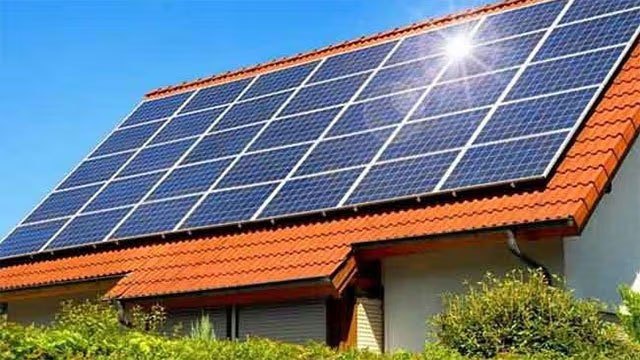
Owners of rooftop solar installations larger than 300 kilowatts have been asked to stop feeding power into the national grid for seven hours a day until Sunday, as electricity demand falls over the holiday period.
The affected systems must suspend generation daily from 8 a.m. to 3 p.m., beginning today (August 27) and running through Sunday, August 30, according to a notice issued by the National System Operator (Pvt) Ltd and reported by the Daily Mirror. Hiru News gave the same seven-hour window and the same four-day span.
The measure is intended to keep the national power system stable. Demand drops sharply when offices, factories and schools close, while midday solar output stays at its peak — an imbalance the grid has limited capacity to absorb.
Who issued the request
The three newsrooms differ on attribution. Daily Mirror described the request as coming from the National System Operator itself, and Ada Derana attributed it to the NSOL chairman. Hiru News reported it as a request made by Energy Minister Anura Karunathilaka. The accounts are not necessarily in conflict — a ministerial announcement of an operator’s notice would produce both — but none of the three explained the relationship.
Ada Derana’s report said only that systems above 300 kW would be switched off until Sunday, without specifying the daily window that Daily Mirror and Hiru both carried.
None of the outlets named which holiday is driving the demand slump, or estimated how much generation capacity the order takes offline.
A recurring measure
This is at least the third such curtailment this year, and the 300 kW threshold has been identical each time.
In April, the Ceylon Electricity Board ordered systems above 300 kW to disconnect for ten days across the Avurudu holidays, citing the same combination of collapsing demand and clear skies. At the end of May, a Vesak-day demand slump went further: the system operator disconnected supply to around 100 areas before restoring it, then asked rooftop solar owners to switch off again the following day.
The repetition points to a structural gap rather than a series of one-off events. Rooftop capacity has grown quickly under net-metering and net-accounting schemes, but Sri Lanka’s thermal and hydro baseload plants have limited ability to ramp down when solar surges at midday. Without storage or more flexible backup generation, curtailment remains the operator’s main tool — and it falls on the largest commercial and industrial rooftops first.