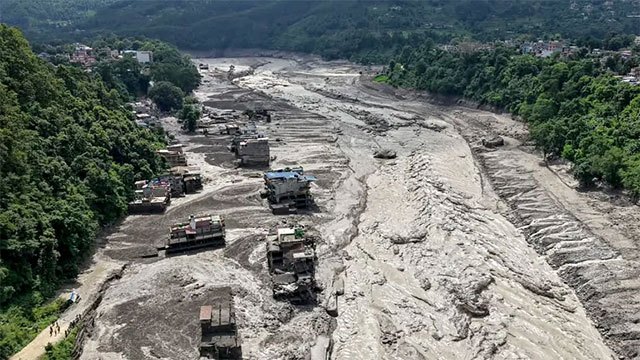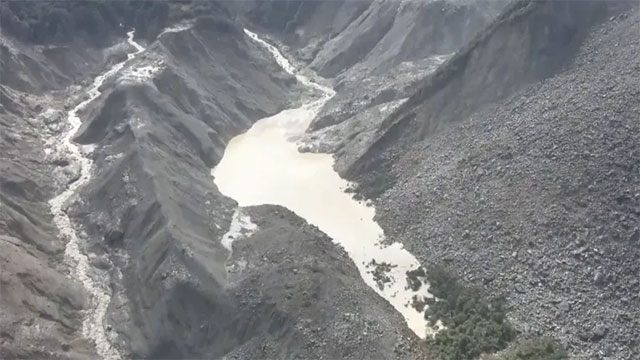
Search and rescue operations near the Nepal-Tibet border were suspended on Friday after the debris-dammed lake left behind by Wednesday’s flash flood began to overflow, with China warning of a “high risk” that it would breach and send a second flood downstream. Later the same day Nepali officials said the lake had breached.
The lake formed when debris blocked a river upstream of Gyirong Port, the main land crossing between Nepal and China, at the site of the earlier flood. China’s Ministry of Water Resources said it has already started to overflow, Ada Derana reported. The area has also had heavy rain.
Why the work stopped
State broadcaster CCTV said on Friday morning that most Chinese emergency services were stuck at a village about 7km from Gyirong Port because the lake was “overflowing non-stop”, raising the prospect of fresh floods or debris flows. Search and rescue work near the border was halted as a result, the Daily Mirror reported, carrying BBC copy.
Teams trying to reach Gyirong, where buildings lie buried under a metre and a half of mud, were told to pause because of mudslide fears, Al Jazeera’s Katrina Yu reported from Beijing. She described the pause as introducing “a sort of anxious ticking clock” for crews racing to find survivors before conditions worsen.
How much water
The two accounts of the lake’s volume differ slightly. CCTV put the accumulation at about 2.5 million cubic metres as of Friday morning; Al Jazeera reported Chinese authorities giving about 2 million cubic metres. Both agree a further 3 million cubic metres is expected to flow in over roughly three days, with Ada Derana reporting peak flow around September 1.
The lake sits at the confluence of the Chhochen Khola and Purepu Tsangpo rivers, in the same area as the Langtang Lirung peak where the collapsing glacier is believed to have originated. Engineering teams have been sent to monitor water levels and weather.
Nepali authorities separately warned that blockages could cause further floods along the Bhote Koshi and Trishuli rivers, and told people to stay away from both until further notice.
The toll
Nepal’s prime minister’s office said on Friday morning that 469 people were confirmed dead and 977 missing. By Friday evening Nepal Police had raised the confirmed toll to 547, with the National Disaster Risk Reduction and Management Authority separately reporting 538 bodies recovered and putting the foreign nationals among the 977 missing at 517. China has confirmed five deaths in Tibet and 558 missing. About 1,550 people have been rescued.
An earlier figure of 644, given by Nepal’s Tourism Board, counted everyone out of contact — 517 foreigners and 127 Nepalese — rather than foreign nationals alone. The running toll and the divergence between the two Nepali agencies are tracked separately.
Bishal Nath Upreti, president of the Nepal Centre for Disaster Management, told Al Jazeera that roughly 42km of road has been “completely wiped out” and that “except for the helicopters, the rescuers cannot go there”. Around 800 people were lifted out by air and 700 by land. “It’s already over 72 hours now and people are really desperate for shelter and food,” he said.
Nepal has deployed 30,000 security personnel; China has sent about 500 military and paramilitary personnel and dispatched Premier Li Qiang to supervise, which Al Jazeera described as very rare.
Kathmandu’s foreign ministry said on Friday that Nepal does not require international assistance with the search itself. Sri Lanka offered rescue and clearance help on Thursday and committed USD 1 million to the relief effort.
The running toll and the glacial-collapse finding are covered separately.
Update: the lake has breached and some rescue work has restarted
Later on Friday the barrier lake breached, according to Rasuwa Chief District Officer Narendra Pariyar, who said the Nepali Army had informed him of it. The Kathmandu Post reported that the National Disaster Risk Reduction and Management Authority recorded a surge in the Bhotekoshi’s water level.
Nepal moved to assess the consequences from the air rather than the ground. An official at the Rescue Coordination Centre at Tribhuvan International Airport said helicopters already stationed at Dhunche and elsewhere in Rasuwa would fly reconnaissance over the Bhotekoshi, and that none would be sent from Kathmandu for the task. “Information has come that the lake on the Chinese side has breached. So, preparations are underway to send helicopters stationed in Dhunche and Rasuwa for reconnaissance,” the official said. Nepali authorities have not yet confirmed how much water was released.
The lake had grown faster than the earlier estimates suggested. Its volume topped 2.5 million cubic metres by Friday, up from the 1.5 to 2 million cubic metres recorded a day earlier, before overflowing into the Bhotekoshi.
On the Chinese side the suspension appears to have been temporary. The risk of a burst prompted all Chinese rescue personnel and vehicles to withdraw to a safe area, but operations were later resumed “as the risk posed by the upstream dammed lake was deemed manageable”, state broadcaster CCTV said in remarks carried by the Daily Mirror. Ada Derana and Al Jazeera were still reporting the suspension at the time of their filings, and no verified Sri Lankan newsroom has yet reported the resumption independently.
President Xi Jinping chaired a meeting that instructed authorities to “scientifically formulate search-and-rescue plans, make every effort to search for missing people from China and abroad”, the state news agency Xinhua said. The meeting described the rescue work as facing “extremely difficult challenges” and called for stronger monitoring of glacier lakes, landslide risks and barrier lakes.
Sources
- ‘High risk’ of lake breaching and causing second flood, warns China — Ada Derana, August 28
- Rescue operations suspended after lake near China-Nepal border overflows — Ada Derana, August 28
- ‘High risk’ of lake breaching and causing second flood, warns China — Daily Mirror / BBC, August 28
- Death toll from Nepal-Tibet flood surpasses 470 as barrier lake threatens — Al Jazeera, August 28
- Nearly 500 killed, over 1,400 still missing due to Nepal floods — Daily Mirror / RTÉ, August 28
- Barrier lake near China border breaches, raising fresh flood threat in Nepal — Kathmandu Post, August 28