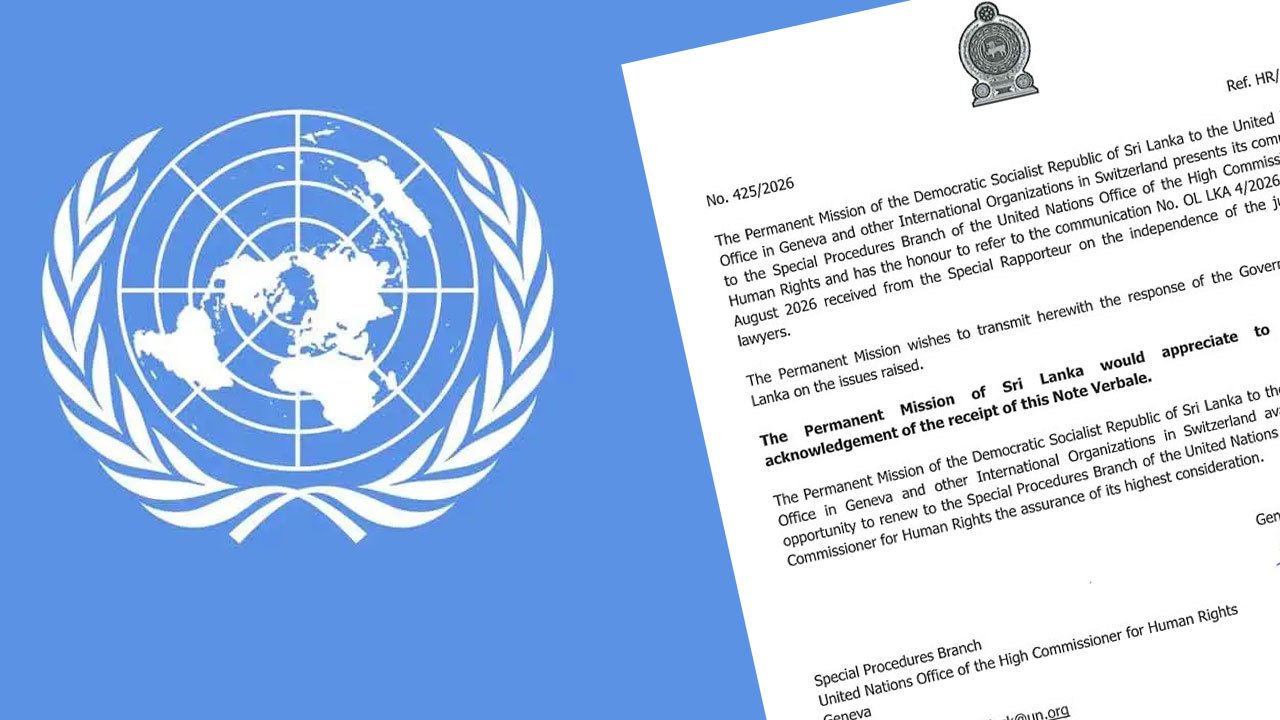
Sri Lanka has filed a formal written answer to the United Nations Special Rapporteur on the independence of judges and lawyers, rejecting the suggestion that raising the retirement age of superior court judges is meant to change who sits on the bench.
The response was transmitted through the country’s Permanent Mission to the UN Office in Geneva, in a Note Verbale numbered 425/2026 addressed to the Special Procedures Branch of the Office of the High Commissioner for Human Rights. It answers communication OL LKA 4/2026, sent on 7 August 2026 by Special Rapporteur Margaret Satterthwaite — the same day the bills were gazetted.
The government said the amendments are “not intended to prolong the mandates of specific judges or alter the composition of the Judiciary for immediate institutional purposes”, according to Ada Derana’s report. It listed the aims as clearing case backlogs, improving access to justice, enabling appellate jurisdiction at regional level and “retaining judicial expertise and institutional knowledge”.
The retrospective question
The Rapporteur’s central objection was that the change would apply to judges already serving rather than only to future appointments. She warned in her August communication that this could create a perception the amendment was designed to alter the judiciary’s composition, and flagged a possible conflict of interest if judges who benefited were later asked to rule on the amendment’s constitutionality.
Colombo answered that question head-on, and inverted it. Excluding sitting judges “would defeat the legitimate objective of increasing the retirement age, being the retention of judicial experience”, the response said. Applying the change to serving judges is “reasonable, rational and is in itself a safeguard to prevent actual or perceived interference” by the executive or the legislature in the composition of the courts.
The government also restated what it called an “unequivocal and longstanding commitment” to judicial independence and the rule of law.
Where this sits
The 22nd Amendment would raise the retirement age for Supreme Court judges from 65 to 67 and for Court of Appeal judges from 63 to 65. Because both ages are fixed in the Constitution, the change needs a two-thirds majority in Parliament.
The written reply marks a shift in register. When the Rapporteur’s letter surfaced, Leader of the House Bimal Ratnayake said the government would not confront the UN over it while rejecting its substance. The Note Verbale sets out that rejection as a formal state position on the record in Geneva.
Domestically the bill remains contested. Petitions both challenging and supporting the amendment have been filed in the Supreme Court, and the Bar Association of Sri Lanka has called for responsible scrutiny of the judiciary as the measure proceeds.
At the time of writing no other verified newsroom had reported the filing of the response.