President Anura Kumara Dissanayake has instructed officials to restrict environmentally harmful diesel vehicles inside the Anuradhapura Sacred City and to introduce an organised electric-bus service, as part of a package of measures aimed at easing traffic congestion at the World Heritage site.
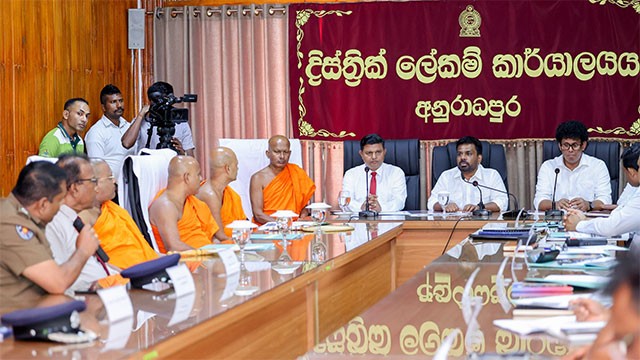
The directive was issued at a meeting held at the Anuradhapura District Secretariat to review the Sacred City Development Plan.
Under the proposal, electric buses would run a circular route within the Sacred City as a daily service operated by the Anuradhapura Municipal Council, carrying pilgrims visiting the Atamasthana, the eight sacred sites. The President also called for measures encouraging devotees to travel on foot, and said the plan should include separate lanes for pedestrians and cyclists along with shaded rest areas for pilgrims arriving by train and bus.
Dissanayake said archaeological sites in the city should be treated not as “ruins” but as “living historical sites” that continue to be venerated, and that facilities for devotees must be developed with the area’s religious and archaeological significance in mind, according to the President’s Media Division.
Timeline and scope
The President ordered an accelerated revision of the development plan. The Director General of the National Physical Planning Department was instructed to present the revised plan to the Anuradhapura Sacred City Development Committee on September 8, with the full detailed plan to be finalised by September 15. Work is intended to begin within this year.
The project is being upgraded with Indian government assistance of up to Rs. 6.5 billion. The Sacred City boundary, currently covering roughly 28 square kilometres, is expected to be expanded to 38 square kilometres. Dissanayake instructed officials to draw a clear distinction between components to be implemented by UNESCO and those funded through Indian assistance, so that all stakeholders including the Maha Sangha understand the overall programme.
He also pressed for projects to be prioritised and sequenced so that development is not held up unnecessarily by archaeological excavation work, with relevant institutions consulted and preliminary approval obtained before individual projects begin.
Resettlement of 331 families
The meeting discussed the resettlement of 331 families living in the Inner City area of Lolugaswewa. The President instructed Divisional Secretary and Chief of Presidential Staff Prabath Chandrakeerthi to engage directly with affected residents and to consider alternatives including land, housing or financial compensation.
Members of the Maha Sangha representing the Atamasthana attended, along with Ministers Wasantha Samarasinghe and Susil Ranasinghe, Anuradhapura District Secretary Ranjith Wimalasuriya, and officials from the National Physical Planning Department, the Urban Development Authority, the Central Cultural Fund and the Department of Archaeology.
The report did not specify when the diesel restrictions would take effect, how many electric buses would be deployed, or what the timetable for the Lolugaswewa resettlement would be.