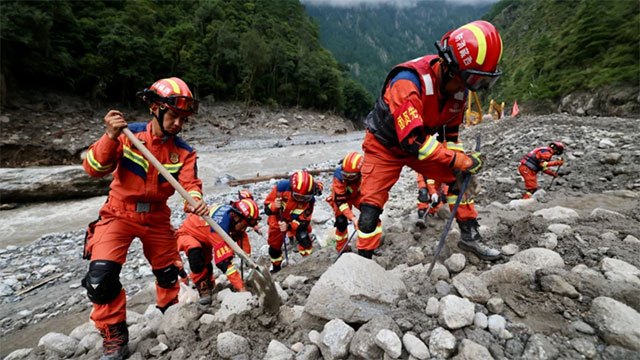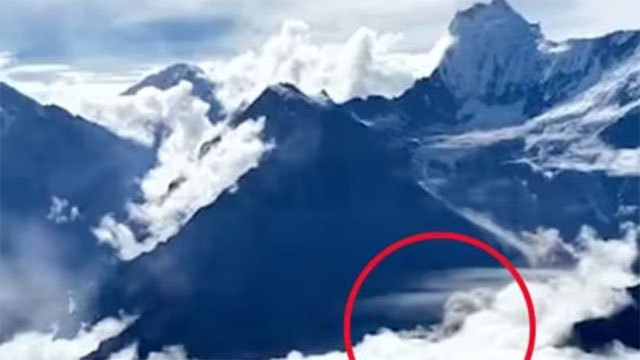
India has ordered its Himalayan border states to monitor every glacier and known glacial lake in their territory, four days after a glacial collapse on the Tibet-Nepal border sent a wall of debris downstream and killed hundreds of people.
The instruction came on Saturday from Uttarakhand, the Indian state that shares the geography — and the border — with the disaster zone. “Since we share a border with Nepal, as a neighbour, and also have a similar geographic situation… we have asked our department to monitor all the glaciers and known glacial lakes in the region,” state disaster management minister Madan Kaushik told AFP, in remarks reported by Ada Derana.
“We have asked our teams to be vigilant and monitor if a similar situation is emerging anywhere in the state,” he said.
Uttarakhand holds 1,266 glacial lakes according to government figures, and is one of India’s most ecologically sensitive regions. The Indian news agency ANI reported on Friday that the state is also commissioning scientific surveys of the most vulnerable lakes and installing early warning systems.
Nepal and China agree to share river data
Nepalese Foreign Minister Shisir Khanal said he had spoken by telephone with his Chinese counterpart Wang Yi, and that the two had agreed to increase the sharing of “real-time hydrological data” — the river-level readings that would give downstream communities warning of a surge coming off the plateau.
Wang said in a Chinese foreign ministry statement that Beijing had “shared crucial information with Nepal, including disaster area imagery, satellite and hydrological data, as well as early warnings about upstream barrier lakes.” He added that “China and Nepal are bound by mountains and rivers, sharing a common destiny.”
The agreement is notable because the water that destroyed the Bhote Koshi valley originated on the Chinese side of the border. Khanal said Nepal needed far more research to “understand the changing dynamics of the Himalayan ecosystem,” and that the risk ran in both directions — “to Nepal and the downstream community, but also to our northern neighbour, to China, as well.”
The UN’s warning
UN climate chief Simon Stiell said the disaster was “a devastating reminder of how fragile these mountain environments can be.”
“We also know a warming climate, driven by humanity burning colossal amounts of coal, oil and gas, is making tragedies like this one, and so many others around the world, much more likely, frequent and severe, with vulnerable communities often hardest hit,” he said in a statement.
Khanal made the same point in blunter terms. “We always highlight that Nepal contributes less than or just about 0.01 per cent of greenhouse gases but we, the people of Nepal, are one of the major victims of the changing climate and its impact,” he said. “So we request the global community also to come together to preserve the Himalayan ecosystem.”
Himalayan glaciers supply water to nearly two billion people and are melting faster as the planet warms. Thawing permafrost also destabilises mountain slopes, raising landslide risk. Experts say climate change combined with poorly planned development is increasing the frequency and severity of these events, though scientists have not yet established how much warming contributed to this particular collapse. The US Geological Survey has attributed the August 26 flood to a glacial collapse rather than an earthquake.
Where the toll stands
The figures quoted in Saturday’s wire copy have already been overtaken. AFP reported 682 confirmed dead and nearly 3,000 missing; that was Nepal’s 675 dead plus the seven then confirmed in Tibet.
China issued a fresh update on Sunday raising its own toll to 16 dead and revising its missing to 546, Hiru News reported. With Nepal’s disaster authority holding at 675 dead and 2,498 missing, the regional total is now 691 dead and more than 3,000 unaccounted for, on the fourth day of the search.
More than 3,700 people have been rescued in Nepal. The government says over 100 hydropower workers may still be alive inside tunnels at the Trishuli 3A and 3B sites, where Indian and Chinese tunnel-rescue specialists are now working. The United States announced more than USD 3.6 million in humanitarian aid on Saturday, including three months of emergency food for up to 10,000 households.
Context
Nepal has put the cost of rebuilding at USD 4-5 billion. Sri Lanka committed USD 1 million and is now preparing to send relief teams. Kathmandu initially refused foreign rescue personnel before reversing, and identification of the recovered dead has become the bottleneck.