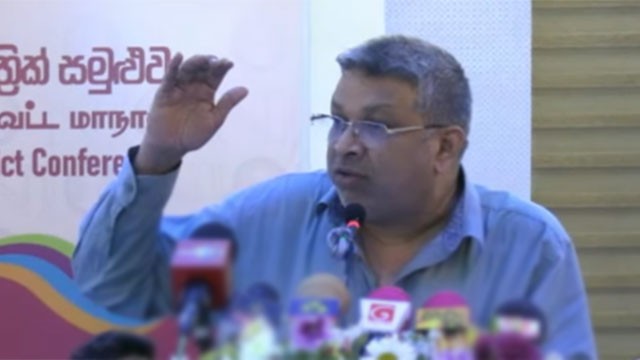
Justice Minister Harshana Nanayakkara said on Sunday that the government will not withdraw the proposed 22nd Amendment to the Constitution in the face of opposition, telling a district conference in Badulla that the judicial reforms will go ahead as planned.
The Minister was addressing the Badulla District Conference of the “Rata Hadana Jana Balaya” movement, Ada Derana reported. He said the government had inherited a judicial system left to stagnate: “When we came into power, the entire system had become stuck after wandering aimlessly for 30 or 40 years.”
Nanayakkara put the pending caseload at around 1.1 million and said clearing it was the point of the exercise. Bringing “corrupt and fraudulent individuals before the courts”, he said, was one of the government’s main promises.
”All means all”
The Minister devoted much of the address to rejecting the charge that the retirement-age extension was written to keep one particular judge in office — an allegation that has followed the Bill since it was gazetted.
He argued the objection would only hold if the extension were selective. “If the Judicature Act is amended, the retirement age of all these judges and all District Judges will be increased by two years. All means all,” he said. In the Daily Mirror’s account of the same speech he put it the other way round: “If we had only increased the age for Supreme Court judges or a selected few, then their argument would hold weight.”
He also conceded ground to critics on the substance, saying the age change alone was not a reform: “I accept the argument that simply increasing the retirement age is not enough. We are looking at this together with the other reforms.”
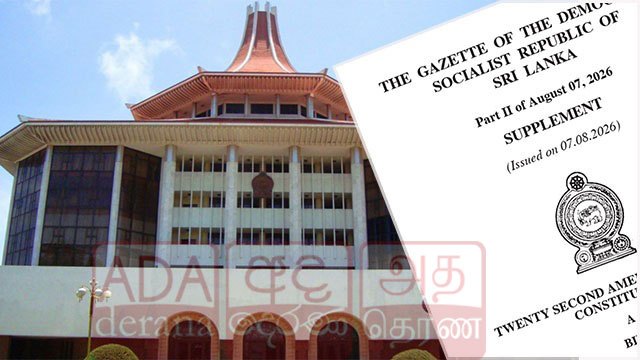
The Bill would raise the retirement age of Supreme Court judges from 65 to 67 and of Court of Appeal judges from 63 to 65. It was tabled in Parliament on 18 August alongside a Judicature (Amendment) Bill covering the lower courts.
A December delay, rejected
Nanayakkara took direct aim at calls to postpone the amendment to December. “They ask why we are bringing this amendment now. Why can’t it be done in December?” he said. “If something is not good when it is introduced now, how does it become good after December?”
Neither outlet identified who has proposed December, and the date does not correspond to the government’s own published schedule: Cabinet Spokesman Nalinda Jayatissa said on Saturday that Parliament would debate the amendment at the end of September or in early October.
The Minister said the public would see results from the reform programme by the end of the year, and closed on the government’s position: “Justice will be delivered. The steps taken by this government will not be reversed. That is not the nature of this government.”
Opposition still widening
The statement comes as professional bodies continue to line up against the amendment. The Government Medical Officers’ Association and the Government Dental Surgeons’ Association decided on Sunday to jointly oppose it and to coordinate with the Bar Association of Sri Lanka, following the Railway Station Masters’ Association earlier in the week. Dozens of petitions for and against the Bill have been filed in the Supreme Court.
The 1.1 million figure the Minister cited is consistent with the range the government has used all year. A Ministry of Justice report put the backlog at 1,134,474 cases across 293 courts as of 30 June 2025, with Magistrate’s Courts carrying roughly 72% of it.