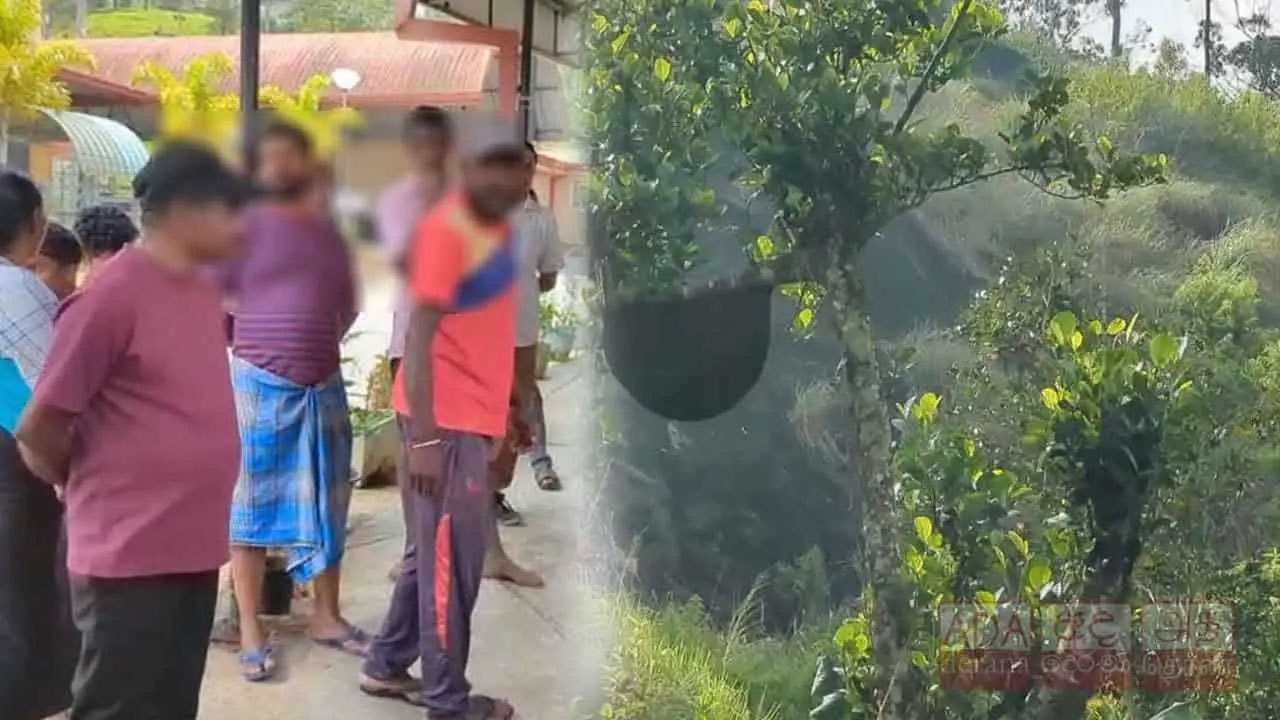
In the village of Kolakanawadiya in Welikanda, Polonnaruwa, daily life is no longer organised around work, school or household chores. It is organised around water.
The taps have stopped flowing and wells are drying up, NewsFirst reported from the village. Families set out each morning and evening on bicycles and on foot to collect enough to get through the day.
“Water doesn’t come through the tap lines anymore. We have to travel one or two kilometres by bicycle to fetch water. We have to do it every morning and evening,” a resident named Nillmini told the broadcaster.
The shortage now reaches basic sanitation. “How are we supposed to live? We don’t even have enough water to use the toilet,” one resident said. Another described newly dug wells failing to help: “Now even the well we dug has no water. We have to travel two or three kilometres to collect water. We don’t have enough water to wash our pots and dishes properly. We gather everything together and wash them all at once because water is so scarce.”
The Water Board’s account
In a separate report the same day, National Water Supply and Drainage Board Chairman Chandana Bandara said the national supply remains stable and that the drought has had a noticeable impact in only a few areas, chiefly Monaragala and Batticaloa districts.
Supply has not been suspended in any district, Bandara said. Distribution in the Bibile and Medagama areas of Monaragala is being run as a controlled supply, and Batticaloa has daily interruptions of about four hours as a precaution. All other treatment plants and distribution networks are operating normally.
The board is rehabilitating around 65 tube wells in Monaragala to restore groundwater sources, and says water bowsers are being arranged for areas with severe shortages.
Bandara said there is no impact on the Western Province, which accounts for more than half of the board’s total consumption. Its six sources — the Kelani, Kalu, Attanagalu Oya and Ma Oya, and the Labugama and Kalatuwawa reservoirs — all hold sufficient water, with Labugama and Kalatuwawa alone estimated to cover about another three months.
Reservoir levels
Reservoirs managed by the Irrigation Department are holding between 30 and 35 percent of capacity, while those under the Mahaweli Authority are between 50 and 55 percent, according to figures Bandara attributed to the Irrigation Department. Sri Lanka produces roughly 2.8 million cubic metres of water a day, about 24 percent of it from major reservoirs.
A gap in the account
The two reports sit awkwardly together. The Water Board names Monaragala and Batticaloa as the districts under strain, but the village NewsFirst filmed is in Polonnaruwa, and residents there describe tap lines that have stopped rather than an area that never had them.
Bandara noted that the worst shortages in Monaragala are in areas outside the board’s pipe-borne network, which may also apply to Kolakanawadiya — but neither report says so, and the board did not address Polonnaruwa. No official was asked about the village. The result is that households describing a total loss of supply fall outside the districts officials list as affected.
The distinction matters for relief: bowser deliveries and controlled-supply schedules are organised by district, and a village that does not appear on that list is not counted.
This follows earlier reporting on dry weather affecting more than 68,000 people and on crop damage across some 8,000 acres.