The Ministry of Plantation and Community Infrastructure will launch a national programme called “Ceylon King Coconut Village” on Wednesday at the Coconut Cultivation Board’s Mahayaya Estate in the Kurunegala District, Ada Derana reported.
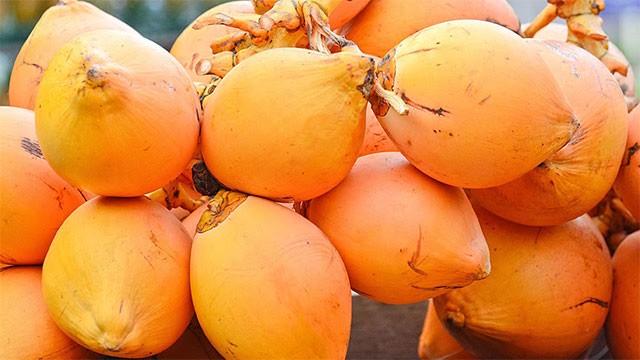
The programme aims to expand king coconut cultivation, raise production and productivity, and widen export markets for king coconut and related products.
250 villages over three years
The plan is to establish 250 king coconut villages island-wide: 75 this year, 80 in 2027 and 95 in 2028.
The first-phase 75 villages span 17 districts — Monaragala, Matara, Kurunegala, Kegalle, Gampaha, Kalutara, Puttalam, Ratnapura, Hambantota, Anuradhapura, Trincomalee, Polonnaruwa, Ampara, Matale, Galle, Batticaloa and Kandy.
The targets
By 2030 the ministry wants annual king coconut production up by 25 million nuts and export revenue from king coconut and related products up by more than US$12 million.
The planting programme behind that is specific. For 2026: 20,300 existing trees rehabilitated and 37,500 new saplings planted. Across 2026–2028: 212,500 new saplings and 221,500 rehabilitated trees.
What growers are offered
Two subsidies carry the scheme.
Farmers rehabilitating existing king coconut trees receive Rs. 700 per tree. For new cultivation, a sapling costs Rs. 750, but growers will be supplied at a subsidised Rs. 150 each — the state absorbing Rs. 600, or 80% of the cost.
The programme also covers irrigation for 500 acres of king coconut cultivation and the creation of a formal data system registering growers, collectors and exporters. The ministry says it expects to improve living standards for 21,250 families through income and employment in cultivation, collection, transport, processing and export.
The scale is modest against the ambition
The arithmetic is worth setting out, because the announcement pairs a large headline with a small planting base.
212,500 new saplings over three years is a limited planting programme by plantation standards, and new king coconut palms take years to bear. Most of the targeted 25 million additional nuts by 2030 would therefore have to come from the 221,500 rehabilitated trees — roughly 113 additional nuts per rehabilitated tree per year — rather than from new planting. Ada Derana’s report does not set out that split, give a total programme cost, or say how the Rs. 700 and Rs. 150 subsidies are funded.
Nor does it name the export markets in view, give a baseline for current king coconut production or export earnings against which the 25 million nuts and US$12 million would be measured, or say which agency will run the grower registry.
Not corroborated
Ada Derana was the only verified newsroom carrying the announcement at the time of writing. It did not appear on the NewsFirst, Hiru News, Daily Mirror, Daily FT or EconomyNext listings, and no verified outlet’s own account of the programme could be found.
Context
King coconut has been treated as a garden crop rather than a plantation crop in Sri Lanka, and earlier attempts to commercialise it have been village-scale pilots rather than national programmes. The wider coconut sector has been under a separate reform push, including a floor price mechanism and a 2030 production target.
The launch also lands in a difficult season for cultivation. The Agricultural and Agrarian Insurance Board reported in August that dry weather had damaged nearly 8,000 acres of crops across five districts, and an MP has warned that weak rainfall may persist. Irrigation availability is the constraint the programme’s 500-acre component addresses directly.