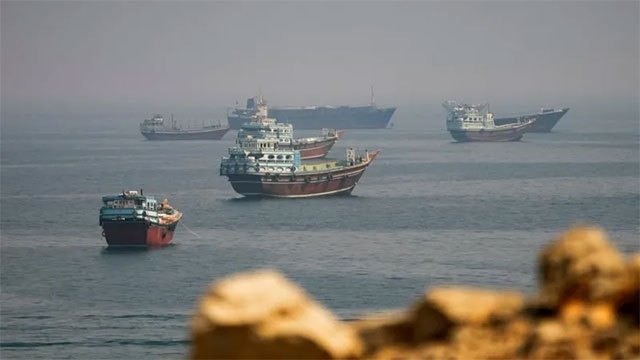
United States forces struck Islamic Revolutionary Guard Corps targets across southern Iran on Tuesday, and Iranian officials said one of the strikes killed at least four people at a wedding celebration.
US Central Command said its forces began striking IRGC targets at 12 p.m. Eastern Time, and announced at 6:33 p.m. that the wave was complete. The targets included air defence sites, radar systems, maritime assets and facilities, mine-laying capabilities and communications sites, CENTCOM said in posts on X reported by Ada Derana. It framed the operation as a response to attempted IRGC attacks on commercial shipping in the Strait of Hormuz and on American service members in the region.
The wedding strike
Iranian officials said at least four people, including a four-year-old, were killed and 50 injured when a US strike hit a wedding celebration in the south of the country. Ahmad Nafisi, deputy governor of Hormozgan province for political, security and social affairs, told state broadcaster IRIB the celebration was taking place in the village of Kouhestak, in Sirik county.
Al Jazeera reported the same incident, citing the Fars news agency, which said a strike hit a home in Sirik hosting a wedding and killed at least four. CENTCOM had not commented on the claim at the time either report was filed.
Iranian state media said explosions were heard east of Bandar Abbas and around Qeshm Island, both on the northern shore of the Strait of Hormuz, and that four projectiles hit the port cities of Chabahar and Konarak on the Gulf of Oman. Press TV said Jiroft Airport and a fishmeal factory on Qeshm Island were struck. Fars reported an explosion in Asaluyeh, the petrochemical hub serving the South Pars gas field, which the local governor confirmed without giving a cause.
Jordan intercepts 10 of 13 missiles
The strikes followed an exchange overnight into Monday, the first between the two countries in more than a month, after the US hit Iranian rocket launchers on Larak Island and Iran fired at American positions in Jordan and the United Arab Emirates.
Iran launched further missiles at Jordan on Tuesday. The Jordanian Armed Forces said it intercepted 10 and that another three fell in remote areas away from population centres, with no casualties. Al Jazeera put the same episode as 10 of 13 intercepted — the two accounts reconcile exactly — and identified the target as Camp Titin, a US Marines barracks. Jordan’s state broadcaster Al-Mamlakah said air raid sirens sounded in Mafraq and Aqaba.
Iran’s Armed Forces Central Headquarters said it would deliver “crushing and devastating blows” against the “American enemy”, IRIB reported.
Oil above US$94
Oil futures climbed above US$94 a barrel after CENTCOM’s announcement, Ada Derana reported; Al Jazeera put the move at more than four per cent. Al Jazeera also reported that a tanker was hit by three “unknown projectiles” while transiting Hormuz, and that US pump prices have passed US$4 a gallon, up from under US$3 before the war.
The escalation cuts against signals from the Trump administration that it was shifting from military action to economic pressure. Treasury Secretary Scott Bessent was promoting that approach at a G20 finance ministers’ meeting in North Carolina the same day, saying alternative shipping routes would eventually make the Strait of Hormuz “a worthless piece of water” and that sanctions would widen weekly.
President Donald Trump warned on Truth Social that Iran would be “hit again at a much harder and higher level” if it retaliated, while saying a larger attack was still “waiting in the wings”. He told Fox News the US had deliberately waited until Iran’s rebuilt radar network was nearly finished before striking it, and said Gulf allies were given advance notice.
For Sri Lanka, the price move is the immediate consequence. Fuel is the largest single line in the import bill, and the current account stayed in deficit for a fourth month in July as the trade gap reached US$6.5 billion, with energy imports the main driver.
Not yet reported
Neither outlet reported Iranian casualty figures beyond the wedding claim, the number of sites struck, or whether the Chabahar and Konarak strikes caused damage to port infrastructure. CENTCOM has not responded to Iran’s account of the wedding.