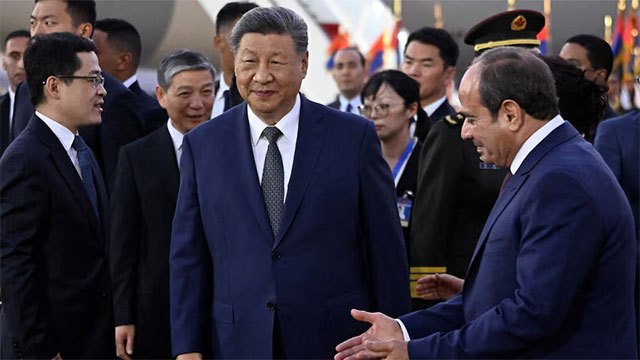
Chinese President Xi Jinping has called on Middle Eastern nations to oppose external interference and consider reshaping the region’s security order, during a visit to Egypt on Wednesday that marks his first trip to the region in four years.
Xi was welcomed by President Abdel Fattah el-Sisi with a military ceremony in Cairo, and the two met at the Ittihadiya Presidential Palace. Countries in the region should be “masters of their own destiny” and explore a new regional “security architecture”, Xi said, according to China’s state news agency Xinhua.
“We must uphold the principle that the people of the Middle East are the masters of their own affairs, oppose external interference and support regional countries in strengthening dialogue on peace and security,” Xi said in remarks reported by Al Jazeera.
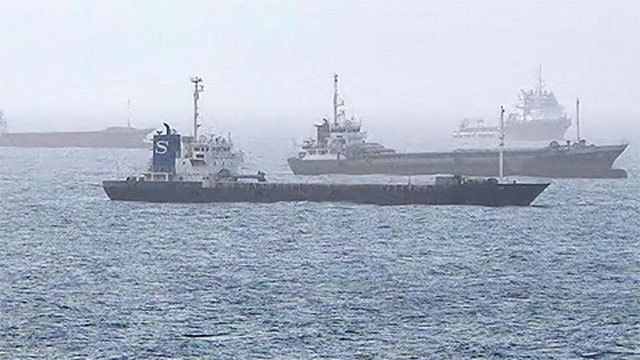
He added that China “stands ready to work with countries in the region to safeguard the security of international shipping lanes” — an offer that carries weight after months of conflict disrupted traffic through the Strait of Hormuz and the Bab al-Mandeb, the two chokepoints that carry much of Asia’s westbound trade.
The two leaders agreed to deepen security cooperation and counterterrorism coordination, Xinhua said. A joint statement committed both sides to expanding cooperation in data centres, semiconductors and critical metals supply chains, and to greater use of each other’s currencies in trade and investment. The third phase of the Egyptian-Chinese industrial zone at the Suez Canal was launched during the visit; the zone currently hosts about 200 companies and some US$4 billion in investment, according to Al Jazeera.
The visit lands as Washington’s regional partners reassess their strategic relationships. Egypt is itself a major US defence partner, receiving roughly US$1.3 billion a year in American military aid, while steadily deepening economic and military cooperation with Beijing. Al Jazeera noted that Saudi Arabia, Turkiye and Pakistan signed the Mecca Defence Alliance last month, an arrangement carrying a NATO-style mutual-defence clause that analysts read as an effort to diversify beyond US security guarantees.
In an article published before the visit, Sisi said Egypt pursued a policy of “strategic balance” amid growing global rivalry. “Egypt wants to widen the circle of its relations with major world powers, including China,” former Egyptian diplomat Ayman Zaineldine told Reuters. “So the visions converge.”