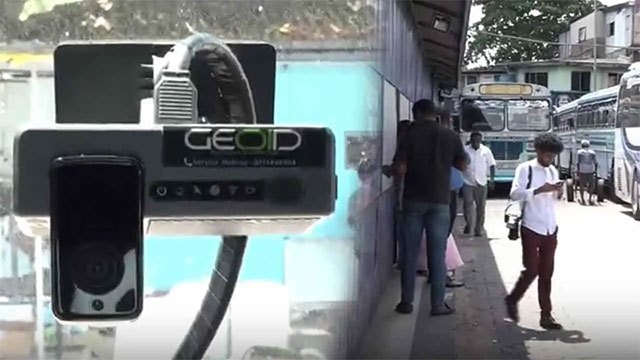
Installation of artificial-intelligence monitoring equipment began on long-distance private buses in Colombo on Saturday (5), the first phase of a pilot project intended to cut road accidents by watching how drivers behave at the wheel.
The equipment was fitted at the Bastian Mawatha Bus Station, Ada Derana reported. The project is coordinated by the National Council for Road Safety and implemented by the National Transport Commission, under the Ministry of Transport, Highways and Urban Development. Ada Derana said it is being carried out under the guidance of Minister Bimal Rathnayake and Deputy Minister Prasanna Gunasena.
Ten buses will be fitted in the initial phase. Both outlets said the technology is to be extended to buses operating islandwide once the first units have been evaluated for effectiveness and operational performance.
The system monitors the interior of the bus and the driver’s actions continuously, from the start of a trip to its completion. Where it detects an unsafe practice — driver drowsiness or fatigue, mobile phone use while driving, or a failure to wear a seatbelt — it issues a warning through a voice message so the situation can be corrected.
Ada Derana was explicit that the equipment is not intended as an enforcement tool: rather than being used to penalise drivers, it reported, the technology is meant to prompt a correction in the moment.
Private intercity buses carry a large share of Sri Lanka’s long-distance passenger traffic and are regulated by the National Transport Commission, which sets fares and route permits. Driver fatigue on overnight and long-haul runs has been a recurring theme in road-safety debate here, but this is the first NTC-backed deployment of in-cab AI monitoring on the network.
Not reported
Neither outlet named the supplier of the equipment, gave its cost, or said who is paying for it. Neither said which routes or operators the first 10 buses run on, how long the evaluation phase will last, or what benchmark the technology must meet before an islandwide rollout is approved. Neither addressed whether footage or driver data is recorded and retained, who has access to it, or whether operators will be able to see it — a question the “not used to penalise drivers” framing raises but does not answer.
The two accounts differ slightly on whose buses these are. Ada Derana describes them as intercity private buses with the NTC as implementing agency; Hiru News describes the devices as going onto “private buses belonging to the National Transport Commission.” Neither reconciles the difference.
Hiru News also does not mention the two ministers, and Ada Derana is the only source for the “not to penalise” characterisation.