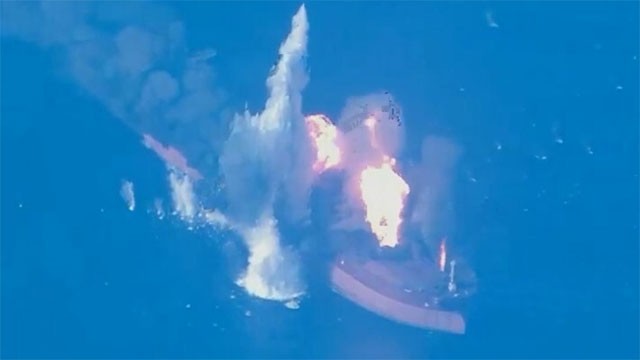
The US military said on Saturday it had struck three Iranian crude oil tankers after the Islamic Revolutionary Guard Corps launched ballistic missiles towards two US Navy warships in the region.
US Central Command said it “permanently disabled” one carrier off Kharg Island and a second near Jask, and “completely destroyed” a third in the Gulf of Oman, Ada Derana reported.
A US aircraft carrier and a guided-missile destroyer “successfully evaded multiple unprovoked Iranian attacks,” Centcom said. No American personnel were harmed.
Iran did not immediately respond to the strikes, and Tehran has not acknowledged attacking the US ships. Iranian state media had reported earlier on Saturday that a tanker was hit near Kharg — the account we reported that morning, when neither government had confirmed anything.
The vessels, named
Hiru News, carrying CNN’s report, named all three: the M/T Downy off Kharg Island and the M/T Stark 1 near Jask were disabled, while the unladen M/T Kylo, also known as the Noxen, was destroyed in the Gulf of Oman. Centcom said the Kylo was struck “in multiple critical locations to render it inoperable after the crew was directed to abandon ship.”
Centcom said the three vessels are “part of a multibillion-dollar shadow network that funds the IRGC and its regional proxies.”
Admiral Brad Cooper, the Centcom commander, said in a statement: “Let the message to the IRGC be clear: If you shoot at two of our ships, we will impose an even higher economic cost — taking out three of yours.” He added that US forces would “not hesitate to defend American forces, and if necessary, destroy Iran’s limited and exposed oil fleet.”
Audio of the warning to a crew
CNN said it had confirmed audio in which a US military aircraft warned the Stark 1 over an emergency channel: “Motor Tanker STARK 1, this is the United States military aircraft. I am preparing to fire at your stern. You have 10 minutes to clear the crew from the stern of your ship. Over.”
A later exchange warned: “This was your final warning… get into your lifeboats and abandon the ship immediately.” Between the two, someone said to be aboard the ship asks the aircraft to stop firing, saying: “We are already destroyed.”
Ship tracking data placed the Stark 1 near Kharg Island a week ago. MarineTraffic records it as built in 2000, with a capacity of 159,681 tonnes.
A financial front as well
The Daily Mirror, carrying CNBC’s account, reported that the strikes came a day after the US Treasury sanctioned a small Turkish investment bank and two subsidiaries — Golden Global Yatirim Bankasi and its Golden Global Varlik Kiralama and Golden Global Portfoy Yonetimi units — accused of moving Iranian oil revenues from China to Turkey to be converted into cash and gold.
It is the second major financial institution targeted under “Operation Economic Outcast,” the Trump administration’s effort to isolate Tehran by sanctioning its business partners.
Where the conflict stands
The strikes follow a week of renewed fighting after a period of relative calm. The US resumed attacks on Sunday, saying it had hit two rocket launchers to stop them being used to lay naval mines in the Strait of Hormuz. Iran retaliated against US targets in the United Arab Emirates, Bahrain, Kuwait and Jordan.
A 60-day ceasefire expired last month with no diplomatic settlement in sight. The US and Israel first launched wide-ranging strikes on Iran on 28 February; Iran responded by attacking Israel, US bases and Gulf states, and effectively closed the Strait of Hormuz.
Iran is OPEC’s third-largest producer and shipped 90 percent of its crude through Kharg Island before the war. On Thursday, US Vice-President JD Vance denied the conflict should be called a “war,” saying there was “no active shooting” — and said he was “extremely sceptical” of Iranian claims that US strikes killed four people, including two children, at a wedding in Sirik, while confirming the US would investigate. The Iranian Red Crescent Society said missile shrapnel hit the ceremony; Tehran called it a war crime.
The Sri Lankan connection
Iranian fuel tankers have been anchored off Galle since the US blockade of Iranian oil exports tightened in mid-April, and the government said last month it was monitoring vessels sitting just outside the exclusive economic zone. The conflict in the strait has pushed energy prices up worldwide.
Update, September 6: Iran says it hit six ships in reply
Iran has retaliated, and Iranian state media has filled in several gaps in the original account.
Iranian state outlet Irib reported that the Islamic Revolutionary Guard Corps struck six ships in the region — three vessels “affiliated” with the United States in unspecified areas, and three oil tankers in the Strait of Hormuz, Ada Derana reported, carrying BBC copy.
The IRGC said the three tankers were using “unauthorised” routes through the strait and warned other shipping not to do the same. Iran has previously targeted vessels taking a southern route through Omani waters that avoids its preferred passage through Iranian waters. The BBC said it had approached Centcom for comment on Iran’s claims.
The crews, answered
Irib’s account resolves the question left open below. It reported that the crews of the two tankers attacked in the Gulf of Oman were taken to shore in lifeboats, and that one of those tankers was empty while the other was carrying oil — consistent with Centcom’s description of the unladen M/T Kylo. Irib also said there were no casualties in the US strike on the tanker near Kharg Island.
This is an Iranian state account of an Iranian loss and has not been independently confirmed.
The threat that preceded it
Ada Derana reported that news of Iran’s retaliation came hours after US Defence Secretary Pete Hegseth wrote on social media: “It’s simple: if Iran shoots at US ships, we will destroy (and sink) their oil tankers.”
The strikes came a day after President Donald Trump dismissed the conflict as “small potatoes,” with little apparent progress towards ending what Ada Derana describes as a six-month war. He had not commented on Saturday’s attacks.
Trump has continued to say the Strait of Hormuz is open despite the Iranian attacks. The waterway has been effectively closed since fighting began in February, and Tehran has said it will not give up some measure of control over it.
Where the accounts differ
Ada Derana, carrying BBC copy, placed the second disabled tanker “near the Strait of Hormuz”; the CNN and CNBC accounts both name Jask, an Iranian port on the Gulf of Oman near the strait’s eastern approaches. The two descriptions are compatible, but only the latter two are specific.
Not reported
Centcom has still not said what became of the crews of the two disabled tankers — Iranian state media says they reached shore in lifeboats, as set out in the update above, but the US has not confirmed it. Neither side has given the vessels’ flags or owners. No outlet reports where the ballistic missiles were fired from, how many were launched, or which carrier and destroyer were targeted. There is no independent verification of Centcom’s claim that its ships were evading attack, and no immediate indication of how oil markets responded.
On the retaliation, Iran has not named any of the six ships it says it struck, given their flags or operators, or said what damage was caused or whether anyone was hurt. Centcom had not responded to the claims at the time of writing, and no outlet reports whether any of the six vessels has been independently identified as damaged.
Sources
- US hits three Iranian oil tankers after saying its warships were targeted — Ada Derana, September 5
- U.S. attacks 3 Iranian oil tankers after missiles target Navy warships — Daily Mirror, September 5
- US military says three Iranian tankers struck in Gulf — Hiru News, September 5
- US and Iran trade retaliatory attacks on ships as conflict flares — Ada Derana, September 6