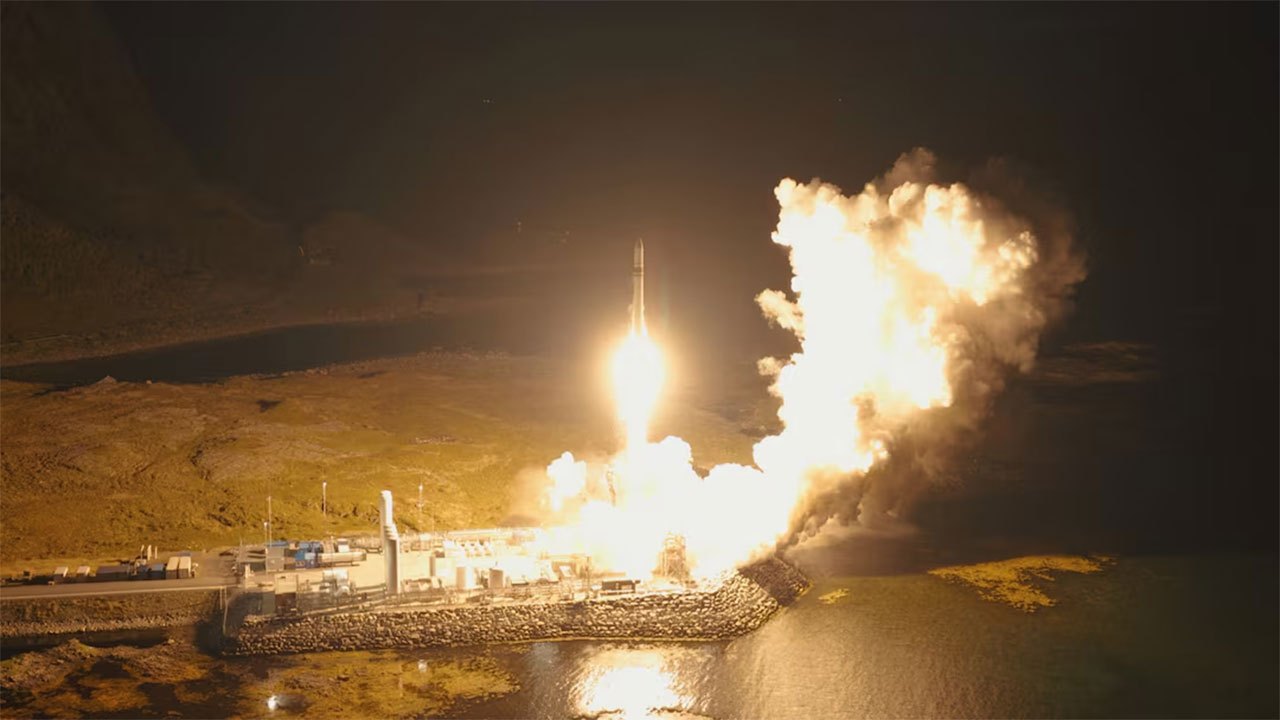
German start-up Isar Aerospace put its Spectrum rocket into orbit from Arctic Norway on Saturday night — the first time a privately developed rocket has reached orbit from continental Europe.
The uncrewed, 28-metre vehicle lifted off from the Andøya Spaceport at 10:12 p.m. (20:12 GMT), NewsFirst reported. It passed 100 km altitude in under four minutes and deployed five small satellites, with the company confirming that “spacecraft separation was completed successfully.” Ada Derana adds that the payload also included an in-flight technological experiment.
“We’re in orbit! And just made European history: This is the first time a privately developed rocket reached orbit from continental Europe.” — Isar Aerospace, on X
Germany’s Ministry for Research, Technology and Space called it a “milestone that impressively demonstrates our country’s innovative strength and technical expertise.” Norway’s minister of industry and commerce, Cecilie Myrseth, said the ability to launch satellites from Andøya “strengthens Norwegian and European security in the turbulent times we live in.”
The second attempt, not the first
Saturday was Isar’s second launch, coming eighteen months after its first rocket plunged into the sea and exploded shortly after takeoff from the same site. Nobody was injured, and the company treated that flight as a partial success for the volume of engineering data it produced.
The date of that failure is reported inconsistently. Al Jazeera places the first test flight in March 2022. Ada Derana, running a Reuters account, dates it to March 2025 and describes Saturday’s flight as coming eighteen months later — arithmetic that fits September 2026 exactly, and that matches contemporaneous international coverage of the crash at the end of March 2025. The 2022 date appears to be an error.
Isar described Saturday’s flight as “both the vehicle’s qualification mission and its first flight carrying payload.”
Why Europe is pushing
Europe has struggled to launch its own satellites since cutting ties with Russia’s Soyuz rockets, leaving Elon Musk’s SpaceX and the Franco-European ArianeGroup — which flies from French Guiana, not Europe — as the main options. German Chancellor Friedrich Merz visited Isar’s launch site in March.
Sweden’s Esrange and Britain’s SaxaVord Spaceport in the Shetland Islands are the nearest rivals to the Norwegian site. Isar said last week it had secured about €200 million (US$232 million) from the European Space Agency to develop new rockets and expand its testing and launch infrastructure.
The commercial launch market has drawn heavy investment this year: SpaceX listed on Nasdaq in June in a record initial public offering, and India flew its first private-sector orbital rocket in July.
Not reported
No outlet identified the five satellites, their operators or their purpose, gave the target orbit, or said whether all five were confirmed healthy after separation. None reported the cost of the launch, Isar’s order book, or when the next Spectrum flight is planned. No figure was given for Spectrum’s payload capacity.
The two Sri Lankan outlets ran different wires — NewsFirst credits DW News and Al Jazeera, Ada Derana carries a Reuters account — which is why their details differ rather than overlap.