The 63rd session of the United Nations Human Rights Council opened in Geneva on Monday with Sri Lanka’s record on human rights, reconciliation and accountability facing renewed scrutiny, and with the High Commissioner’s latest report drawing an explicit line between the country’s rights problems and its corruption cases.
The report treats Sri Lanka’s worst-ever economic crisis as a human rights matter, saying it produced challenges “driven by corruption and fraud”, NewsFirst reported. It refers to the SriLankan Airlines Airbus transaction and its connection to former President Mahinda Rajapaksa, and to investigations into the alleged misuse of public funds involving former President Ranil Wickremesinghe.
Both are referenced as investigations rather than findings.
The Airbus reference lands mid-case
The Airbus matter is not historical. Mahinda Rajapaksa’s son, MP Namal Rajapaksa, was remanded until 18 September over an alleged Rs. 100 million bribe connected to the purchase of aircraft for SriLankan Airlines, and is due to sit in Parliament from remand custody on Tuesday. The Wickremesinghe reference runs alongside the Attorney General’s review of his disputed 2023 UK trip.
The fiscal squeeze, in the report’s own numbers
The report states that 49.38 percent of government revenue in the 2026 Budget goes to interest on debt alone. Adding repayments of principal, 82.59 percent of revenue is required to meet debt obligations — leaving, it says, only a small share for health, education and social protection for poor and vulnerable communities, which it puts at between 1.9 and 2.4 percent of GDP.
Those last two figures are measured against different bases — the 82.59 percent against government revenue, the 1.9–2.4 percent against gross domestic product — and are not directly comparable, though NewsFirst presents them in sequence. NewsFirst describes the document as an advance version.
Land, the PTA and a criticism of the Council’s own project
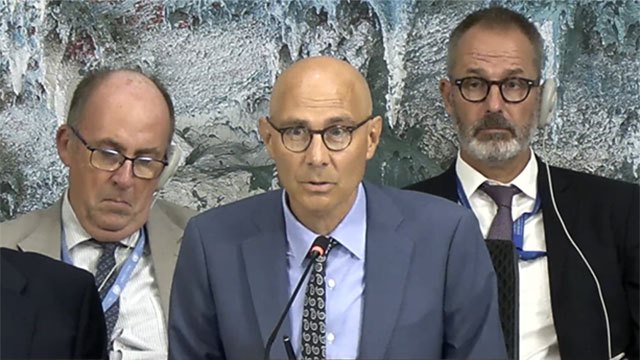
The four-and-a-half-week session runs to 7 October and opened with an address by High Commissioner Volker Türk, Ada Derana reported. The report, released on 3 September, says Sri Lanka remains at a critical point in addressing the legacy of its civil war.
It urges confidence-building measures not previously reported in our coverage of the document: the return of land allegedly occupied by the military in the north and east, preventing further land acquisitions, and accelerating land-titling. It also calls for action on long-term detainees held under the Prevention of Terrorism Act, and on torture, custodial violence and repressive laws.
Türk said the government still had an opportunity to reverse decades of alleged abuse of executive power and entrenched impunity, while acknowledging measures taken on corruption.
Civil-society and human-rights groups, however, have criticised the report for what they describe as insufficient emphasis on the Sri Lanka Accountability Project, established in 2021 to collect, analyse and preserve evidence of alleged violations of human rights and international humanitarian law.
Context
The report’s findings on the Easter attacks, emblematic cases and the PTA were published last week, and the session’s agenda and the form of the Sri Lanka item were set out earlier. Monday’s reporting adds the economic and corruption dimension, the land measures and the criticism over the Accountability Project.
Update, September 7: the accountability finding, and a second report alongside it
Daily Mirror’s account of the same report leads on the core accountability finding rather than the economic material: seventeen years after the war ended, Türk says that while there has been progress in a few significant cases, there has been no recognition or accountability for crimes under international law, gross human rights violations and serious breaches of international humanitarian law committed by all parties to the conflict with the LTTE.
The report assesses the record under President Anura Kumara Dissanayake, whose government took office in September 2024 pledging to pursue justice for past violations.
On the Prevention of Terrorism Act, Daily Mirror reports Türk going further than previously covered: he calls for a moratorium on the PTA pending its repeal, and for the release of people held under it for prolonged periods. The report also says victims’ families and activists, particularly in the Northern and Eastern provinces, continue to face surveillance and questioning by state intelligence agencies.
It urges the government to implement long-delayed legal and structural reforms, repeal repressive legislation, carry out comprehensive security-sector reform and take concrete steps towards reconciliation, warning that failure to do so could further entrench impunity and deepen the trust deficit among victims.
A separate Human Rights Watch report, six days earlier
Daily Mirror also places a Human Rights Watch report of 1 September alongside the UN document. HRW found limited progress in several high-profile cases but little or no movement on enforced disappearances, the killing of aid workers and attacks on journalists. It said the government has yet to fulfil its pledge to establish an independent public prosecutor’s office, or to undertake the legal and structural reforms accountability would require.
HRW’s finding on the Sri Lanka Accountability Project is worth separating from the criticism reported earlier. Civil-society groups faulted Türk’s report for giving the project insufficient emphasis; HRW’s point is different and about the state — that the government has not accepted the project, which the Council established to preserve evidence. The two criticisms run in the same direction but are aimed at different parties.
Not reported
None of the three outlets quotes the report’s language on the two former presidents directly, names the investigations referred to, or says whether Sri Lanka responded in the Council on Monday.