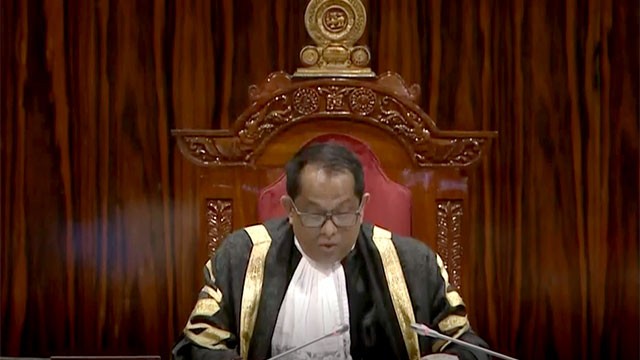
The Supreme Court has found three clauses of the Chartered Institute of Media Professionals of Sri Lanka Bill inconsistent with the Constitution, Speaker Dr. Jagath Wickramaratne told Parliament on Tuesday, meaning the bill cannot pass by a simple majority unless those clauses are deleted or amended as the court has directed.
The bill had been challenged before the Supreme Court under Article 121(1) of the Constitution. The Speaker ordered that the full determination be printed in the Official Report of the day’s proceedings.
What the court found
Clause 3(1) was held to be vague and inconsistent with Articles 12(1) and 14(1)(g) of the Constitution. It may be passed only with the special majority required under Article 84(2) — unless the clause is dropped altogether.
Clause 4(o) was also found inconsistent with Articles 12(1) and 14(1)(g), and likewise requires a special majority. The inconsistency would cease if the clause is amended in the manner the court proposed.
Clause 5(4)(b) was found inconsistent with Article 12(1) alone, again requiring a special majority unless amended as recommended.
All remaining provisions of the bill were held to be constitutional.
Outlets rendered the clause numbering differently: NewsFirst gives the three as 3(1), 4(o) and 5(4)(b), while Ada Derana wrote them as 3.1, 4.0 and 5.4(b). The substance reported by both is identical.
Why those articles matter
Article 12(1) guarantees equality before the law. Article 14(1)(g) guarantees the freedom to engage in any lawful occupation, profession, trade or business.
That second guarantee goes to the heart of what press-freedom organisations objected to when the bill was gazetted in June. The Sri Lanka Working Journalists Association demanded the draft’s withdrawal, warning that its ministerial appointment and disciplinary powers would amount to “a police to punish journalists,” and critics noted that the bill’s sweeping definition of “media professional” — covering journalists, editors, broadcasters, technicians and content creators — could bring ordinary online publishers under a statutory body’s disciplinary reach.
The bill was tabled in Parliament on July 23 without the text being revised in response to those objections.
Neither the Government nor the Ministry of Health and Mass Media said on Tuesday whether it will accept the court’s amendments, drop the clauses, or seek the two-thirds majority. No date has been set for the second reading.
Update, September 8: first organised opposition to a two-thirds route
The Dinana Dakuna Collective has said that any attempt to pass the disputed clauses using a two-thirds parliamentary majority would be a grave assault on democracy, in a media release reported by Hiru News.
The collective’s statement supplies the determination’s case number — S.C.S.D. 27/2026 — which none of Tuesday’s parliamentary reports carried, and confirms that the court found the bill does not require a national referendum. It renders the first disputed clause as 3(i), a third variant alongside NewsFirst’s 3(1) and Ada Derana’s 3.1.
It sets out what the collective says the court gave particular attention to: accreditation powers conferred without clear legal definitions, the placing of the entire media sector under the proposed institute’s oversight and control, and rulemaking authority granted to an interim governing council outside parliamentary control.
Passing those clauses by special majority would, the collective argued, obstruct independent, investigative and regional journalists, and expose social media platforms, YouTube channels and alternative media to arbitrary control. Using parliamentary numbers to legalise provisions the court has identified as inconsistent with fundamental rights undermines both the judiciary and constitutional safeguards, it said.
The collective called on the Government and Parliament to remove the contentious clauses, and urged media organisations, civil society activists, trade unions and the public to unite against a two-thirds route. This is the first organised objection reported since the determination was delivered; the Government has still not said which of the three courses open to it it will take.
Sources
- Speaker delivers SC determination on Chartered Institute of Media Professionals Bill — Ada Derana, September 8
- Supreme Court Says Media Professionals Bill Requires Amendments or Special Majority — NewsFirst, September 8
- Some clauses of Chartered Institute of Media Professionals Bill inconsistent with Constitution — Daily Mirror, September 8
- Special majority required to pass Institute of Chartered Media Professionals bill — Hiru News, September 8
- Dinana Dakuna warns against passing disputed media bill clauses — Hiru News, September 8