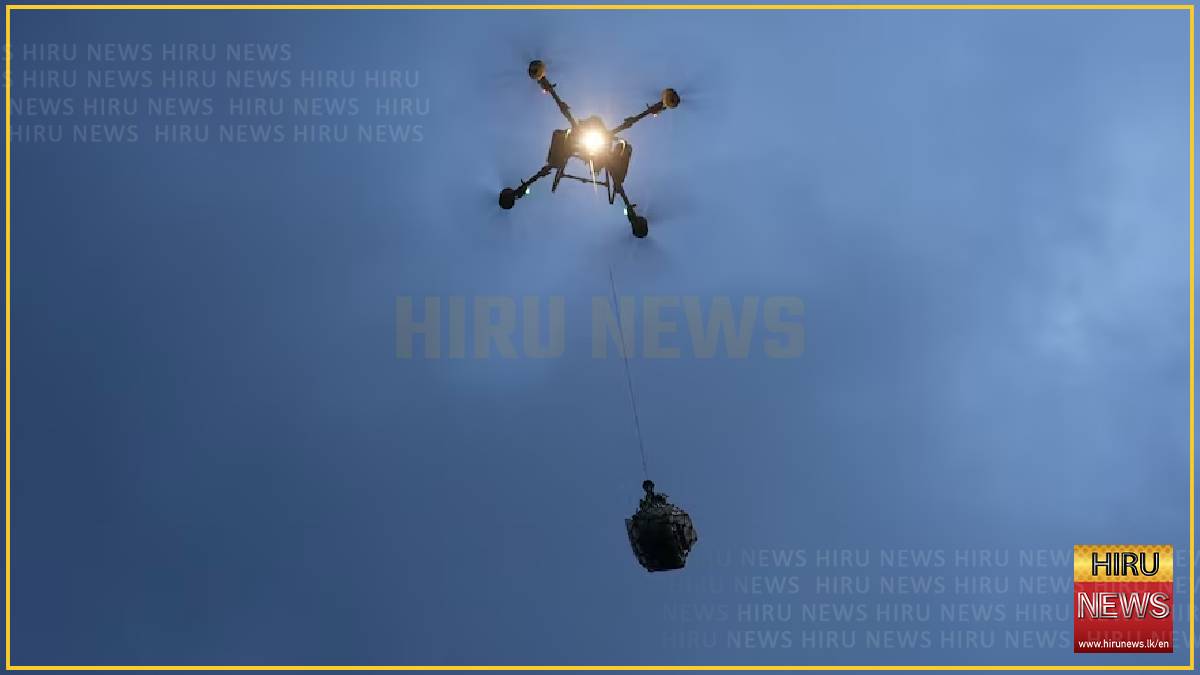
With roads and bridges destroyed and its helicopter fleet committed to search and rescue, Nepal’s army has turned to cargo drones to move food, medicine and fuel to people displaced by last month’s floods.
The army is now making around 10 to 16 aid deliveries a day using four DJI FlyCart 100 drones, all donated by China as part of a recent aid package, according to a Reuters report carried by Hiru News.
What the drones can and cannot do
The aircraft are flown over distances of three to four kilometres and can carry up to 60 kilograms per run — enough to matter in a valley cut off by a washed-out bridge, but a fraction of a helicopter load.
“Most of our helicopters are busy with rescue operations. There is no other way to send food, essentials, medicine and fuel, except for drones, which are the best option to utilise, and we should prioritise them more,” said Santosh Budhathoki, a contract drone pilot working for the Nepal army.
Beyond aid delivery, drones have been used to move the bodies of flood victims in some areas, and reconnaissance drones have been used heavily in search and rescue.
“We’ve been operating back and forth early in the morning. So yes, it is quite hectic, because we need to have this thing right now,” said Milan Pandey of Airlift Technology, the drone operating company. “Nepal has this geography, this terrain where drones would be really faster, quicker and cheaper.”
The toll, and which way it is moving
At least 1,367 people are confirmed dead and more than 5,000 remain missing since a Himalayan glacier broke off near the Nepal–China border in late August, sending destruction down the river systems below.
Read against earlier counts, the two figures are moving in opposite directions. On 30 August the official toll stood at 675 dead. By 5 September wire reports put it at more than 1,300 dead and over 5,600 missing. The confirmed dead has since risen again, while the missing count has fallen by several hundred — the pattern expected as people are traced or as the missing are reclassified among the dead. The report does not say which.
Sri Lanka’s involvement
Colombo deployed relief teams at the end of August and approved a US$1 million aid package at cabinet on 1 September. A Sri Lankan family related to former cricketer Muttiah Muralitharan remains among those unaccounted for.
Not reported
The report does not say how many displaced people the drone runs are reaching, how the four aircraft are distributed across the affected districts, or whether more are being sought. It also does not say how long the helicopter fleet is expected to remain committed to search and rescue rather than resupply.