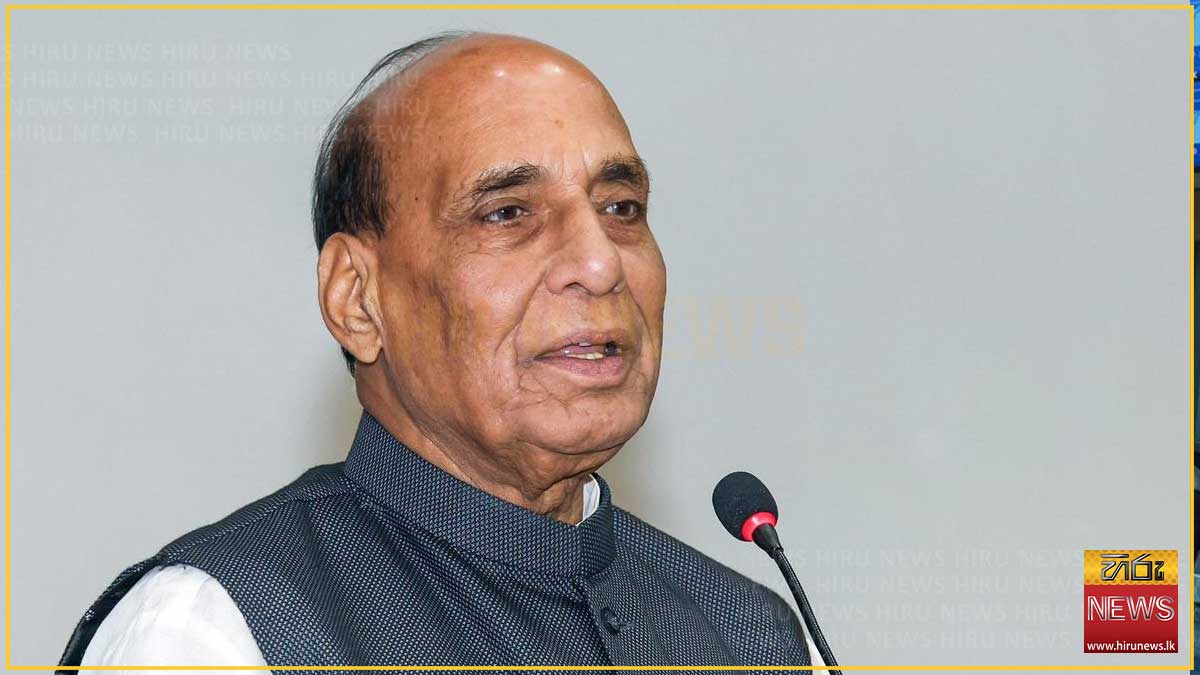
India and Sri Lanka will work together to create an Artificial Intelligence laboratory for the Sri Lanka Army, visiting Indian Defence Minister Rajnath Singh said on Wednesday evening, adding a capability commitment to a day that had already produced three exchanged defence agreements.
Singh made the announcement at a deck reception aboard INS Udaygiri in Colombo, the Indian news agency ANI reported.
“Let me reiterate that India remains a committed partner for the capacity enhancement of the Sri Lankan Armed Forces. Going ahead, we will also be working together for creation of an Artificial Intelligence Lab for Sri Lankan Army for its capability enhancements.”
The ship, which arrived in Colombo on Monday, also carried defence equipment supplied under India’s Defence Diplomacy initiative: spares for the Indra MK 2 radar used by the Sri Lanka Air Force, spares for the naval vessel SLNS Sayura, and inflatable targets for the Navy. That answers the standing question of what the port call was for.
A maritime domain awareness system, jointly owned
Earlier at the Ministry of Defence, Singh told Sri Lankan officials that national security, economic growth and development “cannot be viewed in isolation from geography,” and that neither country can afford indifference to regional developments affecting trade and freedom of navigation, Hiru News reported.
He quoted the naval strategist Alfred Thayer Mahan — “who rules the sea rules the world” — and said he hoped the two countries would become joint stakeholders in an integrated maritime domain awareness system sharing real-time information. Cooperation between navies, coast guards and other agencies would help counter illegal fishing, suspicious vessel tracking, narcotics trafficking, human trafficking, piracy and terrorism. He cited the Colombo Security Conclave and the Maritime Rescue Coordination Centre as existing proof of that commitment.
Singh addressed the dispute involving northern fishermen as a livelihood question, calling for disputes to be handled “with care and concern” alongside maritime law enforcement and stronger preventive systems. Beyond security, he proposed an institutionalised structure for economic cooperation in fisheries, aquaculture, marine biotechnology, ocean science, environmental protection and maritime tourism.
What the President asked for in return
The President’s Media Division account of the same meeting leads on a different subject entirely. President Anura Kumara Dissanayake briefed Singh on Sri Lanka’s recently launched national anti-drug programme and said that, with the Indian Ocean now “a hub for drug trafficking,” Sri Lanka expects India’s fullest support against the illicit drug trade, EconomyNext reported.
The President went further, expressing confidence that India would help extradite Sri Lankan drug traffickers currently serving prison sentences in India — a specific and previously unstated request. Sri Lanka has spent the past fortnight pursuing suspects abroad, including Konda Ranji, deported from Dubai.
On the question India cares most about, the PMD quotes the President saying Sri Lanka will continue to support peace in the Indian Ocean and that, “as a sovereign state, Sri Lanka enters into various agreements with countries around the world while remaining mindful of regional security” — a formulation that concedes India’s security interest without limiting Colombo’s freedom to sign with others.
Not reported
None of the three accounts gives a timetable, location or cost for the AI lab, or says which Indian institution would build it. Neither Sri Lankan outlet reports the deck reception at all, and neither Indian nor Sri Lankan reporting confirms whether the wreath-laying at the IPKF Memorial in Battaramulla — listed on the police traffic plan for the visit — took place.
Sourcing note
Ada Derana was returning a CloudFront 403 across its entire domain while this was written, and Daily Mirror and NewsFirst had filed nothing on either engagement. The AI lab announcement rests on a single Indian wire report.
Sources
- Sri Lanka President urges Indian Defence Minister to back anti-drug trafficking campaign — EconomyNext, September 9
- National security and economic growth cannot be viewed in isolation, says Rajnath Singh — Hiru News, September 9
- India to assist Sri Lanka in creating Artificial Intelligence facility for Lankan Army, says Rajnath Singh — ANI, September 9