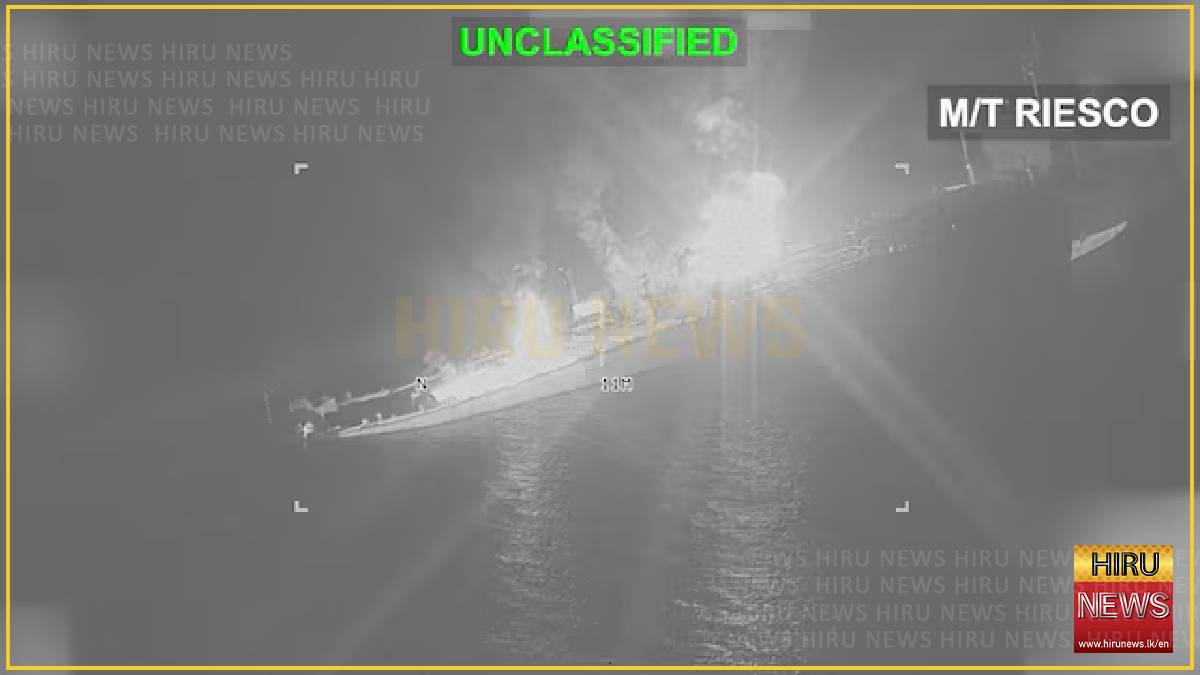
A tanker holding about 2 million barrels of Iraqi fuel oil was struck in Iraqi territorial waters on Wednesday, and Iran said it had attacked 10 ships near the Strait of Hormuz — the largest declared wave of tit-for-tat attacks on shipping since the US–Iran war began six months ago.
Fire broke out aboard the Panama-flagged New Andros after it was hit at around 6 a.m. (0300 GMT), two Iraqi port officials told Reuters. There were no casualties among the 22 crew, the officials said. Both the Daily Mirror and Hiru News carried the Reuters account.
Iraq’s oil ministry said later on Wednesday that the vessel — used to store fuel oil rather than move it, and chartered by the Iraqi Oil Tankers Company — sustained minor damage to its hull. It confirmed no injuries and no leakage of cargo into the water.
What hit it is not established
The reporting does not settle the weapon. The Reuters lead says the tanker was struck by a drone, citing port officials. Iraq’s oil ministry says only that it was hit by an unknown source. Hiru News headlines it as an unknown projectile.
Those are three different degrees of certainty about the same event in a single wire story, and no party has claimed the strike on the New Andros specifically.
The wider pattern overnight
The United Kingdom Maritime Trade Operations agency — the Royal Navy-affiliated body that tracks threats to merchant shipping — said vessels in the northern Gulf and the Gulf of Oman were hit by disabling fire during military activity overnight. It said it could not confirm casualties or environmental impact.
UKMTO reported a separate incident on Wednesday 24 nautical miles from Port Rashid in the United Arab Emirates, where a vessel was seen listing at anchor, possibly having taken on water after being struck by an unknown projectile.
Iran’s declaration of 10 attacked ships followed the US sinking of five Iranian oil tankers, which Washington said was retaliation for two Iranian attempts to hit a US Navy warship.
How this escalated
The strikes on the five Iranian tankers were reported on Tuesday, when US Central Command described the vessels as part of a “shadow network” funding the IRGC, and Iran fired 20 ballistic missiles at a base in Jordan. At that point the IRGC Navy had warned crews on tankers near Kuwaiti and Bahraini ports to abandon their vessels. Wednesday’s attacks are the follow-through on that warning, extended across the northern Gulf.
Secretary of State Marco Rubio had said on Tuesday that the pattern would hold: “for every time they do that, or try to do that, they’re going to lose tankers.” Both sides are now striking commercial shipping rather than only naval or state targets.
The price is already moving
Brent crude passed $100 a barrel on Wednesday for the first time since 24 July, up 2.2 per cent, with Goldman Sachs, Bank of America and HSBC all raising forecasts in recent days. That move was driven principally by Houthi strikes on Saudi energy facilities, which threatened the Red Sea corridor — the main alternative route while Hormuz traffic has been curtailed.
Attacks on merchant vessels inside the Gulf compound that. Hormuz was already the constrained artery; disabling fire in the northern Gulf and the Gulf of Oman raises the risk on the approaches to it as well.
What it means for Sri Lanka
Sri Lanka imports effectively all of its crude and refined fuel, so a sustained rise in freight and insurance costs on Gulf routes feeds directly into the import bill and, in time, into administered fuel prices. The Ceylon Petroleum Corporation has not commented on the week’s disruption.
The war is also visible in Sri Lankan waters. The Foreign Minister told Parliament this week that 47 vessels are anchored beyond the country’s maritime boundary after a US Embassy approach — anchorages that reflect the same shipping disruption now producing casualties in the Gulf.
Not reported
Neither report identifies who owns or operates the New Andros, where it was anchored, or whether the fire was extinguished. Neither names any of the 10 ships Iran says it attacked, gives their flags or cargoes, or says whether the claim has been independently verified — nor whether the New Andros and the Port Rashid vessel are among them. No casualty figure is given for the overnight disabling fire, and no shipowners’ association, insurer or the International Maritime Organization is quoted. There is no assessment of the effect on Iraqi export volumes.