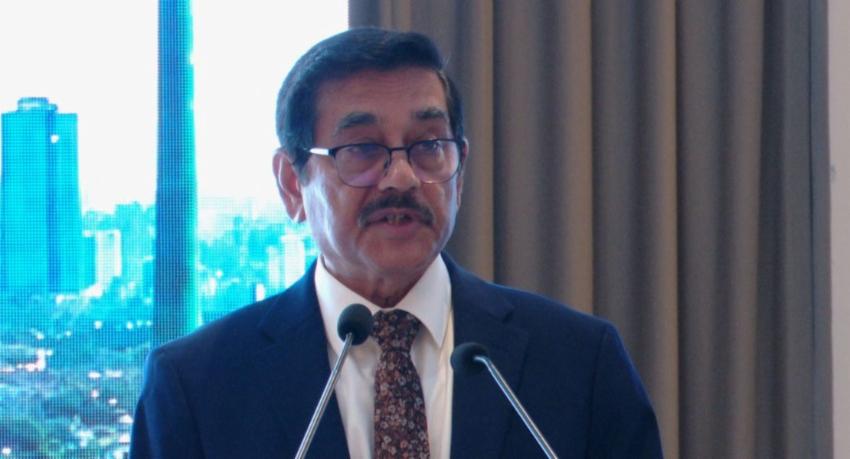
Central Bank Governor Dr. Nandalal Weerasinghe told an international reserve management conference in Colombo on Thursday that rebuilding Sri Lanka’s foreign reserves cannot be pursued at any cost, and that geopolitical risk has stopped being something a reserve manager can treat as external.
“The geopolitical risk can no longer be treated as something external to the investment process. It has become an integral part of reserve management,” he said, according to NewsFirst.
The conference is the one our September 3 report previewed — a two-day event at The Kingsbury on 10 and 11 September, hosted by the Central Bank.
The three routes he ruled out
The substance of the speech was a set of exclusions. Reserves cannot be accumulated through market distortions, money printing or heavy foreign borrowing, EconomyNext reported, because excessive intervention distorts price signals, monetary financing feeds inflation, and commercial debt simply moves the burden into the future.
“We can’t accumulate reserves at any cost. We have to be very mindful about overall macroeconomic stability,” Weerasinghe said.
“A sustainable reserve accumulation strategy is not merely about acquiring reserves; it is about building an economy that naturally generates and retains foreign exchange.”
That distinction matters against the Central Bank’s own recent record. It bought a net US$579 million from the domestic market in August, its largest monthly absorption since March 2024, taking net purchases for the first eight months of 2026 to US$1,484 million. The Governor’s framing places a limit on how far that route can be pushed.
2022 as the reference point
Weerasinghe returned repeatedly to the crisis. “Sri Lanka knows this particularly well. As the economic crisis in 2022 demonstrated, in the most tangible way, what happens when external buffers become inadequate. Reserves become critically low.”
Depleted buffers crippled imports, accelerated inflation and triggered the default, EconomyNext reported him saying. He described reserves as “a country’s — a nation’s — first line of defense against external shocks,” and as national savings that buy time and policy space before a correction turns disorderly.
He credited bilateral support from the Reserve Bank of India during that period as an example of regional resilience.
On the recovery, he was measured rather than triumphal: “Since the crisis, Sri Lanka has undertaken a comprehensive process of macroeconomic stabilization and structural reforms. It has demonstrated considerable resilience and the external sector has strengthened substantially compared with the difficult period that we had during 2022-2023.”
But: “Building reserves is not a linear process. You can accumulate reserves during favourable periods, but external shocks can bring them down very quickly.”
A different question than “how much”
Weerasinghe argued the headline reserve number is the wrong thing to watch.
“The relevant questions are not simply how much reserves do we have today. We must ask: How resilient are those reserves? How accessible are those reserves? How quickly can they mobilize liquidity? And ultimately, will they be sufficient for the next shock that we never know when it will materialize?”
Adequacy should move beyond months of import cover to account for debt servicing, volatile capital flows and climate shocks, he said. On the traditional trio of safety, liquidity and return, he put adequacy ahead of yield: “Before asking how to maximize returns, we must ensure that reserves are sufficient for their intended purposes. A portfolio that is too small cannot be made safe simply by earning a higher return.”
He gave the same warning about diversification. “Diversification can reduce concentration risk, but diversification for its own sake can introduce complexity and reduce liquidity. Therefore, diversification should be based on clearly identified risks and objectives.”
Reserve frameworks, he said, must now price jurisdictional risk, sanctions risk, settlement risk, counterparty risk, market-access risk and geopolitical concentration risk alongside conventional financial metrics.
The AIIB Treasurer on gold and the dollar
Domenico Nardelli, Treasurer of the Asian Infrastructure Investment Bank — named as a speaker in the Central Bank’s published programme a week ago — dismissed the idea of an imminent dollar collapse, noting the currency still accounts for roughly 57 percent of allocated global reserves.
Gold has hit record levels, he said, but pays no yield and carries sharp price swings. Even nominally safe assets such as US Treasuries expose reserve managers to volatility.
His argument was that liquidity should be paid for rather than resented: “Liquidity carries an inherent cost of carry. Rather than viewing this financing drag as lost yield, institutions must treat it as an essential insurance premium.” He cited historical merchant bank failures and the 2023 collapse of Silicon Valley Bank as cases where ample liquid buffers bought the time needed to reassure markets.
The dollar’s position, quantified
In a second NewsFirst report on the same address, Nardelli put numbers to the point. The dollar’s share of official global reserves has declined gradually over time but still stood at about 57% in the first quarter of 2026, against global official foreign exchange reserves of roughly US$13 trillion. US Treasury markets remain among the deepest and most liquid in the world.
“The US dollar remains the dominant reserve currency,” he said. “The international financial system remains deeply anchored in dollar liquidity.”
He rejected the de-dollarisation reading of recent reserve shifts. Investors are not abandoning the currency, he argued, but diversifying: “Global investors, instead of rushing to abandon US dollar assets, are looking to improve one key feature in their portfolio, and this is diversification.”
The driver he named is jurisdictional concentration: “In today’s world, with the rise of geopolitical conflict, why would you want to tie your assets to one single jurisdiction given the possibility of those assets being impacted by an increasingly volatile geopolitical climate?” And: “In theory, the more fragmented the geopolitical environment becomes, the stronger the case for more diversification” — though “we should be mindful that diversification also has a cost.”
That caution converges with the Governor’s own warning against diversification for its own sake, from a different direction.
Why gold, specifically
Nardelli’s case for gold rests on what it is not exposed to: “Gold has intrinsic value.” Unlike most financial assets it does not depend on the creditworthiness of any government or institution, which is what lets it function as insurance during geopolitical instability and market turmoil — the same asset his yield objection counts against.
The Florentine precedent
The historical case he cited is more specific than “merchant bank failures.” Nardelli named the Bardi and Peruzzi houses of 14th-century Florence, then among Europe’s leading financial institutions, which lent heavily to the English crown during the Hundred Years’ War expecting repayment when the fighting ended. The war dragged on, the debts went unpaid and both houses collapsed. “A great depression followed for more than a decade around Florence and the surrounding area.”
His summary of the standing risk: “However strong your liquidity policy, it is always one shock away from being tested. And when the unexpected happens, it tends to happen fast.”
Two discrepancies in the reporting
The outlets disagree on who delivered the keynote. NewsFirst says Weerasinghe delivered the keynote address; EconomyNext says Nardelli attended as chief guest and delivered the keynote address. Both men clearly spoke at length, and neither report resolves the billing.
NewsFirst also calls the event the Central Bank’s inaugural “Resource Management Conference”. EconomyNext, and the Central Bank’s own programme as reported on September 3, call it a reserve management conference. The subject matter throughout is foreign reserves.
Update (September 17): the Central Bank’s own account, and who was in the room
A week after the conference closed, the Central Bank issued a summary of it, reported by EconomyNext on Thursday morning.
Its substance restates what was reported on the day — the Governor’s position that sustainable reserve accumulation “must be underpinned by sound external-sector fundamentals and an economy capable of generating and retaining foreign exchange,” and his argument that geopolitical developments, fragmentation, sanctions, trade tensions and market disruptions have become an increasingly important consideration for reserve managers. Domenico Nardelli is described simply as having shared his perspectives on the evolving international financial landscape, without the billing dispute the day-of reports left unresolved.
“The conference provided a timely forum to consider the changing nature of reserve management and the importance of remaining agile, forward-looking and resilient in an increasingly complex and uncertain global environment,” the Central Bank said.
The attendance list closes a gap
What the statement adds is the one thing neither the day-of coverage nor our September 3 preview could supply: which institutions actually attended. Thirteen are named —
Asian Infrastructure Investment Bank, Asian Development Bank, Banque de France, Bank for International Settlements, Bank Indonesia, Bank Negara Malaysia, Bank of Korea, Bank of Thailand, Inter-American Development Bank, Reserve Bank of India, Swiss National Bank, World Bank and the World Gold Council.
That is a wider institutional field than the published speaker list implied, and it includes the Bank for International Settlements and four regional Asian central banks that had not been named anywhere in the advance programme. The Reserve Bank of India’s presence is worth noting against the Governor’s own remarks: he had credited bilateral support from the RBI during the 2022 crisis as an example of regional resilience.
The Central Bank’s closing framing is that the conference let participants draw on diverse international experiences, share lessons and strengthen professional networks among central banks, international financial institutions and market participants.
Not reported
Neither outlet gives a current gross official reserves figure, states a target level or timetable for rebuilding, or says whether the Central Bank intends to change its own reserve composition — including any change to its gold holdings — in response to the risks the Governor listed. Neither reports whether NewsFirst’s “inaugural” describes the conference as a new annual fixture.
The Central Bank’s own week-later summary does not resolve those points either. It names the participating institutions but not the number of delegates, does not say who funded or co-hosted the event, does not record any outcome, commitment or follow-up beyond the exchange of views, and does not say whether the conference will be repeated. It also passes over both discrepancies noted above — who delivered the keynote, and whether the event was a “reserve” or a “resource” management conference — without addressing either.
The remarks were delivered on the same day an IMF staff mission arrived in Colombo for the seventh review of the Extended Fund Facility and the 2026 Article IV consultation, a programme under which reserve accumulation is measured against floor targets. Neither report links the two.
Sources
- Sri Lanka cannot build reserves at any cost, must prepare for shocks: Central bank — EconomyNext, September 10
- Why Must Sri Lanka Strengthen Buffers in an Uncertain World? — NewsFirst, September 10
- US Dollar Remains Dominant, But Gold Gains Ground as Safe-Haven Asset — NewsFirst, September 10
- Central bankers meet in Sri Lanka to discuss reserve strategies — EconomyNext, September 17