Latest (Friday): The reasoning behind the judgment has now been reported. Justice De Silva held that a pardon is not a private act of grace, that the Presidential Secretariat held no record of why the pardon was granted, and that the President must give reasons. Jump to the reasoning.
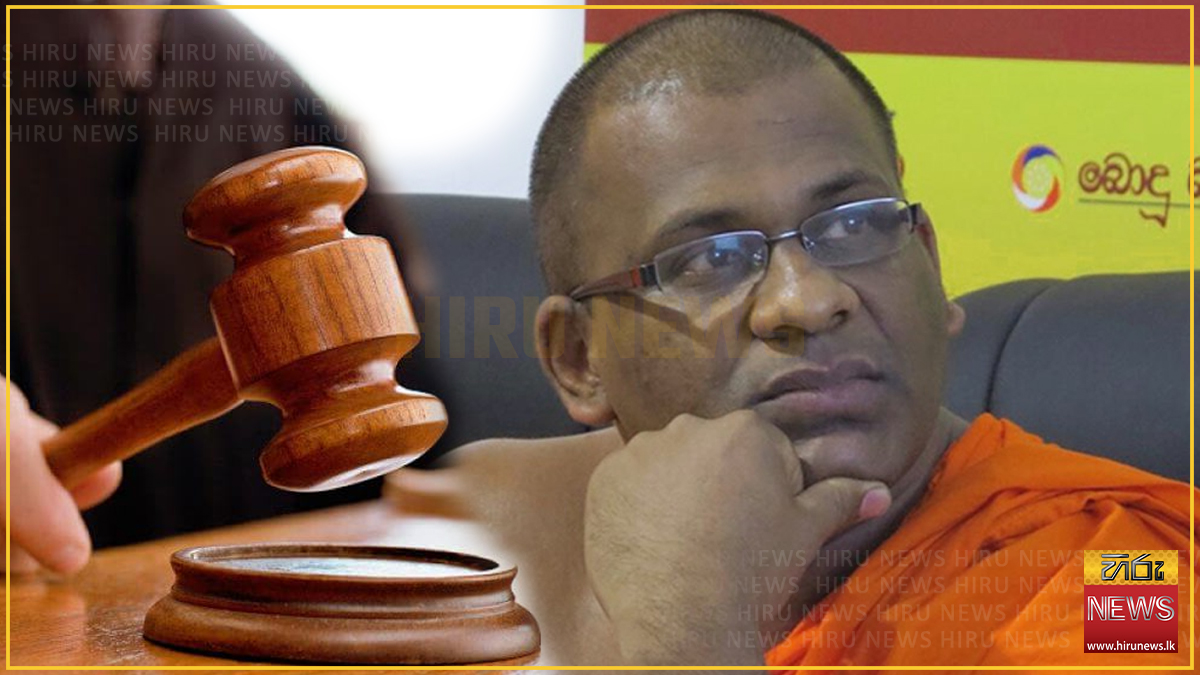
The Supreme Court ruled on Thursday that former President Maithripala Sirisena’s decision to pardon Bodu Bala Sena general secretary Ven. Galagoda Atte Gnanasara Thera was arbitrary and invalid in law, the Daily Mirror reported.
A three-judge bench headed by Justice Janak De Silva delivered the judgment on fundamental rights petitions filed by the Centre for Policy Alternatives (CPA) and Sandhya Ekneligoda, wife of the missing journalist Prageeth Ekneligoda.
Hiru News reported the court declared the pardon null and void.
The conviction the pardon erased
The sentence set aside by Sirisena was for contempt of court, not for any of the monk’s better-known religious-hatred cases.
Gnanasara Thera was convicted over his conduct inside the Homagama Magistrate’s Court on 25 January 2016, during proceedings in the case of Prageeth Ekneligoda, the journalist and cartoonist who disappeared in January 2010.
In August 2018 the Court of Appeal sentenced him to 19 years of rigorous imprisonment, to be served concurrently as six years. The Supreme Court upheld that judgment on 5 October 2018. He was released from Welikada Prison on 23 May 2019 after the pardon.
Hiru’s account gives the Court of Appeal sentence simply as six years. The Daily Mirror’s fuller version — 19 years across the counts, running concurrently as six — reconciles to the same term. NewsFirst also reports six years, putting two of the three outlets on the shorter form of the same sentence.
NewsFirst describes the successful petition as a fundamental rights application filed by “a group including” Sandhya Ekneligoda, consistent with the Daily Mirror’s account of petitions brought by the CPA and by Ekneligoda. It confirms the court heard and concluded the matter before delivering the ruling on Thursday, and — like the other two outlets — does not say what the judgment means for the unserved balance of the sentence.
Which pardon this is
Gnanasara Thera has received more than one presidential pardon, and Thursday’s ruling touches only the first.
The 2019 pardon quashed today covers the contempt conviction. A separate pardon followed his 2022 conviction for inciting religious hatred. He also currently faces indictments in the Colombo High Court over remarks said to insult Islam, a live prosecution unaffected by this judgment, in which he was granted bail in April.
Counsel
Viran Corea, PC, with Luwie Ganeshathasan and Khyati Wikramanayake appeared for the CPA. Counsel Asthika Devendra, with Pulasthi Hewamanne, instructed by Manjula Balasuriya, appeared for Sandhya Ekneligoda.
Thishya Weragoda, with Sanjaya Marambe and Iresh Senevirathne, appeared for Gnanasara Thera. Faiszer Musthapha, PC, with Pulasthi Rupesinghe, appeared for former President Sirisena.
Not reported
Neither outlet says what the ruling means in practice — whether Gnanasara Thera must return to custody to serve the balance of the six-year term, or whether the judgment is declaratory only. That is the central unanswered question, and both reports stop short of it.
Neither gives the reasoning behind the finding of arbitrariness, states which constitutional provision the pardon was held to offend, says whether the court made any order against the former President personally, or reports how much of the sentence had been served before the May 2019 release. Neither says how long the petitions had been pending, and neither carries a response from Sirisena, from Gnanasara Thera or from the Bodu Bala Sena.
The reasoning was reported the following day — see the update below. The remaining gaps stand.
Update (Friday): the court’s reasoning
The Daily Mirror published an account of the judgment’s reasoning on Friday morning, reporting that the court stressed the President exercises the executive power of the People in trust, and must exercise it in the public interest.
A pardon is not a private act of grace. Delivering the judgment, Justice Janak De Silva observed that a Presidential pardon is not a private act of grace exercised for the benefit of the President or for the advancement of any personal, political or other self-serving interest. The power to pardon is a constitutional power derived from the sovereignty of the People, and must be exercised towards an end consistent with the public interest.
No reasons existed anywhere on the record. The court observed that the records kept at the Presidential Secretariat contained no reasons for the decision to pardon Gnanasara Thera, and that the former President had also failed to state reasons in his affidavit. This is the concrete finding underlying the conclusion of arbitrariness that Thursday’s reports gave without explanation.
The duty to give reasons. Justice De Silva held that the President must remain accountable for decisions taken in the exercise of constitutional powers and must furnish reasons for them. The requirement exists so that a court can determine whether the power was exercised within the limits the Constitution prescribes, and to ensure that the exercise of presidential power remains subject to effective judicial scrutiny.
Why the pardon was reviewable at all. The judgment notes that before the 19th Amendment the President enjoyed immunity for acts done in the capacity of President. The 19th Amendment removed that immunity and rendered presidential acts justiciable. The pardon was granted in May 2019, while the 19th Amendment was in force.
The separation-of-powers framing. The judgment further observed that the judiciary exercises the judicial power of the People and therefore constitutes a constitutional check on the legislative and executive powers, exercised respectively by Parliament and the President.
The finding that no reasons were recorded lands while the government is separately working on the problem. A committee headed by retired Supreme Court Justice S. Thurairaja has recommended establishing a formal procedure for presidential pardons, and Justice Minister Harshana Nanayakkara said in August that its report would go to Cabinet. Neither the Daily Mirror nor any other outlet connects the judgment to that work.
What the update still does not answer
The Daily Mirror’s report does not address the practical question left open on Thursday — whether Gnanasara Thera must return to custody to serve the balance of the six-year term. It does not name the specific constitutional article the pardon was held to offend, say whether any order was made against Sirisena personally, or report any response from the former President, from Gnanasara Thera or from the Bodu Bala Sena. No other newsroom had filed on the reasoning at the time of writing.
Sources
- Supreme Court invalidates presidential pardon granted to Gnanasara Thera — Daily Mirror, September 10
- Supreme Court invalidates Sirisena’s pardon to Gnanasara thera — Hiru News, September 10
- SC Overturns Presidential Pardon for Gnanasara Thero — NewsFirst, September 10
- President cannot exercise executive power for self-interest: Supreme Court — Daily Mirror, September 11