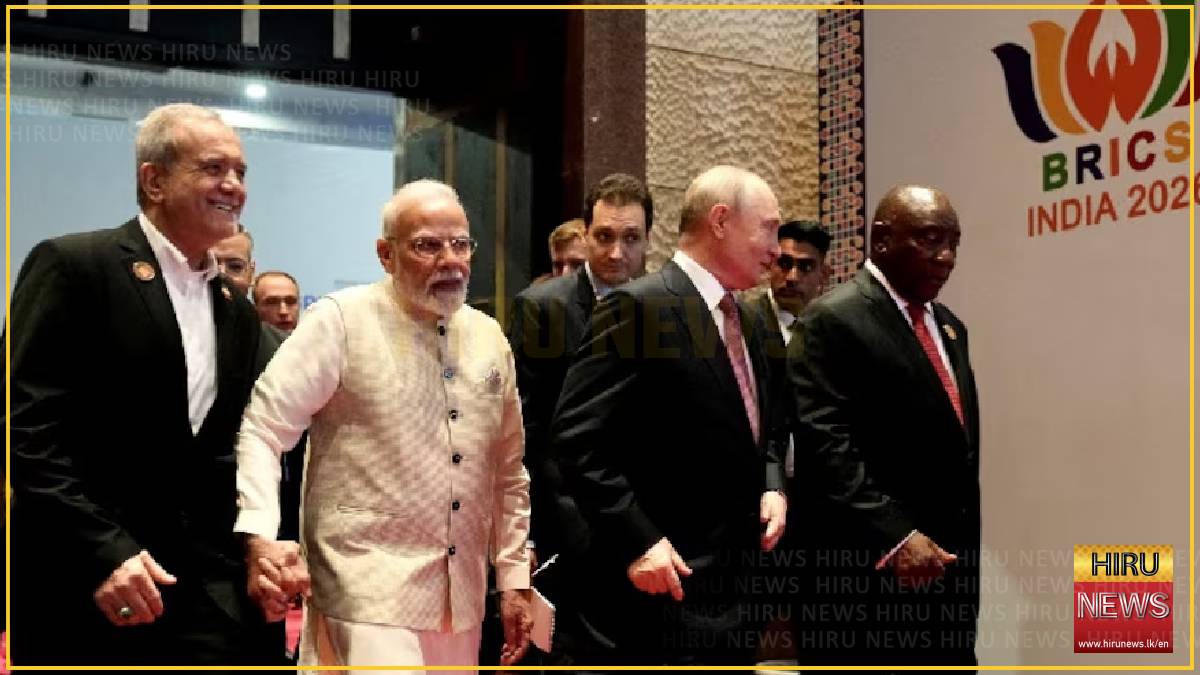
The 18th BRICS Leaders’ Summit opened in New Delhi on Saturday with the bloc agreeing a joint declaration — the outcome that had been in doubt ahead of the summit because members Iran and the United Arab Emirates sit on opposing sides of the Gulf war.
Negotiators settled on text that does not name any country but condemns unilateral war by any state, four sources told Reuters, carried by Hiru News. BRICS foreign ministers meeting in New Delhi in May had failed to issue a joint statement, blocked by the same Iran–UAE split.
What the declaration says
The text voices “deep concern over the continued escalation of tensions” in the Middle East and calls for “maximum restraint,” warning specifically against deliberate attacks on civilian infrastructure and nuclear facilities, Al Jazeera reported.
On trade, it opposes “unilateral sanctions and tariffs” and stresses maintaining “the smooth flow of global trade, supply chains and energy.” It backs the expansion of non-Western cross-border payment channels.
On Palestine, the bloc expressed “firm opposition” to forced displacement and to changing the geography or demography of the occupied territory, called for an end to Israeli violence in Gaza, supported UNRWA and backed full UN membership for Palestine.
Xi in Delhi
Chinese President Xi Jinping landed in the Indian capital on Saturday morning to a red-carpet welcome and traditional dance performance, the Daily Mirror reported, citing Reuters and Indian television.
It is his first visit to India in seven years. Relations froze after the 2020 clash on the disputed Himalayan border, in which 20 Indian and four Chinese soldiers were killed. His meeting with Prime Minister Narendra Modi, scheduled for Saturday evening, is their third in three years, China’s foreign ministry said. Beijing “is willing” to work with India, manage differences and be “good neighbours and friends, as well as mutually supportive partners,” a spokesperson said.
Xi also announced that China will take over the BRICS presidency next year and host the 19th summit, Hiru News reported. On the Gulf war he said the fighting had caused serious losses across the region and did not serve “the common interests of the international community,” according to Xinhua.
Modi and Putin
Modi and Russian President Vladimir Putin agreed on Friday, on the summit’s eve, to deepen ties, the Daily Mirror reported.
Putin told a BRICS business forum the bloc should build a platform for global growth free of Western rules. “We have always been told that competition is a sacred cow, something that must not be touched,” he said, with Modi, Iran’s Masoud Pezeshkian and South Africa’s Cyril Ramaphosa listening. “Yet, unfortunately, today your Western competitors are trying by any means necessary to regain their former leadership… This competition is sometimes assuming unsightly forms. They even include direct physical attacks or the destruction of industrial and logistical facilities, pipelines, and so forth.”
Putin’s special envoy Kirill Dmitriev told Reuters BRICS was shifting from a geopolitical grouping to a practical economic partnership focused on business and technology cooperation, payment systems and joint infrastructure.
Who came
Modi hosted Xi, Putin, Pezeshkian, Ramaphosa, Egypt’s Abdel Fattah el-Sisi, Ethiopia’s Abiy Ahmed and Indonesia’s Prabowo Subianto. The UAE sent Abu Dhabi Crown Prince Sheikh Khaled bin Mohamed bin Zayed Al Nahyan.
Brazil’s President Luiz Inácio Lula da Silva did not attend, sending Foreign Minister Mauro Vieira in his place — the one founding member represented below head-of-state level. El-Sisi used his remarks to press the case for “stability and freedom of international navigation.”
Why it matters here
Sri Lanka is not a BRICS member, but the declaration’s two operative economic phrases — the smooth flow of global trade, supply chains and energy, and freedom of navigation — describe the exact pressure on the country’s import bill this quarter. The Gulf war has pushed Brent above US$100, and the Ceylon Petroleum Corporation said this week it has no immediate plan to raise pump prices while absorbing higher crude costs.
Update (September 13): the Xi–Modi bilateral outcome
The two leaders agreed to strengthen bilateral relations, each describing China and India as partners rather than rivals, the Daily Mirror reported a day after the talks. The meeting took place on September 12 and covered bilateral relations, economic cooperation, border issues and global affairs.
Xi said China viewed the relationship from a strategic and long-term perspective, noting that institutional exchanges had resumed, cooperation had expanded and bilateral trade had reached a new high. He set out four areas for strengthening ties: maintaining an objective strategic outlook, expanding mutually beneficial cooperation, resolving differences through mutual respect, and enhancing coordination in multilateral organisations. He called for more people-to-people exchanges and direct flights, and urged both sides to address trade concerns in a balanced way. On the border, he said the two countries should improve relations while seeking a resolution to the boundary question and keeping the frontier peaceful.
Modi said India took the same strategic, long-term view and wanted the two to be partners rather than rivals. He stressed that India’s relations with China are not influenced by any third country, and said India was ready to deepen strategic communication and people-to-people exchanges.
The two agreed to coordinate through BRICS, the United Nations, the Shanghai Cooperation Organisation and the G20. India thanked China for supporting its BRICS chairship and pledged to back China when it takes the chair next year.
Not reported
None of the accounts publishes the declaration’s full text, says whether it was formally adopted by the close of Saturday’s session, or reports how the Iran–UAE disagreement was resolved in the drafting. India’s foreign ministry did not respond to a Reuters request for comment on the declaration.
No account reports any Sri Lankan participation or observer status, or says what China’s 2027 presidency will prioritise beyond cooperation among emerging economies. None says why Lula stayed away. The bilateral readout names no agreements signed, sets no timetable for restoring direct flights, and gives no detail on what a boundary resolution would involve.
Sources
- BRICS reaches joint declaration deal before New Delhi summit — Hiru News, September 12
- China, India agree to strengthen ties as Xi, Modi meet — Daily Mirror, September 13
- BRICS nations urge ‘restraint’ in Middle East, smooth flow of global trade — Al Jazeera, September 12
- China’s Xi lands in Delhi for BRICS summit and talks with Modi — Daily Mirror, September 12
- Modi, Putin seek stronger ties as Russia calls for BRICS to counter West — Daily Mirror, September 12
- Xi says China will take over BRICS presidency next year — Hiru News, September 12