Update — 16 September. The verdict was delivered as scheduled. Thaci was convicted and sentenced to 25 years in prison, and the three KLA commanders tried alongside him were also sentenced. Details below.
A war crimes tribunal in The Hague will announce its verdict on Wednesday in the trial of former Kosovo President Hashim Thaci, over charges dating to the 1990s conflict fought over independence from Serbia, Hiru News reported citing Reuters.
Prosecutors are seeking 45-year sentences for Thaci, 58, and three other former senior commanders of the ethnic Albanian Kosovo Liberation Army (KLA). All four deny the charges and their lawyers have sought acquittal.
The four are charged with persecution, murder, torture and forced disappearances of Kosovo Albanians and Serbs during and shortly after the 1998–99 uprising that eventually brought independence for the ethnic-Albanian majority territory. Prosecutors say more than 100 political opponents and perceived collaborators with Serbian security forces were killed during what they describe as a violent power grab by the KLA.
Thaci’s lawyers argue the accusations are unfounded and an attempt to rewrite history, saying there is no evidence directly linking him to any of the alleged crimes or showing that he controlled other KLA commanders.
Thaci was Kosovo’s president from 2016 to 2020 and prime minister from 2008 to 2014.
A country watching a countdown
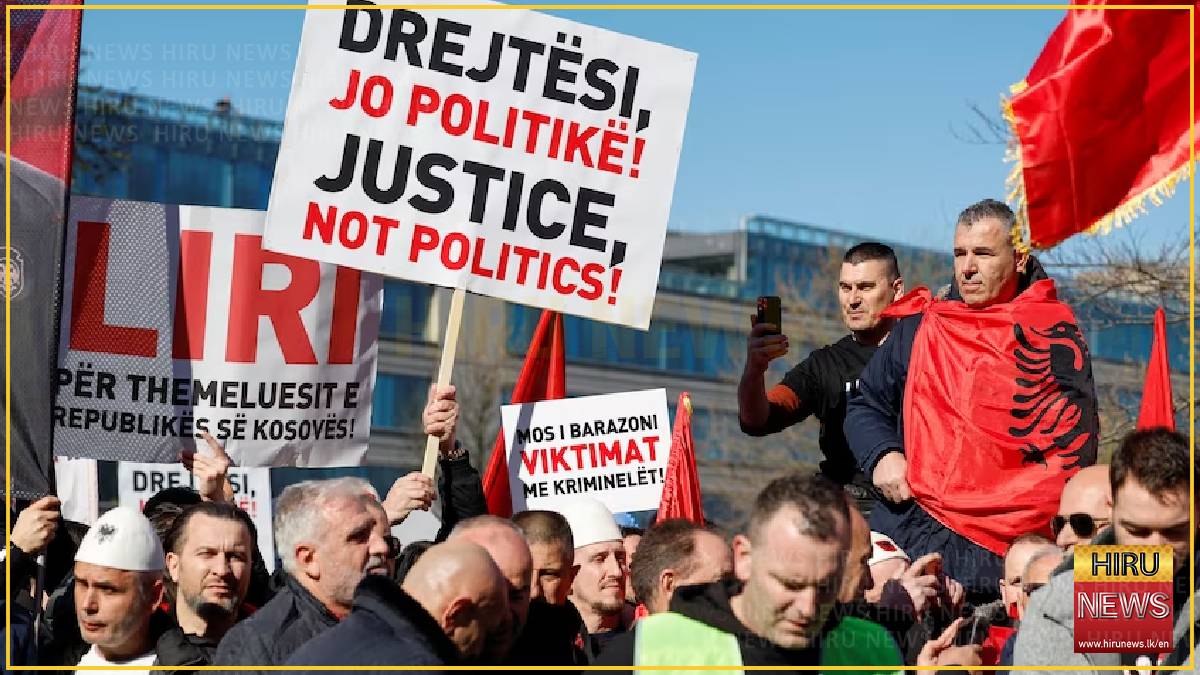
Cities across Kosovo have set up large screens showing a countdown to the judgment, due to begin at 10am in The Hague (0800 GMT). On Saturday, thousands attended a rally in the capital, Pristina, demanding the men’s release.
“For us, Hashim Thaçi is a hero of Kosovo, a freedom fighter. He should return to Kosovo,” said Mentor Plakaj, a Pristina resident.
The Kosovo Specialist Chambers, staffed by international judges and lawyers, is deeply unpopular in Kosovo. Pristina agreed to the tribunal in 2015 under international pressure; it handles war crimes cases under Kosovo law against former KLA guerrillas. Because of the risk of witness intimidation, many prosecution witnesses testified behind closed doors — which deepened public mistrust of the institution.
What analysts expect
“The verdict is a tectonic event,” said Agon Maliqi, a nonresident senior fellow at the Atlantic Council’s Europe Center.
An acquittal and release could shift the balance of Kosovo politics towards Thaci’s pro-Western opposition party and restore confidence in closer cooperation with the West on regional security, Maliqi said. A conviction, he argued, could push Kosovo further from the West than it has already moved under Prime Minister Albin Kurti.
“The outcome of the verdict will also have an immediate impact on already strained ethnic relations within Kosovo, as emotions will be high, and radical forces, including external actors, may have an incentive to stir tensions,” he said. In the longer term it could affect prospects for lasting peace with Serbia, depending on Belgrade’s reaction.
The outcome could also strain Kosovo’s relations with the United States, its main ally, and create fresh tension with Serbia, which does not recognise Kosovo as an independent state.
An acquittal would not mean immediate release. Prosecutors are separately seeking a six-year sentence against Thaci in a case over alleged witness tampering, which he also denies.
Balkan memory still raw
The report notes that the trial has underlined how contested the Balkan wars of the 1990s remain. It cites a large public funeral held in Belgrade last week for Bosnian Serb General Ratko Mladic, who it says died while serving a life sentence for genocide, war crimes and crimes against humanity, as evidence that public opinion across the region remains sharply divided.
Update — September 16: convicted on four counts, sentenced to 25 years
The Kosovo Specialist Chambers in The Hague convicted Thaci of four counts of war crimes and sentenced him to 25 years in prison on Wednesday, the Daily Mirror reported citing Al Jazeera, and Hiru News reported citing Reuters.
The crimes — murder, torture and illegal detention — were committed while he was top commander of the KLA during the territory’s violent break from Serbia in the 1990s. The chambers found him guilty of the murder of 96 political opponents and perceived collaborators with Serbian security forces.
Thaci, 58, denied all the charges. He wore a suit and tie and stood in silence as Presiding Judge Charles Smith read out the sentence.
The three co-defendants, named at last
The earlier reporting did not identify the three former KLA commanders tried alongside Thaci. The sentencing does:
| Defendant | Sentence |
|---|---|
| Hashim Thaci | 25 years |
| Jakup Krasniqi | 25 years |
| Kadri Veseli | 18 years, including time in custody |
| Rexhep Selimi | 13 years, including time in custody |
Acquitted of crimes against humanity
All four were acquitted on six counts of crimes against humanity. The judges held that prosecutors had failed to prove the crimes were committed as part of a widespread and systematic attack on civilians.
That acquittal is the reason the sentences fell well short of what was sought. Prosecutors had asked for 45 years for each of the four; Thaci received 25.
Before reading the sentences, Judge Smith referred to the severe torture and killings carried out by the KLA. “No flag is big enough to hide the shame of killing innocent people,” he said, quoting the American historian Howard Zinn.
The trial has been divisive in Kosovo, where many Kosovar Albanians regard the KLA and Thaci as revered figures for their role in the 1998–99 independence war.
Still not reported
Neither Wednesday’s report gives the length of the trial, an appeal route or deadline, or where the sentences will be served. Neither says whether time already spent in custody counts toward Thaci’s or Krasniqi’s terms, though it is specified for Veseli and Selimi. Neither addresses the separate witness-tampering case in which prosecutors are seeking a further six-year sentence against Thaci, and neither reports a reaction from Pristina, Belgrade or Washington.
Sources
- War crimes tribunal to announce verdict in trial of former Kosovo president Thaci — Hiru News, September 14
- Former Kosovo President Hashim Thaci sentenced to 25 years for war crimes — Daily Mirror, September 16
- Former Kosovo president Thaci sentenced to 25 years in prison for war crimes — Hiru News, September 16