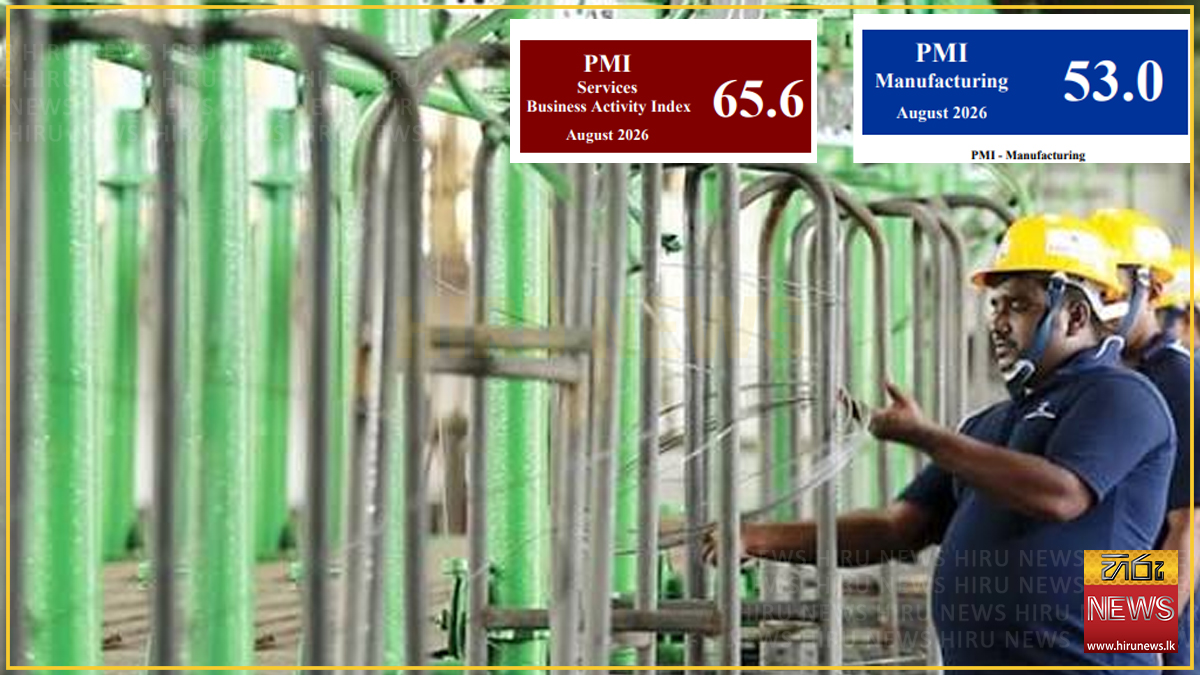
Sri Lanka’s services sector expanded faster in August while manufacturing growth slowed, according to the Purchasing Managers’ Index released by the Central Bank.
The services PMI rose to 65.6 in August, indicating an accelerated expansion on the previous month. The Central Bank attributed the improvement to stronger performance in transportation, wholesale and retail trade and professional services, with financial services and other personal services also contributing.
New business increased during the month, driven mainly by wholesale and retail trade, financial services and other personal services, with professional services contributing as well. Employment in the sector rose on new recruitment, and backlogs of work declined — reversing the build-up recorded a month earlier.
The manufacturing PMI stood at 53.0, still above the neutral 50 threshold that separates expansion from contraction, but growing more slowly than in July.
Manufacturing has given back its July improvement
The August manufacturing reading is not merely a slowdown — it returns the index to exactly where it sat in June. EconomyNext reported in August that manufacturing had registered 55.0 in July, up from 53.0 in June, and that services had risen to 61.4 in July from 58.5 in June. Against those figures, August’s 53.0 erases July’s two-point manufacturing gain in full, while services have added a further 4.2 points on top of July’s rise.
The divergence shows up in the sub-indices. All manufacturing sub-indices except Production remained above neutral in August, and New Orders sat at the neutral level, indicating broadly unchanged new business — down from the 55.9 that EconomyNext reported for July. The moderation in Production was attributed mainly to textiles and wearing apparel, Sri Lanka’s largest export manufacturing sector.
Employment and Quantity of Purchases both increased, which the Central Bank linked to continued recruitment and a build-up of inventories ahead of year-end seasonal production. Suppliers’ Delivery Times lengthened further, pointing to persistent supply-chain disruption.
The readings follow second-quarter GDP growth of 4.2%, itself a slowdown on the previous quarter.
Update (16 September): the sub-index levels, from a second outlet
NewsFirst reported the same release on Wednesday and supplies the index levels Hiru omitted. Its headline figures — services 65.6, manufacturing 53.0 from 55.0 in July — match Hiru’s exactly.
| Sub-index | August | Direction |
|---|---|---|
| Manufacturing | ||
| New Orders | 50.0 | at neutral |
| Production | 48.4 | below neutral |
| Employment | 54.8 | up from 51.0 |
| Stock of Purchases | 54.8 | up |
| Suppliers’ Delivery Times | 63.0 | lengthening further |
| Services | ||
| New Business | 60.0 | expanding |
| Employment | 53.3 | up |
| Backlogs of Work | 48.3 | contracting |
| Expectations for Activity | 71.7 | — |
Two readings stand out. Production at 48.4 is the only manufacturing sub-index below neutral, which the Central Bank attributes mainly to moderation in textiles and apparel — the sector that dominates Sri Lanka’s export manufacturing. And Suppliers’ Delivery Times at 63.0 is the highest reading on the manufacturing side; in PMI convention a rising delivery-times index means orders are taking longer to fill, so this is a measure of supply disruption, not of strength.
On the services side, Expectations for Activity at 71.7 is the strongest number in the release. NewsFirst reports that respondents cited anticipated economic improvement and rising tourist arrivals as the reasons — the forward-looking counterpart to Hiru’s account of transport and retail driving the current month. The Central Bank paired that optimism with a caution that global economic uncertainty poses downside risks.
NewsFirst adds that manufacturing continued to expand in China, the United States, India, the United Kingdom and the Eurozone in August, with services growing across most major markets — context Hiru does not carry.
The two accounts do not conflict anywhere. NewsFirst still does not give the June or July sub-index levels, so the July comparisons below remain drawn from EconomyNext’s reports of that release.
Update (17 September): EconomyNext files on the release, and New Business was not a gain
EconomyNext reported the August release on Thursday, a third verified newsroom carrying the same figures — services 65.6 against July’s 61.4, manufacturing 53.0 from 55.0, and Production at 48.4.
Its account supplies one comparison neither Hiru nor NewsFirst gives, and it cuts against the headline. Services New Business at 60.0 was slightly down on July’s 60.2 — not an acceleration. The services index rose 4.2 points in August while the sub-index measuring incoming work edged lower, meaning the month’s expansion was driven by activity on business already in hand rather than by faster order intake. EconomyNext also dates the Production fall precisely: 48.4 in August against 55.9 in July, a drop of 7.5 points.
EconomyNext quotes the Central Bank saying business activity “grew at a faster pace in August 2026, supported by the improvements observed across many sectors,” and repeats the caution that “broader global economic uncertainties continued to pose downside risks to the outlook.”
Not reported
Hiru does not give the July or June PMI values, the Suppliers’ Delivery Times or New Orders index levels, or the Central Bank’s stated expectations for the next quarter. The June comparisons above are drawn from EconomyNext’s reports of the July release, published on 19 August and cited as background rather than as same-day sources. None of the three accounts gives the June sub-index levels.
Sources
- Services sector accelerates in August as manufacturing growth slows — Hiru News, 15 September 2026