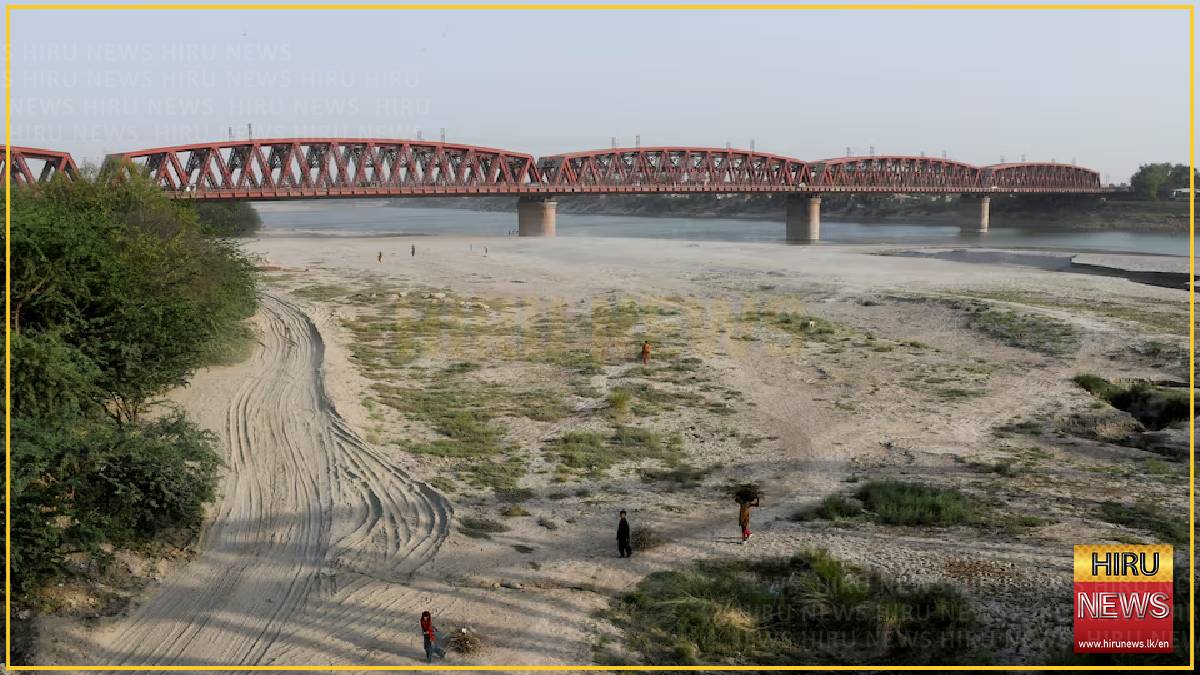
Rivers worldwide ran through one of their driest years in 35 years of record-keeping in 2025, the World Meteorological Organization said on Thursday, in an annual assessment that also documents a decade-long fall in the water stored on land.
Below-normal flows were recorded across more than a third of the world’s river basins, Hiru News reported, citing Reuters. Affected regions included much of North America, parts of South America, Eastern Europe, the Middle East and Central Asia.
The “savings account” is being drawn down
Terrestrial water storage — the water held in groundwater, lakes, vegetation, ice and snow — has been declining since around 2016, the State of Global Water Resources report found. In 2025, 42% of the world had storage below historical norms, and two-thirds of monitored wells sat outside their normal range, CNN reported.
WMO Secretary-General Celeste Saulo said those slow-moving reserves have historically buffered bad years so that “a single drought or a single dry season does not translate directly into a water crisis.”
“We are depleting that savings account,” she said.
Glaciers lost mass in every region for a fourth consecutive year. Between 2023 and 2025 they shed enough water to fill roughly 560 million Olympic-sized swimming pools, the report calculated — a loss the WMO links to long-term water insecurity.
South Asia had the opposite problem
The report is not a uniform picture of scarcity. Some basins — including parts of South and South East Asia and Australia — recorded above-average flows, which the WMO presents as evidence of a water cycle swinging harder between extremes rather than simply drying out.
That whiplash is familiar in Sri Lanka, where the past year has delivered both. The island is still rehousing families displaced by Cyclone Ditwah, with 5,799 homes under construction and about 30,000 families newly identified as living at landslide risk. In the same period, dry conditions forced the closure of blocks at Yala National Park.
Asia and Africa were worst affected by water extremes in 2025, both in number of events and lives lost. Saulo warned the year ahead could bring more of the same, raising drought risk in some regions and flood risk in others.
The assessment drew on data from more than 60 countries, but its authors flagged critical gaps — often, they noted, in precisely the regions of Asia and Africa where extremes are most severe.