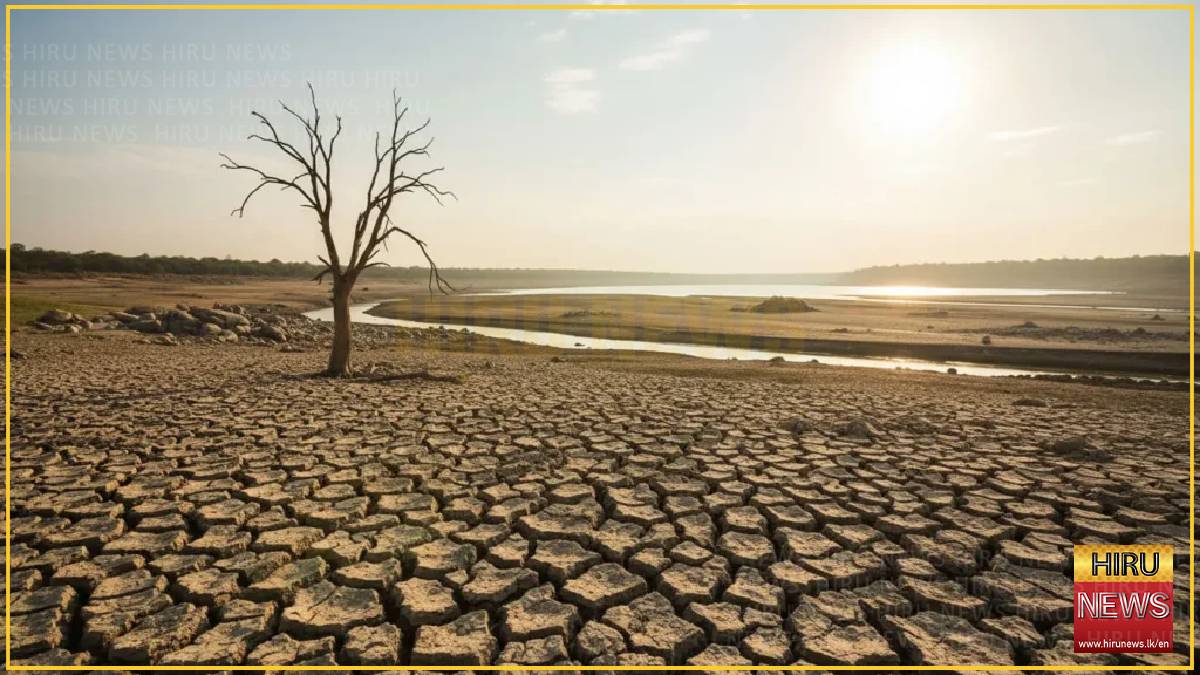
More than 78,000 people have lost their livelihoods to the El Niño dry spell, and the Labour Ministry has said it has no mechanism to intervene on their behalf because almost all of them work outside the formal economy, Hiru News reported on Friday, carrying an interview given to The Daily Morning.
Deputy Labour Minister Mahinda Jayasinghe said the ministry’s powers are confined to employment disputes in the formal sector — company closures, factory shutdowns — and that nothing in that toolkit reaches an agricultural labourer or a self-employed fisherman.
“People working in the formal sector have not faced employment-related issues. But, people engaged in agricultural activities and other sectors in the informal sector have lost their livelihoods.”
He went further, framing the absence of a response as a question of thresholds rather than capacity:
“There is no problematic situation to the extent that the Ministry needs to intervene. We can intervene if an employment issue arises in the formal sector, such as if factories and companies are closing down. At present, we don’t have a mechanism to intervene in the informal sector.”
Jayasinghe said the government is preparing a separate assistance programme for those affected. He did not say what it contains, what it costs, or which ministry will run it.
The figure closes a gap that has been open for a fortnight
The statistics were delivered to Parliament on 10 September by Environment Minister Dr. Dammika Patabendi: 78,368 individuals from 25,037 families across seven districts.
That number answers a question this desk flagged as unanswered on 3 September, when the Cabinet subcommittee on El Niño took up job losses for the first time. That meeting — also chaired by Patabendi — produced a commitment to “possible relief for those who lose their jobs” and no figures at all: not for jobs at risk, not for the cost of a scheme, not for which sectors were expected to shed workers. All three are now partly on the record.
Where the losses fall
| Sector | People | Families |
|---|---|---|
| Agriculture | 36,875 | 12,304 |
| Other livelihood activities | 10,297 | 3,450 |
| Livestock | 9,408 | 2,966 |
| Plantation | 7,889 | 2,333 |
| Fishing | 7,491 | 2,107 |
| Self-employed | 6,039 | 1,769 |
| Business | 369 | 108 |
| Total | 78,368 | 25,037 |
Both columns sum exactly to the stated totals, which is worth saying because ministry tables relayed through a second outlet often do not.
Agriculture accounts for 47 percent of the people affected. Add livestock, plantation and fishing and the primary sector alone reaches 78 percent. The “business” line — 369 people, 0.5 percent — is the only category that plausibly sits inside the formal economy Jayasinghe says his ministry can act on.
The average affected household contains just over three working people, which suggests the count is reaching whole families rather than individual earners.
This is not the number you have seen before
Two different drought counts are now circulating and they measure different things.
The Disaster Management Centre’s running total — 163,869 people across eight districts as of 16 September — counts people affected by dry weather. The 78,368 figure counts people who have lost a livelihood. The second is a subset of the first, not a revision of it, and the two should not be presented as a contradiction or as an improvement.
The district lists also differ, and not trivially. The livelihood count names Monaragala, Badulla, Ratnapura, Trincomalee, Batticaloa, Ampara and Anuradhapura. The disaster count as of mid-September covers Ampara, Badulla, Batticaloa, Matale, Monaragala, Polonnaruwa and Ratnapura, plus an eighth.
So Trincomalee and Anuradhapura appear in the livelihood count but not the disaster count, while Polonnaruwa and Matale appear in the disaster count but not the livelihood count. Polonnaruwa’s absence is the odd one: it was on the six-district disaster list on 2 September and shut off the last of its irrigation releases that week. Neither the parliamentary statement nor the report explains why the two lists diverge.
The gap the admission exposes
Sri Lanka’s social protection architecture is organised around formal employment. The Employees’ Provident Fund, the Employees’ Trust Fund and the Labour Department’s dispute machinery all attach to a registered employer. A drought that takes out paddy labour, inland fishing and smallholder livestock removes income from people who never had that attachment in the first place.
Jayasinghe’s statement is therefore accurate as a description of the ministry’s legal remit, and that is precisely what makes it notable: the department of state named after labour has confirmed it has no instrument for the largest labour shock of the year. Relief, if it comes, will have to come from disaster management or social welfare budgets instead — which is where the Rs. 3 billion for ruined crops and the livelihood survey begun on 16 September already sit.
Not reported
Neither the minister nor the report says when the separate assistance programme will be announced, what it will pay, who administers it, or whether it draws on new money. The 10 September figures are eight days old as reported and no updated livelihood count has been published since.
It is not stated whether these 78,368 people are counted inside the Defence Ministry’s divisional-secretariat livelihood survey or separately from it, nor whether “lost their livelihoods” means permanent loss of work or suspended earnings for the season — a distinction that changes what relief is appropriate.
No other verified newsroom had filed on the Labour Ministry’s position at the time of writing. Searches across Ada Derana, NewsFirst, Daily Mirror, EconomyNext, Island and The Morning returned the running disaster-toll stories but not this interview; Ada Derana remains blocked to direct fetching. The account therefore rests on Hiru’s relay of The Daily Morning’s reporting.