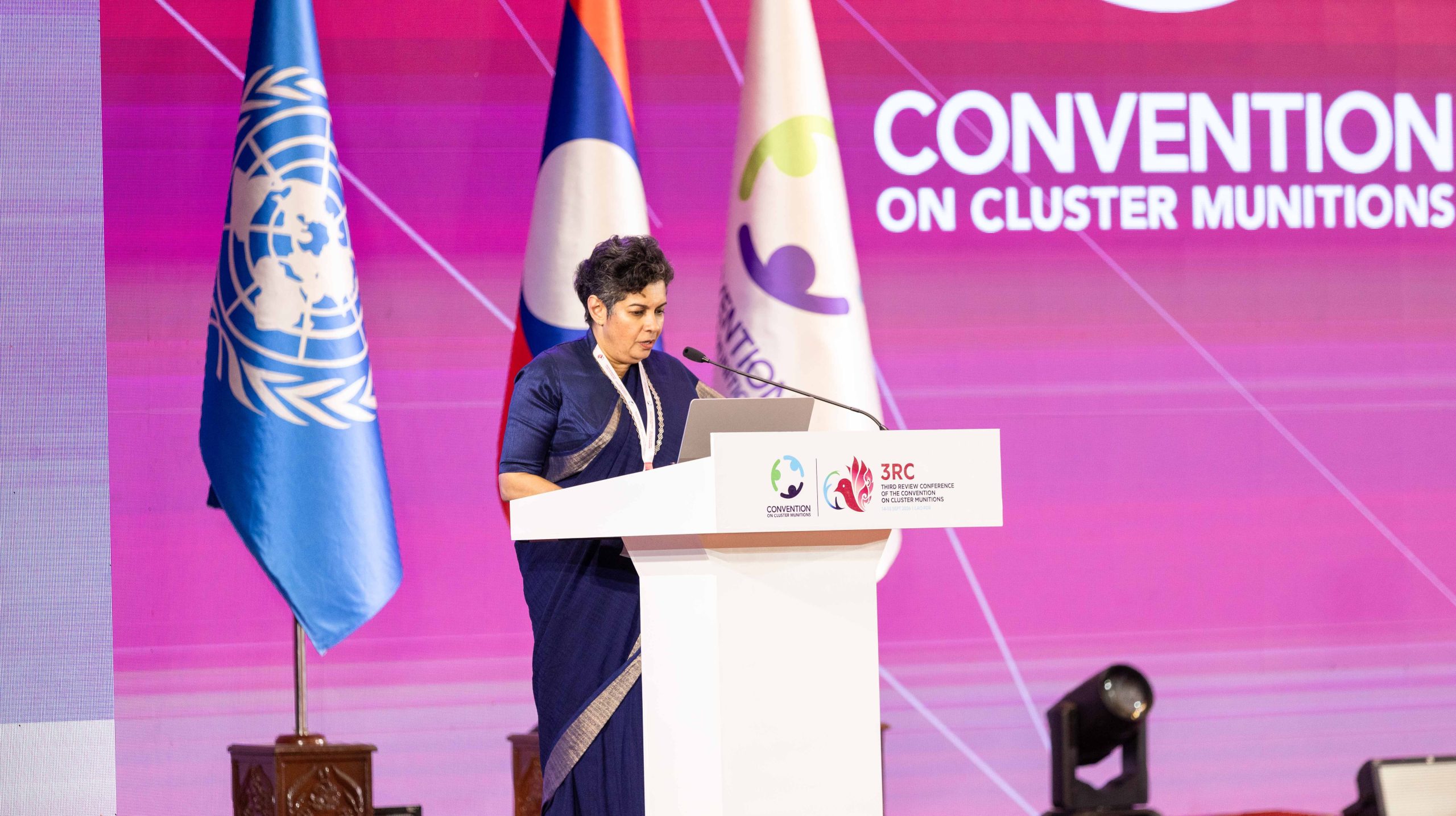
Sri Lanka has condemned the use of cluster munitions “by any actor and under any circumstance” and called on states holding large stockpiles to stop producing and transferring the weapons, in a statement delivered to the Third Review Conference of the Convention on Cluster Munitions (CCM) in Vientiane, Laos.
The conference ran from September 14 to 18. Sri Lanka’s delegation was led by Manisha Gunasekera, Additional Secretary for United Nations and Human Rights at the Ministry of Foreign Affairs, who addressed the high-level segment.
Gunasekera argued that “any erosion of international norms should not undermine the humanitarian gains achieved through the Convention,” pointing to what the delegation described as a heightened risk of the use, production and transfer of cluster munitions in recent conflicts.
What Sri Lanka asked for
The delegation pressed for continued progress on victim assistance, stockpile destruction, clearance of cluster munition remnants, and risk-reduction education aimed particularly at children and young people.
It welcomed the conference’s outcome documents — including the Vientiane Capital Action Plan for 2027–2031, successor to the Lausanne Action Plan — as a framework for the next five years, while entering a practical caveat: Sri Lanka supported the plan’s quantitative targets but urged “practical and standardized methodologies for measuring progress,” and asked that affected states with limited administrative capacity be given simplified reporting pathways and technical assistance rather than heavier paperwork.
In its full statement, published by Sri Lanka’s Permanent Mission in Geneva, the delegation also backed folding cluster munition survivors into national disability, health and social welfare systems instead of running parallel schemes, and welcomed the new action plan’s emphasis on environmental and climate risk assessment during clearance work.
The unspoken context
Sri Lanka acceded to the Convention in 2018 and moved quickly into a leadership role, holding the presidency of the Ninth Meeting of States Parties in 2019 and serving four consecutive years as a vice-president on the Bureau.
That record sits alongside an unresolved question at home. As EconomyNext notes, Sri Lanka has long denied using cluster munitions during the war against the Liberation Tigers of Tamil Eelam, while human rights organisations have pointed to physical evidence and witness testimony suggesting they were used, particularly in the closing stages of the conflict. Neither the statement nor the conference addressed that dispute.
The delegation’s statement referenced a field visit to Luang Prabang, where unexploded submunitions left by decades-old bombing still contaminate land — Laos remains the most cluster-munition-contaminated country in the world, which is part of why it hosted the review.
Sri Lanka also welcomed three states that have joined the Convention since the last review conference: Nigeria (2023), South Sudan (2023) and Vanuatu (2025).
Sri Lanka’s full statement is published by the Permanent Mission of Sri Lanka in Geneva.
Not reported
Neither the Foreign Ministry readout nor the statement says which other Sri Lankan officials attended, whether Sri Lanka signed or sponsored any of the outcome documents, or whether the government intends to respond to the long-standing allegations about its own wartime use of these weapons.