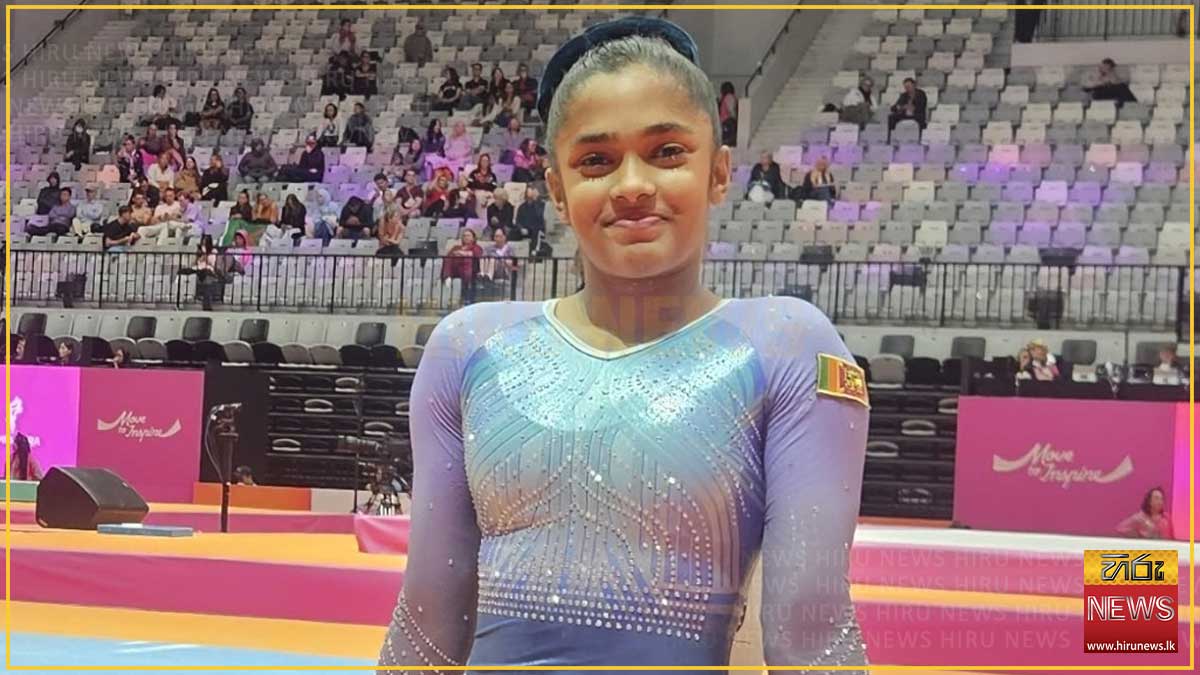
Sri Lanka marches into the opening ceremony of the 20th Asian Games in Aichi-Nagoya on Saturday behind two flag bearers: modern pentathlete Isiwaruna de Silva and 16-year-old artistic gymnast Nuyara Fernando.
Fernando is the youngest athlete in the squad, Hiru News reported. She has previously represented Sri Lanka at the Commonwealth Games and is a past pupil of Lyceum International School, Nugegoda.
The Daily Mirror’s sports desk named both flag bearers a day earlier, in a report by Susil Premalal. Hiru’s account names only Fernando and does not mention de Silva — a straightforward omission rather than a conflict between the two reports.
The largest delegation Sri Lanka has sent
A record 156 athletes will compete across 26 sports at the Games, which run from 19 September to 4 October. The contingent is 100 men and 56 women, accompanied by 82 officials.
That is the biggest team Sri Lanka has ever sent to an Asian Games. Among South Asian nations it ranks fourth by size:
| Country | Athletes |
|---|---|
| India | 505 |
| Bangladesh | 187 |
| Pakistan | 168 |
| Sri Lanka | 156 |
| Nepal | 136 |
| Maldives | 42 |
| Bhutan | 13 |
The Games overall are expected to draw roughly 10,840 athletes from 45 countries.
Sri Lanka will compete in athletics, rugby sevens, cricket, gymnastics, judo, rowing, table tennis, squash, wrestling, weightlifting, 3x3 basketball, wushu, kabaddi, beach volleyball, boxing, karate, sailing, taekwondo, surfing, badminton, golf, hockey, modern pentathlon, aquatics, diving and archery.
Nearly every Sri Lankan gold has come from the track and field
Sri Lanka has competed at every Asian Games since the inaugural edition in New Delhi in 1951, and its all-time record stands at 51 medals — 12 gold, 13 silver and 26 bronze.
Medals have come in seven sports: athletics, cricket, boxing, sailing, tennis, cycling and karate. Athletics alone accounts for 31 of the 51 — 11 gold, seven silver and 13 bronze.
Set those two figures side by side and the dependency is stark: of Sri Lanka’s twelve Asian Games gold medals, eleven were won in athletics. Every other sport in the country’s history at these Games has produced a single gold between them. Neither outlet draws the comparison, but it is the reason a javelin final carries the weight it does.
The record is not uniformly good. Sri Lanka failed to win any medal at the 2010 Guangzhou and 2018 Jakarta editions. At the last Games in 2022 it took five — one gold, two silver and two bronze.
The main medal hope has not left yet
Javelin thrower Rumesh Tharanga, Sri Lanka’s most-cited medal prospect, was due to depart for Japan only on Saturday night, his coach Tony Prasanna told Hiru. A special javelin set supplied by the Ministry of Sports is scheduled to reach Japan in time.
His preliminary round is on 26 September.
Two things follow that neither outlet states. Sri Lankan teams began leaving for Japan in stages from 13 September, so Tharanga departs six days behind the first of them — and on the evening of the opening ceremony itself, meaning the team’s leading medal hope is not present at the parade his flag bearers lead. With his event nine days off, that is a scheduling choice rather than a setback; it does mean the equipment he throws with is travelling separately to the athlete who needs it.
Tharanga climbed to 13th in World Athletics’ overall rankings this week and has said he intends to compete through to the 2036 Olympics.
A note on his name: the Daily Mirror calls him Rumesh Pathirage; Hiru and this archive use Rumesh Tharanga. Both refer to the same athlete. We retain the more widely used rendering.
Competition began before the ceremony
The opening ceremony is not the start of the Games for Sri Lanka. The women’s cricket team beat Malaysia by 86 runs on 18 September to reach the semi-finals, with Chamari Athapaththu making 63 off 37 — a result banked a day before the flag was carried into the stadium. Both the men’s and women’s cricket teams are rated medal contenders.
Not reported
Neither outlet gives Isiwaruna de Silva’s age, club or competition record, or says how the two flag bearers were selected or by whom. Nothing explains why a 16-year-old in her first Asian Games was chosen for the honour.
Neither report gives Nuyara Fernando’s event schedule, which Commonwealth Games she attended or how she placed there. No medal target has been set for the delegation by the National Olympic Committee or the Ministry of Sports, and neither outlet reports what the 82-official delegation costs or how it is funded.
Hiru does not say why Tharanga travels separately from the main party, who is paying for the special javelin set, or what it costs.