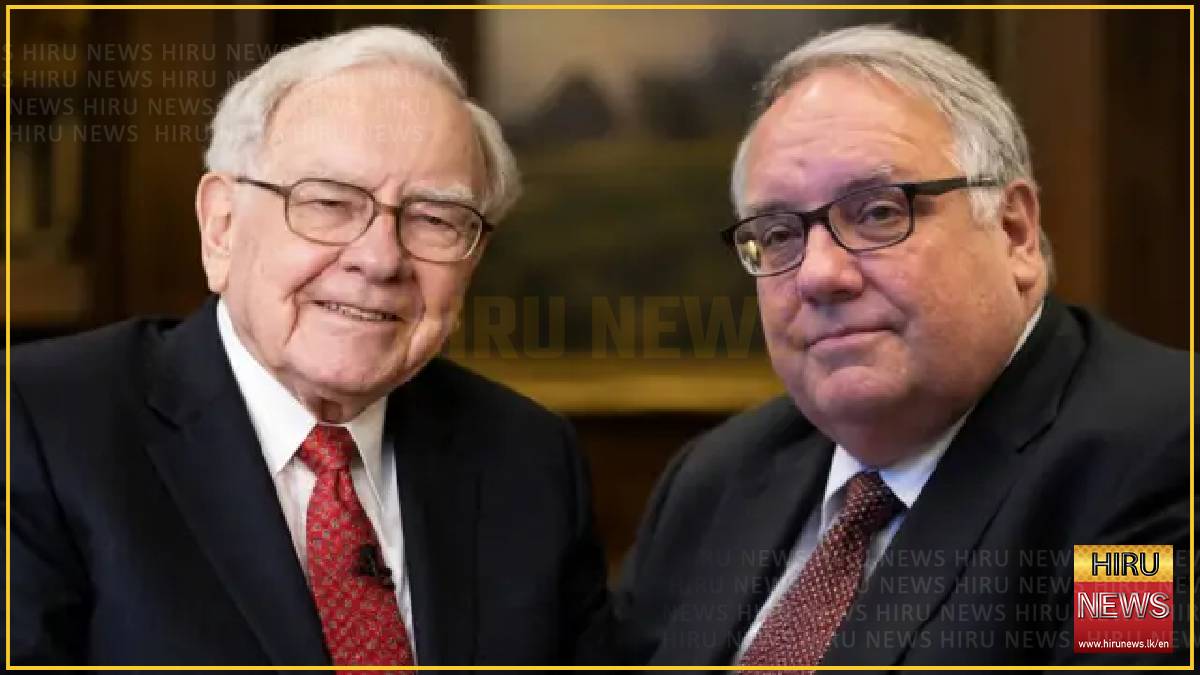
Warren Buffett stepped down on Friday as chairman of Berkshire Hathaway, ending more than six decades at the head of the conglomerate he built, Hiru News reported, carrying a Reuters report.
Buffett, 96, was named chairman emeritus. His eldest son Howard Buffett, 71, a director since 1993, becomes non-executive chairman. Warren Buffett remains on the board.
The last step in a planned handover
The change comes nearly nine months after Buffett stepped down as chief executive, handing that role to longtime lieutenant Greg Abel. The chairmanship was the remaining title.
That sequencing is the point: this is the completion of a succession that has been signalled for years, not an abrupt departure. Buffett’s reduced role was not a surprise to the market, and Berkshire shares rose 0.4% in afternoon trading — a muted reaction that reflects how thoroughly the transition had been priced in.
“It was always a matter of when, not if. Buffett has made a graceful exit,” said Brian Jacobsen, chief economic strategist at Annex Wealth Management in Brookfield, Wisconsin. “This feels more like the completion of a carefully planned succession than a sudden changing of the guard.”
In his own words
In a letter to shareholders, Buffett wrote:
“Father Time always wins. He has, however, been generous with me. Sixty-plus years in, I still have the best job in the world. That is not something many people my age can say, and I have never felt better about what comes next.”
He gave no new details about his health, but said he had recently seen his one-year-old great-grandson, who was “moving a bit faster” than he could.
What he built
Buffett turned Berkshire from a failing New England textile company into a $1.1 trillion conglomerate, promoting a value-oriented investment philosophy that shaped generations of investors — delivered with a folksiness that made him widely understood and earned him the nickname the Oracle of Omaha.
The group’s wholly owned businesses include GEICO car insurance, the BNSF railroad, a range of energy, industrial and retail operations, Dairy Queen, and older brands such as Ginsu knives and the World Book Encyclopedia. It also holds hundreds of billions of dollars of stock in companies including Apple, American Express, Alphabet and Coca-Cola.
Berkshire is the outlier in the trillion-dollar club, which is otherwise dominated by technology companies — a conglomerate of insurance, rail and consumer businesses sitting among firms built on software and semiconductors.
Why the split of roles matters
The structure now separates three jobs that Buffett once held together: Abel runs the company, Howard Buffett chairs a non-executive board, and Warren Buffett sits as a director and chairman emeritus.
The Reuters account does not explain what the non-executive chairmanship is for, and the distinction is worth stating plainly: a non-executive chair carries no executive authority over Abel or over Berkshire’s operating businesses. Howard Buffett has been a director for 33 years but has never held an operating role at the company.
Not reported
The report does not say whether Buffett intends to stand for re-election as a director, what his shareholding is now after years of giving stock away, or whether the change affects the timetable for distributing his remaining holdings to charity.
It gives no board vote or date of effect beyond “Friday”, does not say whether Howard Buffett’s appointment was put to shareholders, and carries no comment from Greg Abel or from Howard Buffett himself.