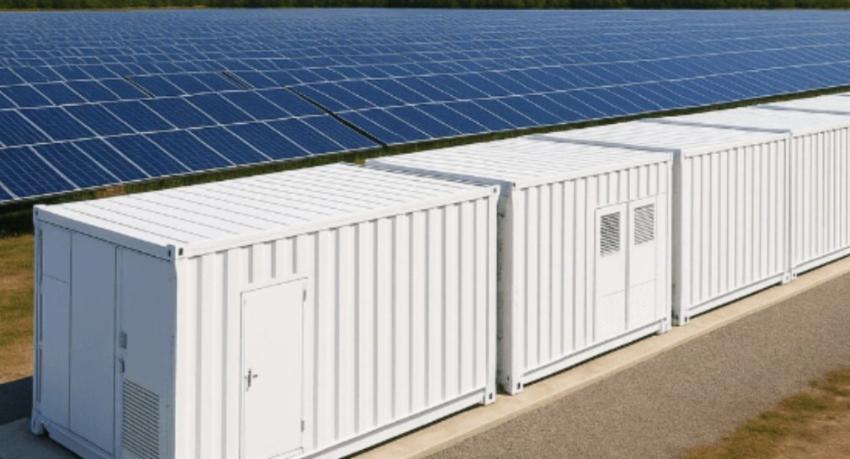
A 10 megawatt Battery Energy Storage System (BESS) is being commissioned at Galle on Sunday, the second of sixteen such plants to join Sri Lanka’s national grid, NewsFirst reported.
The plant is part of a national programme to absorb the midday solar surplus and release it after dark, stabilising the grid and cutting the volume of evening electricity that must come from fossil-fuel plant.
The timetable has tightened by about two months
The most consequential detail in the filing is a date.
Dr. Pradeep Perera, Chairman of National System Operator (Pvt) Ltd, said the programme covers 16 separate 10 MW facilities at strategic locations island-wide — a cumulative 160 MW — and that all 160 MW “will be fully connected and integrated into the national grid by next month.”
That is a materially tighter schedule than anything previously on record, and this desk now has three different completion dates for the same 160 MW from three sources in two days:
| Source | Date given | Completion |
|---|---|---|
| NSO Chairman Pradeep Perera (NewsFirst) | 20 September | October |
| Energy Minister Anura Karunathilaka (Daily Mirror) | 19 September | before the end of this year |
| Storex, the developer (Daily FT) | 19 September | two to three months — November or December |
The National System Operator is the body that actually performs the grid connections, which gives its chairman’s estimate particular weight. None of the three accounts acknowledges the others.
Galle was meant to go first
Galle is not a new name in this programme. When the first batch of components arrived in May, the Ministry of Power and Energy designated Galle and Matara as the initial connection points for the 160 MW project, then costed at around Rs. 40 billion. The opening 20 MW shipment covered exactly those two sites.
In the event, Anuradhapura went first. President Anura Kumara Dissanayake presided over the commissioning of that 10 MW / 40 MWh unit on Friday — “just two days prior” to Galle, as NewsFirst puts it — at a ceremony where the Energy Minister set a 960 MW national storage target for 2027.
No outlet has explained why the order changed. On the May designation, Matara would be the natural third.
The arithmetic reconciles
The figures given on Sunday check out against the record. At 10 MW apiece, 16 plants is exactly the 160 MW the Ministry has described since May. Each unit runs a four-hour discharge at 40 MWh, so the full set carries 640 MWh — consistent with the 520 MWh attributed to the thirteen systems held by developer Storex, the WindForce–Vidullanka joint venture that won 13 of the 16 slots.
That leaves three of the sixteen plants in other hands. Whether Galle is one of Storex’s thirteen or one of the unnamed three is not stated in any account this desk has seen.
Not reported
NewsFirst does not name the developer or contractor of the Galle plant, give its cost, say which substation it connects through, or report who attended the commissioning. It does not list the remaining fourteen sites, name the three non-Storex bidders, or explain why Anuradhapura preceded Galle after May’s designation. Nor does it address how the 160 MW relates to the separate 250 MW / 1,000 MWh standalone tender opened in July across 25 grid substations.