Sri Lanka’s food inflation has already accelerated to 8.5%, and weather-related supply shocks are likely to keep food prices elevated and push headline inflation higher through the end of 2026, First Capital Research said in its latest review.
The finding comes from the same review in which the house cut its growth forecast to 3–4% for 2026 and 2027, and it fills in the inflation call that report left unstated.
The damage already done
Roughly 80,000 hectares of agricultural land have been affected by adverse weather, First Capital said, and the government has allocated about Rs. 3 billion for relief and remediation to support affected farmers and limit crop losses.
The house frames the driver as El Niño — the recurring Pacific pattern that displaces rainfall, bringing excess to some regions and drought to others, and which cuts agricultural output either way. It notes the United Nations has warned of a heightened risk of heavy rainfall events towards the end of 2026, with further disruption possible to both production and food distribution networks.
That warning is already being tested. The Met Department has forecast falls above 100mm across the southwest this week, and the Met Office has separately confirmed the current El Niño has surpassed previous records.
What the chart adds
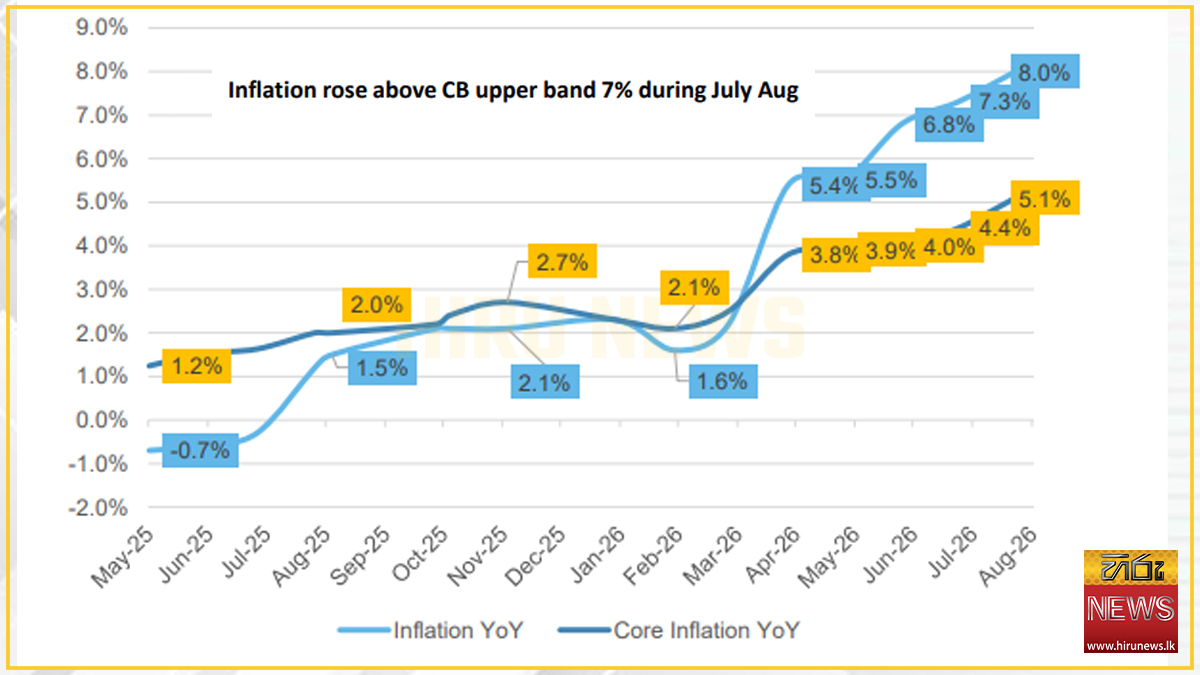
First Capital published an inflation chart with the review that Hiru’s text does not describe. It carries the caption “Inflation rose above CB upper band 7% during July Aug” and plots headline and core inflation from May 2025:
| Month | Headline YoY | Core YoY |
|---|---|---|
| May 2025 | −0.7% | 1.2% |
| Sep 2025 | 1.5% | 2.0% |
| Feb 2026 | 1.6% | 2.1% |
| Apr 2026 | 5.4% | 3.8% |
| Jun 2026 | 6.8% | 4.0% |
| Jul 2026 | 7.3% | 4.4% |
| Aug 2026 | 8.0% | 5.1% |
Two things follow from it. Headline inflation has run above the Central Bank’s 7% upper band for two consecutive months, which is the formal trigger for the Bank to explain itself. And core inflation — the measure that strips out food and energy — has climbed from 2.1% to 5.1% in six months, so the pressure is not purely a food-supply story.
The 8.5% figure needs care
First Capital’s 8.5% food inflation reading is not the figure the Census Department published for the national index. NCPI food inflation was 6.6% in August, against a national headline of 8.1%.
The 8.5% almost certainly refers to the Colombo basket, which is the index the chart’s 8.0% August headline and the 7% Central Bank band both track. The two baskets weight food differently and cover different areas; they are not interchangeable, and the review as reported does not label which it is using.
The oil leg
Alongside weather, the house flags supply risk from potential disruption in the Strait of Hormuz and Bab el-Mandeb, tied to Iran-linked regional tensions and intermittent Houthi attacks — though it notes alternative shipping routes offer some mitigation, and that weak demand, particularly from China, continues to cap crude prices despite the geopolitics.
Not reported
Hiru gives no date or title for the review, no numerical inflation forecast for end-2026, and no breakdown of the 80,000 hectares by crop, district or cause. There is no figure for how much of the Rs. 3 billion has been disbursed, and no First Capital analyst is quoted by name. The review is a commercial sell-side product, not an official projection.