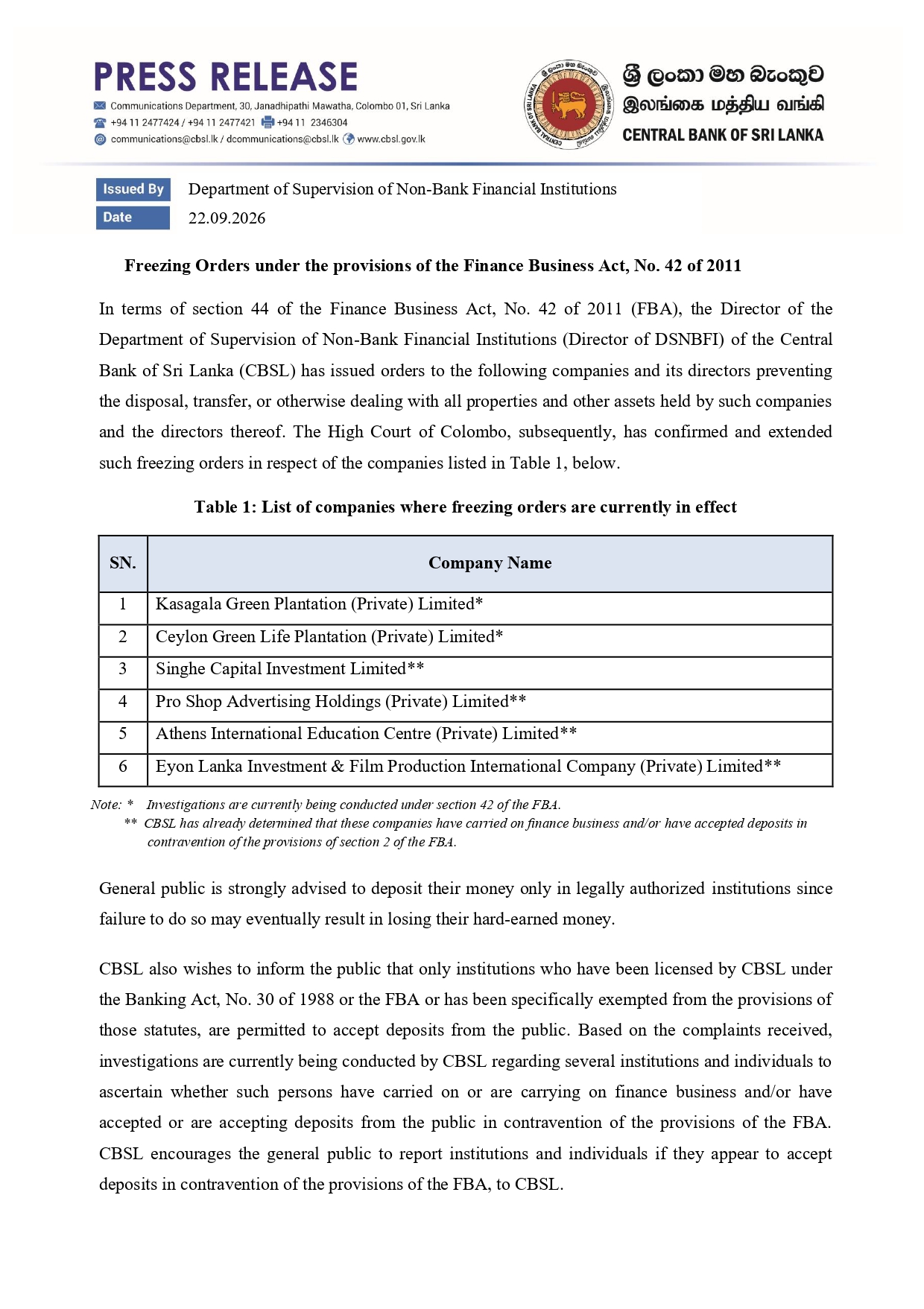
The Central Bank of Sri Lanka has confirmed that freezing orders remain in force against six companies and their directors, barring them from selling, transferring or otherwise dealing with any property or assets they hold. The Colombo High Court has since confirmed and extended the orders.
The orders were issued by the Director of the Department of Supervision of Non-Bank Financial Institutions under Section 44 of the Finance Business Act, No. 42 of 2011, according to a press release dated 22 September that the regulator published and which Daily Mirror and NewsFirst both reported on Wednesday morning. EconomyNext separately reported the court extension.
The six companies
| # | Company | Status |
|---|---|---|
| 1 | Kasagala Green Plantation (Private) Limited | Under investigation, Section 42 |
| 2 | Ceylon Green Life Plantation (Private) Limited | Under investigation, Section 42 |
| 3 | Singhe Capital Investment Limited | Determined to have breached Section 2 |
| 4 | Pro Shop Advertising Holdings (Private) Limited | Determined to have breached Section 2 |
| 5 | Athens International Education Centre (Private) Limited | Determined to have breached Section 2 |
| 6 | Eyon Lanka Investment & Film Production International Company (Private) Limited | Determined to have breached Section 2 |
The distinction matters. For the two plantation companies, the Central Bank says investigations are still running under Section 42 of the Act. For the other four, the regulator states it has already determined that they carried on finance business and accepted deposits in contravention of Section 2 — the provision that reserves deposit-taking for licensed institutions.
A case that started with a television advertisement
Kasagala Green Plantation is not a new name. In June the Central Bank publicly rejected the company’s televised claim that it operated under CBSL oversight, and warned broadcasters that carrying advertisements for unauthorised deposit-takers exposes them to liability under the same Act.
Governor Nandalal Weerasinghe returned to the theme in July, warning the public against plantation and forestry schemes that promise a monthly payout plus a lump sum at the end of a cultivation project. That structure, he said, is unauthorised deposit-taking whatever it is called. Wednesday’s freeze is the first time that campaign has produced named companies with their assets locked and a High Court order behind it.
What the Central Bank is telling depositors
Only institutions licensed under the Banking Act, No. 30 of 1988 or the Finance Business Act — or specifically exempted from them — may accept deposits from the public. The regulator warned that money placed with anyone else may simply be lost, and urged the public to report suspected illegal deposit-takers.
The Central Bank added that investigations into several other institutions and individuals are still under way, based on complaints received. It did not say how many, name them, or indicate how much depositor money is tied up in the six frozen companies.